ARTS / CULTURE & LEISURE
China’s theme parks chase a future built on ‘stories,’ not ‘spectacle’
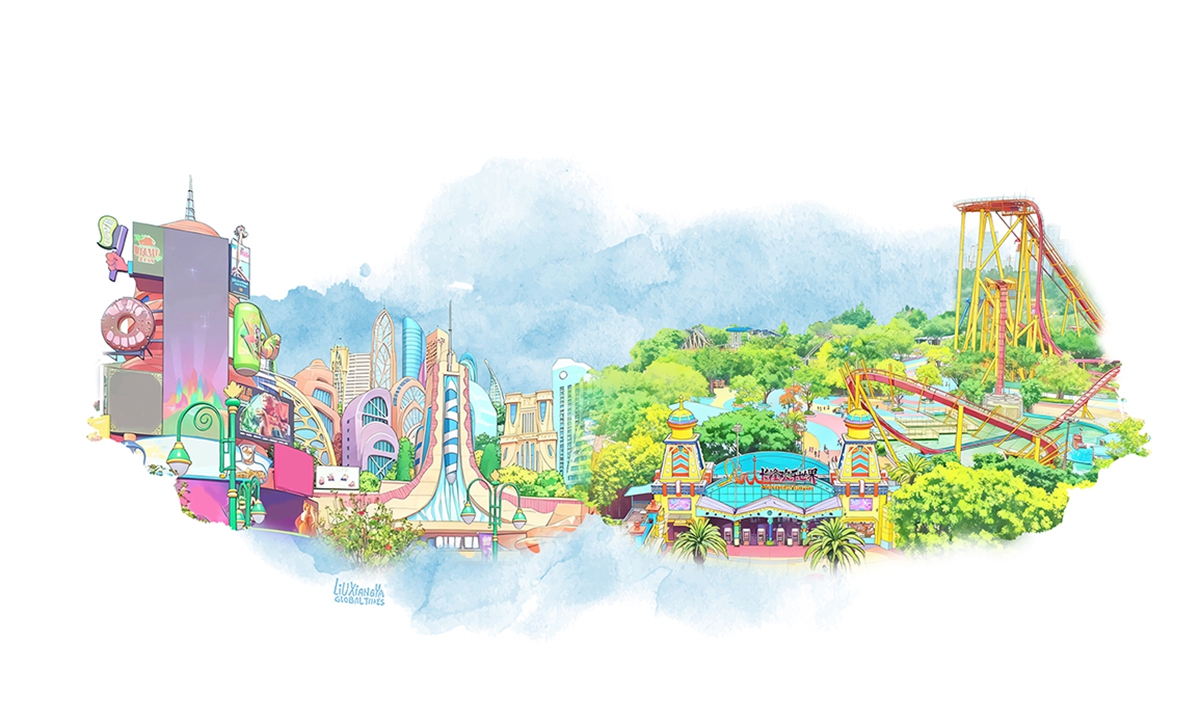
Illustration: Liu Xiangya/GT
As winter sets in, some theme parks in China have rolled out a host of adjustments to entice visitors amid the cold weather. But challenges lie ahead, as the 2025 China Theme Park Competitiveness Evaluation Report, released at a seminar held recently in Guangzhou, South China's Guangdong Province, shows that in 2025, the industry has yet to see a clear rebound, with visitor numbers continuing the slight decline seen in 2024.
In this case, it is the steady stream of new content that is propping up theme parks, but stagnant revisit rates reveal that the pace of innovation is falling short. Theme parks, especially domestic brands, will need to step up innovation and seek differentiated paths to stand out.
According to data reported by the Economic Information Daily, the 90 theme parks included in the 2024 dataset received a total of 127.8568 million visitors and generated 29.252 billion yuan ($4.14 billion) in revenue. Compared with 2023, visitor numbers fell by 1.76 percent, and revenue dropped by 3.74 percent. In the 2024 overall rankings, the Shanghai Disney Resort and Universal Beijing Resort again took the top two spots, followed by Chimelong Ocean Kingdom, Happy Valley and Chimelong Paradise in third to fifth place.
Shanghai Disneyland has rolled out new character interactions, limited-time performances and themed dining tied to Zootopia 2, while Universal Beijing Resort and LEGOLAND Shanghai Resort have launched winter programs. These steady streams of new offerings are the core reason visitors on social media say they keep coming back.
But the dip rather than uptick in overall footfall suggests that the current pace of updates is still struggling to attract visitors.
Lin Huanjie, head of the Institute for Theme Park Studies in China, told the Global Times on Tuesday that outdated facilities, slow content refresh cycles and phased openings that drag out the formation of a full experience have left many visitors feeling that "once is enough." Xi'an's Silk Road theme park's sluggish initial phase, as well as the Fantawild parks in Xuzhou and Yingtan failing to gain traction, are cited as typical examples of being "half a beat too slow."
"At present, a significant proportion of local theme parks still rely on importing overseas IPs to attract visitors. The newly announced Ferrari World entertainment complex in Beijing's Tongzhou district and the latest Phase II expansion unveiled for the LEGOLAND Shanghai Resort are both investments made on the basis of China's potential in the cultural tourism market."
In face of global players such as Disney and Universal, domestic parks are trying to break through. Their path forward depends on creating distinct cultural themes and localized innovation.
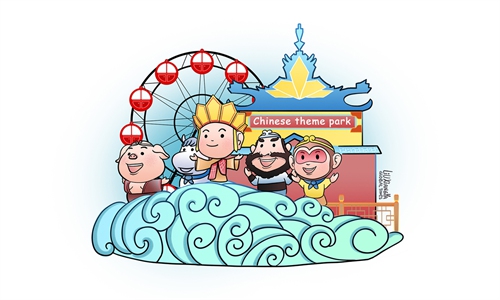
For example, in 2023, the night-tour program based on Journey to the West launched by the Changchun Zoological and Botanical Park became a social media hit, per the Xinhua News Agency. Today the zoo has kept the model alive: running as a regular zoo by day and selling separate tickets for night-time immersive experiences inspired by the 1986 TV adaptation of the classic novel, continuing to draw sizeable crowds.
In mid-August, Qiu Qiu, a visitor from Changsha, Central China's Hunan Province, visited an amusement park themed on Journey to the West in Huai'an, East China's Jiangsu Province, the hometown of the novel's author Wu Cheng'en, with her child. Qiu told the Global Times that beyond seeing iconic attractions such as "Havoc in Heaven" and "The Monkey King," which blend holograms and light shows, they were lucky enough to catch a drone performance themed on the Jiangsu Football City League, or Suchao in Chinese.
"For children, it's really the image of the Monkey King and all the colorful sets that hold their attention. For us adults, it's a form of cultural memory," she said.
While international brands and large resorts maintain their appeal through strong IPs and heavy investment, parks with vague positioning or unclear themes are losing out. For domestic brands to break free from "look-alike landscapes," they need memorable cultural settings that encourage repeat visits.
This doesn't mean that cultural settings need to be confined strictly to traditional culture. The Chimelong Group has similarly built its brand through a model of animal conservation, themed entertainment and cultural-tourism integration, including the aforementioned Chimelong Ocean Kingdom and Chimelong Paradise. Paired with Guangdong's first maglev line and the region's rich natural forests, this approach has earned founder Su Zhigang a place in the international hall of fame run by the Global Association for the Attractions Industry.
By weaving animal protection, ecological culture and themed entertainment into a single narrative, Chimelong has become a globally recognizable Chinese original.
To go further, what will broaden the global reach of China's theme parks is not merely traditional culture, but the transition from "running a park" to "running an IP." Growth depends on the ability to tell compelling stories.
Industry insiders make clear that the biggest gap between domestic parks and international brands lies in original IP development and the ability to build coherent narrative systems. The closure of the Snoopy theme park is cited as a textbook example of leaning on nostalgic IP without sustained innovation. Future competition will no longer hinge on "who has the most rides," but on who can offer richer, more immersive and more sustainable stories.
Yang Hong, a professor of social communication at the Communication University of China, told the Global Times that the key lies in turning Chinese culture into an operable, immersive and continually renewable content system, one that can render regional culture into IPs and integrate cultural elements with rides, landscape design and performances.
Allowing visitors to experience a complete narrative linked to Chinese culture is what will truly captivate tourists and lead to the success of Chinese-themed parks.
The author is a reporter with the Global Times. life@globaltimes.com.cn
RELATED ARTICLES