Ministries vow to enhance integration of culture, tourism and civil aviation
By Published: Dec 03, 2025 10:46 PM

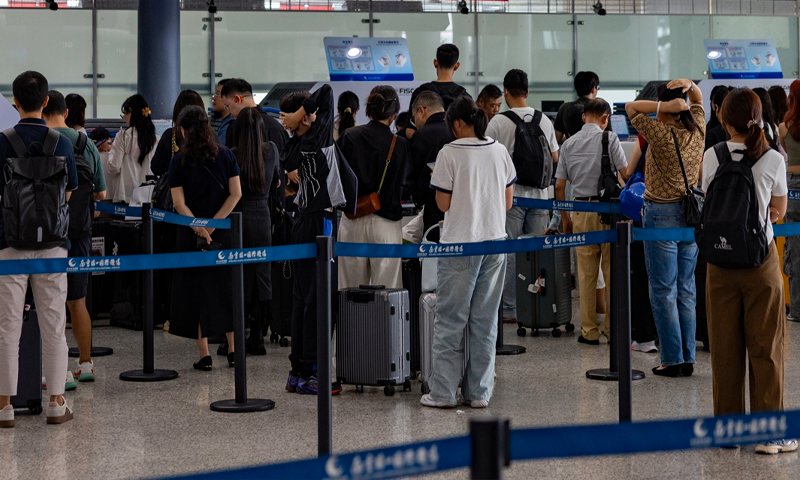
Passengers line up orderly at check-in counters at Nanjing Lukou International Airport in Nanjing, East China's Jiangsu Province on October 1, 2025. Photo: VCG
The Ministry of Culture and Tourism (MCT) and the Civil Aviation Administration of China on Wednesday pledged to deepen the integration of the cultural, tourism, and civil aviation sectors, aiming for a significant rise in tourism travel service standards by 2027.
The two government departments jointly issued an action plan, which aims to better connect domestic and international tourist routes, representing a coordinated effort to unlock fresh consumption potential across these industries.
The plan detailed various measures, including further improving the convenience of inbound tourism. It encourages domestic major airlines and hub airports to enhance the convenience of boarding, entry, and transfer services, and strengthen guidance and assistance for international passengers traveling to China by air.
The plan required increasing the frequency of inbound tourism flights. Chinese and foreign airlines are encouraged to open more direct flights to main tourist source countries and emerging markets, particularly Belt and Road Initiative (BRI) partner countries.
It also supports airlines in increasing flight frequencies based on travel demand during peak seasons and for activities such as study tours, parent-child trips, and winter sports tourism.
The plan aims to promote in-depth integration and mutual empowerment among culture, tourism, and civil aviation, enrich new cultural and tourism experiences, and unleash new consumption potential, according to the official website of the MCT.
By 2027, the service level of tourism travel will be significantly improved, with broader coverage of international and domestic tourism routes, and more diverse integrated products and scenarios. The integration of culture, tourism, and civil aviation will be deeper, broader, and of higher quality, forming a virtuous development cycle where demand drives supply and supply creates demand, said the plan.
The measures are being implemented as part of broader national efforts to stimulate cultural and tourism consumption, coinciding with the expansion of China's visa-exemption policy to a growing number of countries.
In line with these initiatives, Chinese airports have enhanced their services to facilitate a more convenient entry process for international travelers.
Effective from November 20, 2025, the National Immigration Administration (NIA) officially implemented the online arrival card filing policy for foreigners. The complimentary Wi-Fi service at Beijing Daxing International Airport now allows authentication using a passport.
This enables arriving foreign passengers to promptly complete filing their online arrival cards and enjoy convenient clearance upon landing, the airport told the Global Times.
After connecting via Wi-Fi, arriving foreign passengers can immediately scan the on-site QR code to complete the online filing via the official platform of the NIA, effectively reducing waiting time at ports, said the airport.
Chinese airlines are also ramping up efforts to expand their global networks, driven by fast demand with countries and regions along the BRI increasingly becoming top destinations for Chinese carriers.
China Eastern Airlines launched a direct flight on Sunday from Beijing to Muscat, the capital of Oman. The inaugural flight, departing from Beijing Capital International Airport, carried 270 passengers with a load factor of more than 90 percent, the airline said in a release sent to the Global Times on Sunday.
RELATED ARTICLES