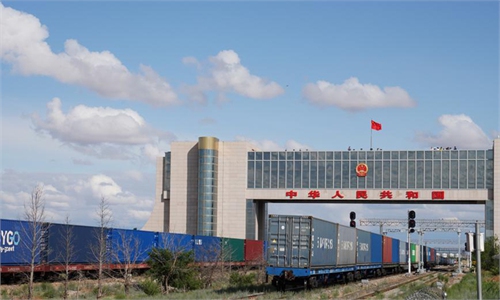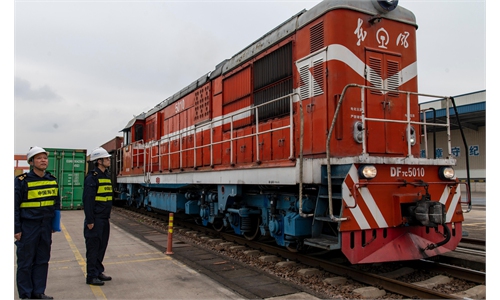
China-Europe (Central Asia) freight train trips passing through the Horgos railway port have surpassed 9,000 this year as of December 2, 2025. Photo: Courtesy of China Railway Urumqi Group Co
The number of China-Europe (Central Asia) freight trains passing through the Horgos railway port in Northwest China's Xinjiang Uygur Autonomous Region has surpassed 9,000 this year, injecting fresh momentum for high-quality Belt and Road cooperation, China Railway Urumqi Group Co told the Global Times on Wednesday.
At 2 pm on Tuesday, a China-Europe freight train of 55 wagons carrying garments, toys, electromechanical products and auto parts departed the Horgos railway port for Malaszewicze, Poland, marking the milestone.
Since the beginning of 2025, Xinjiang railway authorities have expanded port and hinterland capacity as part of efforts to build a golden channel across the Eurasian continent and a gateway for opening-up. More than half of all China-Europe freight trains now run through the region's western route, bolstering the high-quality development of the intercontinental logistics service, China Railway Urumqi Group Co said in a press release.
Leveraging its strategic location, the Horgos port has continued to boost capacity, posting growth in both China-Europe freight train traffic and cargo throughput. As of November 23, a total of 8,742 trains had passed through the port in 2025, surpassing the full-year figure 38 days ahead of schedule last year. Cumulative cargo throughput reached 12.26 million tons on November 13, meeting the full-year target 48 days early.
Horgos is accelerating its smart-port construction, introducing China's first "Smart Railway Port + Local Rapid Customs Clearance" model, which has boosted turnaround efficiency by more than 20 percent. The station coordinates closely with its Kazakh counterparts through regular mechanisms to refine dispatch plans, train volumes and cargo mix based on daily operating conditions, according to the press release.
Bian Yongzu, a senior researcher at the China Institutes of Contemporary International Relations, told the Global Times on Wednesday that the fact that more than 9,000 China-Europe freight train trips have already passed through Horgos this year underscores both the steady expansion of the service and the port's importance as a key gateway. The rail link is helping stabilize China-Europe trade, offering advantages over sea transport such as faster transit, more reliable schedules and development benefits for inland countries along the corridor, he said.
He added that European and Central Asian partners have strong expectations for the route. As economic ties across Eurasia deepen and Central Asian economies push for growth, demand for the China-Europe freight service is likely to remain solid, giving the corridor considerable room for further expansion, Bian said.
Currently, 90 China-Europe freight routes run through the Horgos rail port, reaching 18 countries and 46 cities and regions, and carrying more than 200 categories of goods.
Global Times
RELATED ARTICLES