DPP pressures S.Korea over labeling Taiwan as part of China on e-arrival card; experts say Seoul’s move aligns with one-China principle upheld globally
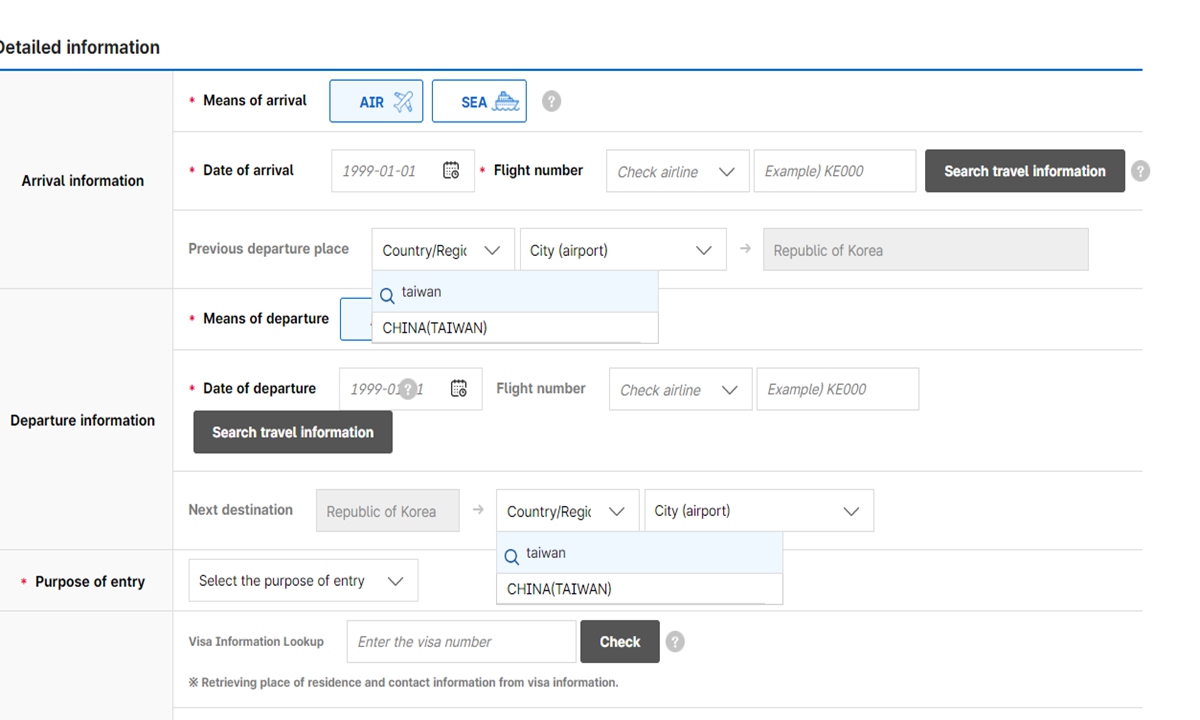
Photo: screen grab from South Korea's e-Arrival card system
The Taiwan region's Democratic Progressive Party (DPP) authorities on Wednesday forced South Korea to "correct" its updated e-arrival card system— which has been in place for months and lists Taiwan as "China (Taiwan)" under the "previous departure place" and "next destination" fields. Experts say Seoul's move aligns with one-China principle upheld globally.
In a statement released on Wednesday, the island's so-called "foreign affairs" department claimed that since the system's launch, it has repeatedly asked Seoul to fix the listing, which they claimed it is "inaccurate" and requires "correction," but has yet to receive a positive response.
Zheng Jian from the Taiwan Research Institute at Xiamen University interpreted this policy adjustment by South Korea as not only in compliance with the one-China principle widely followed by the international community, but also reflects the country's intention to maintain the regional order based on international law since World War II.
South Korea implemented its electronic arrival declaration system on February 24 this year. According to this system, foreigners can fill out and submit the entry declaration form online through a computer or mobile phone three days before their arrival, according to korea.kr.
Taiwan's reaction has garnered attention from South Korea media. Herald Corporation reported on Thursday with the title, "Taiwan officially demands correction of the "China (Taiwan)" designation on South Korea's electronic entry card."
As of press time, there is no official replies from South Korean government on this issue.
As of press time, the website of South Korea's e-Arrival card system remained unchanged in terms of its China (Taiwan) label.
Zheng said the DPP authorities are wishfully believing they stand at the center of the world stage and that their move can alter the fact that both sides of the Taiwan Straits belong to one China.
On the separatist stance of "Taiwan independence," the State Council Taiwan Affairs Office has frequently criticized the DPP authorities for stubbornly rejecting the 1992 Consensus and undermining the development of cross-Strait relations.
RELATED ARTICLES