SPORT / BASKETBALL
China sets 2035 goal for men’s basketball to qualify consistently for Olympics, unveils comprehensive reform plan
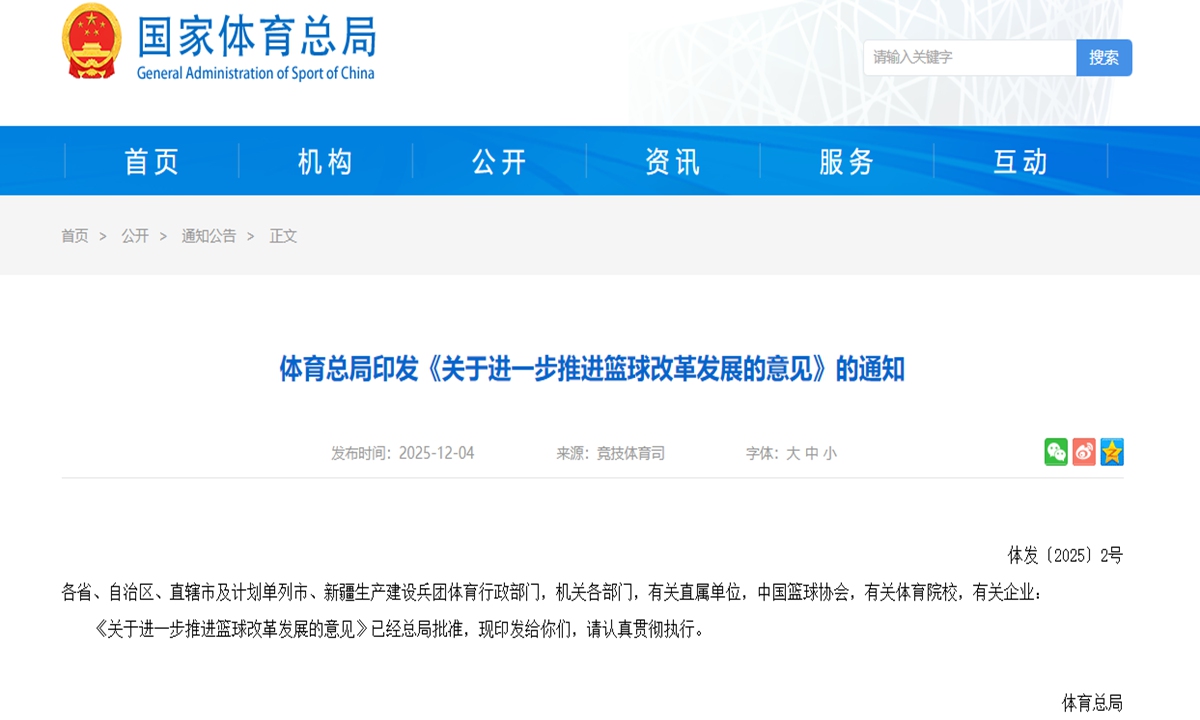
The General Administration of Sport of China (GASC) on Thursday released a circular on the measures for further promoting reform and development of basketball in the country, stressing that advancing basketball reform is essential to building China into a leading sporting nation and to addressing long-standing issues in the sector. The document calls on provinces, autonomous regions, municipalities, and relevant associations, institutions, and enterprises to implement the guidelines. Photo: GASC Offical Website
The General Administration of Sport of China (GASC) on Thursday released a circular on the measures for further promoting reform and development of basketball in the country, stressing that advancing basketball reform is essential to building China into a leading sporting nation and to addressing long-standing issues in the sector.The document calls on provinces, autonomous regions, municipalities, and relevant associations, institutions, and enterprises to implement the guidelines.
The measures outline overall requirements that align with the goal of turning China into a global sporting power. Following the natural laws of basketball development and talent cultivation, China will prioritize talent, encourage open competition, promote comprehensive development and pilot reforms, and build a system for organizational management, training, competitions, and talent development that is government-led, department-coordinated, and supported by society.
According to the plan, for 2030, targets include a markedly improved development environment, a substantial expansion of the youth basketball population, widespread community-level events, a major boost in the competitiveness and international influence of professional leagues, a significant increase in world-class athletes, coaches and referees, the men's national team qualifying for the 2028 Olympics, and the women's team reaching world-class status.
By 2035 China aims to significantly improve youth, grassroots, and professional basketball; ensure the men's national team consistently qualifies for the Olympic Games; maintain the women's national team among the world's leading teams; raise all U-series national squads to advanced international levels; and foster a strong basketball culture across society.
Building on these overall requirements, the document call for exploring new and innovative development paths, including improving leadership structures and working mechanisms; establishing pilot zones for comprehensive basketball reform; promoting the internationalization of talent development; advancing the orderly opening-up of professional basketball; and encouraging broad social participation.
The document also calls for building a disciplined and battle-ready national team by improving personnel selection mechanisms, enhancing training standards, strengthening technological support, and reinforcing ideological, moral, and work-style construction.
Long-term efforts will be dedicated to strengthening youth basketball, with measures to broaden talent pathways, enhance youth training quality, promote campus basketball, and create an integrated competition system.
To advance the high-quality development of professional basketball, the document proposes reforming and improving the league structure, fostering the healthy development of professional clubs, and enhancing league management systems.
Efforts will also focus on expanding grassroots basketball, improving community competition systems, increasing event supply, and consolidating the foundation for mass participation.
The document further stresses the need to strengthen the management and incentives for professional personnel such as coaches and referees through improved certification, training and evaluation standards, enhanced incentive mechanisms for youth coaches, and better industry-wide personnel development and management.
Global Times
RELATED ARTICLES