ARTS / CULTURE & LEISURE
NW China yields large early Longshan-period storage complex, signaling critical stage in prehistoric social development
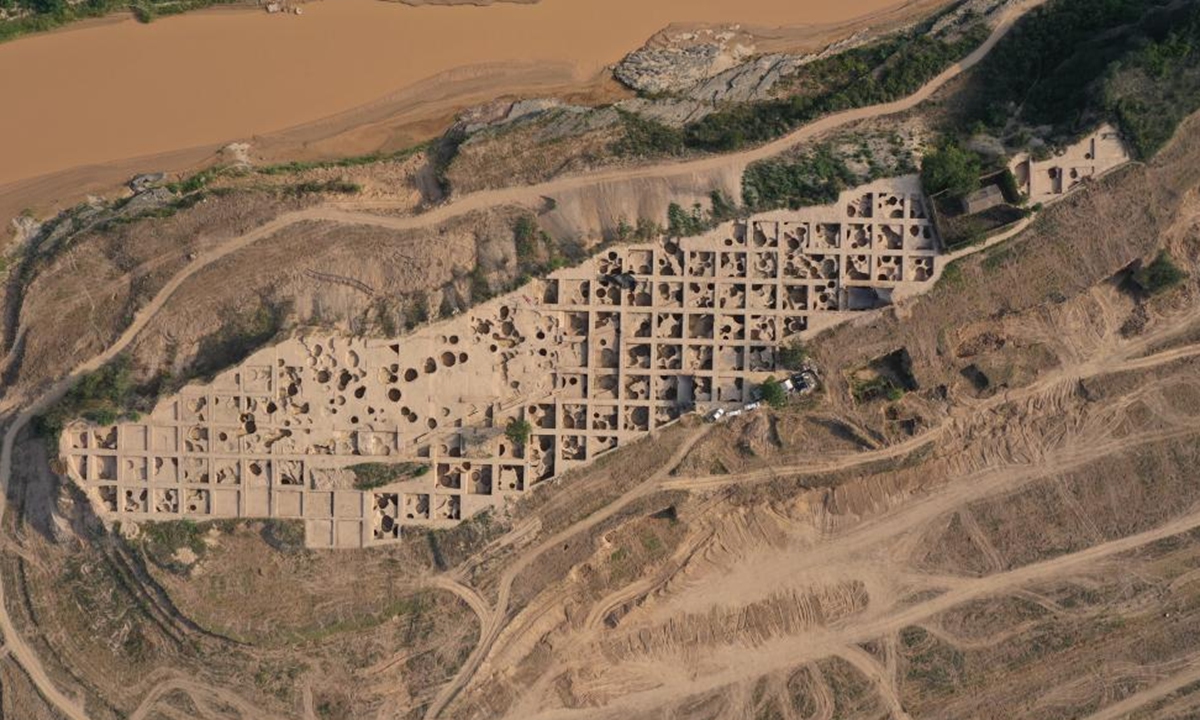
The Xianyang Institute of Cultural Relics and Archaeology told the Global Times on Thursday that recent excavations at the Luojiahe site in Chunhua County, Xianyang, in Northwest China's Shaanxi Province, have identified the site, dated to about 4,800 - 4,200 years ago, as belonging to Phase II of the Miaodigou culture from the early Longshan period. Photo: Xinhua
Recent excavations at the Luojiahe site in Chunhua County, Xianyang in Northwest China's Shaanxi Province have revealed the 4,800-4,200 year-old ruin belongs to the Phase II of the Miaodigou culture from the early Longshan period, archaeologists from The Xianyang Institute of Cultural Relics and Archaeology told the Global Times on Thursday. The discovery has provided important physical evidence for the study of early civilization and origins of state formation in the Guanzhong region.
"The Luojiahe site is a specialized settlement centered on grain storage, marking a crucial stage in the rise of social complexity in prehistoric times," Wu Hai from the institute told the Global Times on Thursday.
"The centralized control and redistribution of large quantities of grain serve as direct evidence of social administration, class differentiation and the emergence of early states," he said.
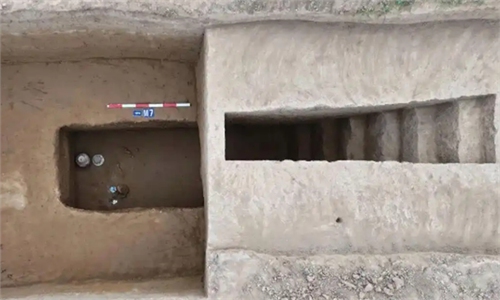
Archaeologists have uncovered 17 grain-storage pits at Luojiahe, which are round or oval in shape, with carefully constructed, bag-shaped profiles. Their walls are neatly finished, and the bottoms were intentionally prepared to be level and compact. Tool-mark traces were also identified on some pit walls. Each storage pit is accompanied by a shallower ash pit at its entrance, forming an interconnected structural unit. These auxiliary ash pits are believed to have served as workspaces, enabling ancient inhabitants to handle stored materials and to access the pits, according to the Xinhua News Agency.
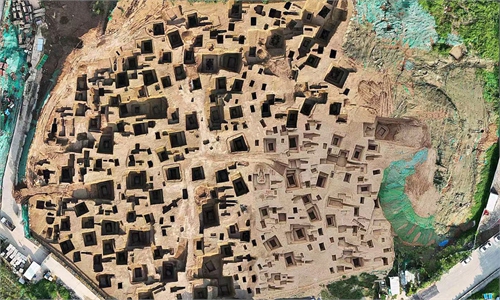
Latest excavations have largely clarified the basic layout of the site's core functional zone, revealing a clear pattern of specialized spatial divisions. The central area consists of a densely distributed cluster of storage pits, likely serving distinct storage and protective functions; the eastern area appears to have been a residential zone, where house foundations and ash pits are concentrated; and the westernmost section of the terrace contains a dense distribution of pottery kilns that may represent an area devoted to production activities.
The Luojiahe site sits in the Beishan area along the middle reaches of the Jinghe River, a transitional zone between the Loess Plateau and the Guanzhong Plain. Archaeological work in this region has been limited, and knowledge of Longshan cultural types and distribution remains incomplete.
From March 2022 to September 2025, the Xianyang Institute of Cultural Relics and Archaeology conducted systematic excavations at the site to support the construction of the Dongzhuang Water Conservancy Project in Shaanxi.
Preliminary surveys and explorations confirmed that the site covers a total area of 50,000 square meters, with the excavation area, located at the site's central zone, spanning approximately 14,200 square meters.
According to Wu, the spatial organization of the site reflects a clearly structured and functionally distinct settlement layout.
A rich array of artifacts with well-defined chronological features has been unearthed at the site, including pottery, stone implements, bone and shell objects, and jade items. To date, a total of 1,003 restored and cataloged artifacts have been restored and cataloged, according to CCTV News.
RELATED ARTICLES