US trade rep’s remarks on China-US trade reflect ‘contradictory mentality toward China’; US urged to safeguard hard-won stability achieved: expert
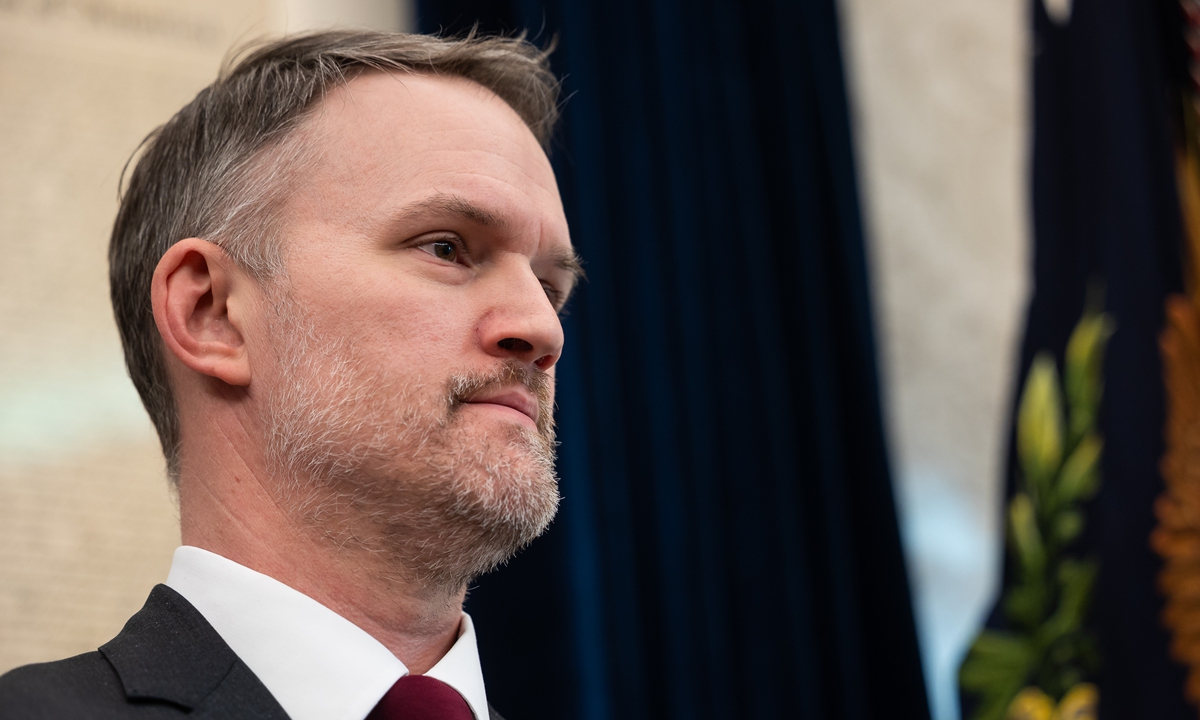
US Trade Representative Jamieson Greer File Photo: VCG
US Trade Representative Jamieson Greer reportedly on Thursday claimed that US trade with China needs to be balanced and probably needs to be smaller, but he also said no one wants to have a full-on economic conflict with China. A Chinese expert said the remarks reflects a contradictory mentality which seeks stable cooperation with China while clinging to "America First," urging the US to safeguard the hard-won stability achieved so far.
According to Reuters, Greer claimed during the American Growth Summit, a policy conference in Washington, that US trade with China needs to be balanced and probably needs to be smaller, adding that he viewed a 25 percent drop in goods trade with China as heading in the "right direction."
"The landing zone with China is our trade with them needs to be more balanced. It needs to probably be smaller so we're not so dependent on each other, and it needs to be in areas of non-sensitive goods," he said in the report.
Zhou Mi, a senior researcher at the Chinese Academy of International Trade and Economic Cooperation, told the Global Times on Friday that whether interdependence exists and to what degree should not be unilaterally determined by the government, but decided by the market and enterprises based on actual needs.
If bilateral trade is artificially reduced through artificial intervention, American companies would have to source equivalent goods from other countries at higher costs, which would raise overall economic and social costs for the US and ultimately run counter to America's own interests, Zhou said.
In addition, China has never deliberately sought to maintain any specific scale of exports to the US, and the volume of trade should be left to enterprises to decide autonomously according to market demand, the expert noted.
"The essence of China-US trade is the natural outcome of spontaneous cooperation between enterprises and markets of the two countries driven by comparative advantages and complementarity — it leads to win-win results," Zhou said.
On Thursday, the China-US Economic and Trade Cooperation Forum were held in Washington. Ren Hongbin, President of the China Council for the Promotion of International Trade (CCPIT), led a delegation of Chinese entrepreneurs to attend the forum and deliver a keynote speech. In his address, Ren said that the essence of China-US economic and trade relations is mutual benefit and win-win cooperation, and that after years of development, the economies of the two countries have become deeply integrated, China Trade News reported on Friday.
Representatives from the US business community attending the event expressed strong optimism about the enormous potential of the Chinese market. They said that they will strengthen supply chain cooperation with Chinese enterprises in the future and called on both sides to continuously foster an open, stable, and predictable business environment, create more cooperation opportunities for the business communities of the two countries, and jointly promote the building of a secure, efficient, and resilient global supply chain system.
According to Reuters, during the summit, Greer said "I don't think anyone wants to have a full-on economic conflict with China, and we're not having that."
He said the US had many levers in its relationship with China, ranging from software to semiconductors, and that many allies were interested in taking coordinated action. "But the decision right now is we want to have stability in this relationship," he said. Greer added ties with China were now stable, but Washington was monitoring the situation on a daily basis, according to Reuters.
"Greer's latest statement demonstrates a contradictory mentality toward China: a desire to maintain stable cooperation with China while pursuing 'America First' with strategic bias against China," Zhou said.
In China-US economic and trade relations, both sides should jointly safeguard the hard-won stability achieved so far, and the US should refrain from taking further disruptive measures that could undermine the foundational stability of bilateral relations, the expert noted.
Zhou said that the US does indeed possess comparative advantages in certain areas—a fact that China has never denied. "The essence of China-US economic and trade relations lies in mutually beneficial cooperation built on each side's respective strengths and needs," Zhou noted, urging the US to avoid weaponizing its advantages and instead treat them as the premise and guide for normal economic and trade cooperation, in order to bring more practical and effective outcomes to both countries.
According to the Reuters report, the US Trade Representative also claimed that Canada and Mexico should not be used as export hubs for China, Vietnam, Indonesia and other countries, adding that this was already happening in some cases in Mexico.
Greer claimed that there were problems with the US-Mexico-Canada trade agreement, but some measures - including tariffs on foreign autos - were helping to correct issues.
Zhou said the US, by coercing allies to impose tariffs in the vehicle sector, not only inflicts damage on the industries of those countries and its own related sectors, but also gravely undermines international trade rules. This is yet another lose-lose move disguised under the banner of "America First."
The expert said the norm in international trade is that trade has never been confined to just two countries, but rather, it inherently involves multinational cooperation and coordination. This multinational division of labor in supply chains brings benefits to all parties and should be respected.
"Forcibly disrupting or distorting this naturally formed global division of labor serves no one's long-term interests," Zhou added.
"As the world's two largest economies, China and the US bear both the responsibility and the obligation to play a leading role. The US should continue to build mutual trust and steadily solidify the foundation for cooperation with China, therefor jointly fostering a more stable and sustainable environment for economic globalization, and steering global economic governance toward a fairer and more inclusive direction," Zhou noted.
On October 30, China's Ministry of Commerce (MOFCOM) unveiled the outcomes achieved by Chinese and US delegations during their economic and trade talks in Kuala Lumpur. A spokesperson from the ministry said that the China-US economic and trade talks in Kuala Lumpur have yielded positive results, demonstrating that by upholding the spirit of equality, respect and mutual benefit, and through dialogue and cooperation, the two sides can find solutions to problems, the spokesperson said.
Noting that the outcomes are hard won, the spokesperson said China looks forward to working with the US side to jointly ensure the implementation of the outcomes, and inject more certainty and stability into bilateral economic and trade cooperation as well as the world's economy, according to the MOFCOM.
RELATED ARTICLES