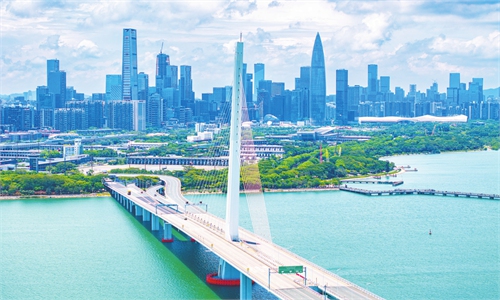

A view of the Lujiazui area in Shanghai on August 27, 2025 Photo: VCG
China's continuous, stable, and relatively high growth rates are impressive, and even the particularly turbulent year 2025 will see another Chinese growth rate of about 5 percent. This is mainly an indication of the robustness of the strong structures of the Chinese economy, society, and public sector.
The strategy to care for a complete set of products that any nation needs, with a complete set of industries and services sectors, has proven to be correct. Also, caring for continuous high-productivity growth, even of the "old" industries, together with complete supply chains, regional clusters, high skills, research and development, and ever better public services, are together mobilizing people on new levels.
This was prominently ingrained in the 14th Five-Year Plan (2021-25) with its grand ideas, such as "dual circulation" and the expansion of social services for health, education, children, mothers, families, and the old-age population. Upward synergies were perceptibly strengthened during the 14th Five-Year Plan period. Market structures in the internet sector, real estate, and finance and banking are improved.
China was once known as the "world's export champion," driven largely by a trade surplus. Now, the economy is primarily driven by domestic development, consumption and investment, demonstrating greater resilience and stronger self-balancing.
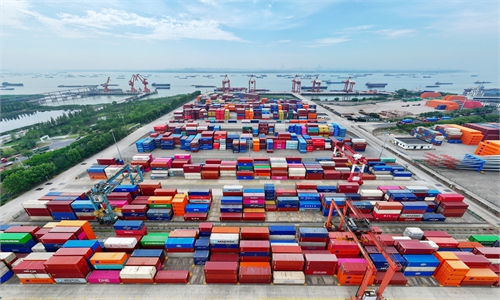
During the outgoing 14th Five-Year Plan period, China contributed about 30 percent of global economic expansion. Its goods and services imports totaled more than 20 trillion yuan ($2.82 trillion) in 2024, creating substantial market opportunities for international businesses.
The opening-up of a further number of industries and core services sectors - health, education and finance - and largely dropping joint-venture requirements have proven to be the right way to strengthen China's international exchanges and general standing.
Re-globalization and restructuring value-added chains with the Global South, industrializing and generating an intra-industry division of labor with Africa, Latin America, Southeast Europe, and Southeast Asia, will further accelerate synergies with countries willing to interact honestly.
While one particular advantage of the Chinese industry, i.e., the solid and relatively cheap financing by banks and bonds, should be maintained, the general opening-up of the finance sector, including stock markets and derivatives, has been a major step, since relevant parts of Wall Street have bound themselves to China now. This should also be conducive to international peace.
As China is set to commence the 15th Five-Year Plan period (2026-30) next year, there is reason for confidence in the country's economic, social, and political development. The international conditions will further improve for China and for its 150+ Belt and Road Initiative partners, given that the Global South will increasingly spiral upwards, in spite of the West's economic restrictions, political and bureaucratic interventionism in trade and investment, and rule-breaking.
What impresses many across the world is that China has granted zero customs tariffs for the least-developed countries. That's a wonderful action. The world has, for the first time, seen Africa's industrialization, and that had been impossible without China's help. Putting such zero-tariff action into a more general strategy will require a carefully balanced longer-term perspective. That will be a long way to go, but China is on the right side of history.
A document of recommendations from the Central Committee of the Communist Party of China (CPC) has sketched out China's development priorities for the next five years, outlining major objectives for economic and social development, spanning high-quality development, scientific and technological innovation, reform, cultural and ethical progress, people's well-being, ecological conservation, and national security.
The 15th Five-Year Plan will further accelerate technological advancement and maintain productivity growth above GDP growth. In the face of problems still to be solved -- for example, the ongoing property-sector downsizing, balancing overly fierce competition in sectors such as new energy, strengthening household consumption, and dealing with demographic issues -- the new grand idea of high-quality productive forces will intensify the utilization of the nation's economic surplus for people's betterment, with an eye on the 2035 goal of socialist modernization.
High-quality productive forces will become a broad socio-economic and political-economic action line. Beyond technological and economic progress, it will embrace skills, further ecological, social, and democratic cultivation and the infrastructure, and lead to ever better social services, and mass mobilization. This will fortify China's robustness and strengthen synergies.
China has developed a unique system of well-regulated markets and state planning. The system is open, flexible, and highly effective, as shown by China's poverty reduction to zero and a people-centered development path. That's unique in the world, and the rest of the world may learn from it.
Western capital knows very well that it can trust China's development, and it is voting with its feet. For example, many German corporations developed their own policies and "voted with their feet," massively investing in China, while making large portions of their profits in the country.

Wolfram Elsner Photo: Courtesy of Wolfram Elsner
The author is a professor of economics (ret.) at University of Bremen in Germany, a guest professor at Jilin University in China, and an expert on China. bizopinion@globaltimes.com.cn
RELATED ARTICLES