Nvidia CEO’s US-China AI competition remarks at CSIS reflect recognition of China’s strength, market access anxiety: expert
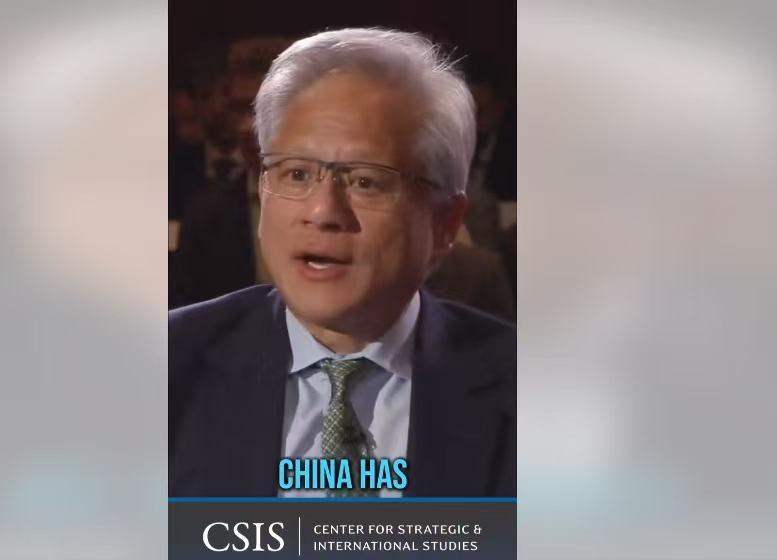
Photo: Screenshot of CSIS
At an event hosted by the Center for Strategic and International Studies (CSIS) on Wednesday, Nvidia CEO Jensen Huang broke down US-China AI competition using a "five-layer" framework, noting that Al should not be viewed as "'a holistic thing reduced to "ChatGPT versus DeepSeek".
A Chinese expert said Huang's analysis reflects both his recognition of China's growing strengths across the layers and his concern over being shut out of a market he views as vital to Nvidia's future.
When asked about his earlier remark that "China was winning the AI race" — and pressed on Nvidia's competition with Huawei — Huang described the competition as a "five-layer cake" of energy, chips, infrastructure, models and applications, analyzing each layer from bottom to top and outlining where the US retains strengths and where China has pulled ahead.
Ma Jihua, a veteran industrial expert told the Global Times that Huang's "five-layer cake" analysis captures the real structural forces shaping today's AI race, especially the decisive weight of energy systems and physical infrastructure. In Ma's view, China's advantages in power supply, engineering efficiency and manufacturing depth give it a stronger foundation as AI moves into a more resource-intensive stage.
At the lowest layer, Huang identified energy as a challenge [to the US], noting that China has "twice the amount of energy we have as a nation," even though the US economy is larger.
"We're building three types of factories in America right now: chip plants, supercomputer facilities, and AI factories," Huang said. "They all require energy, every single one of them."
Huang said "we want to reindustrialize the United States," but noted that "at the energy level, going back to that stack, we're at about 50 percent. And they're growing straight up, while we're basically flat right now."
On the chip layer, Huang affirmed a US lead of "generations ahead," but warned against complacency, reminding the audience that "semiconductors are a manufacturing process" and "anybody who thinks China can't manufacture is missing a big idea."
He highlighted China's advantages at the infrastructure layer. Building a data center in the US takes about three years from groundbreaking to operation, while China can build a hospital in a weekend, he said. "Their velocity of building things is extraordinarily high. Now, really quickly, on chips," Huang noted.
Ma said Huang's focus on US energy and infrastructure limits highlights deeper structural constraints in America's AI ecosystem—problems that cannot be fixed quickly.
China's manufacturing scale, supply-chain integration and rapid build-out, by contrast, are long-term strengths. Ma added that Huang's remarks also reflect the position of a US company whose competitiveness is closely tied to Washington's tech policy, and the gap in infrastructure capacity will likely shape how global AI computing power is allocated in the years ahead.
As the model layer, Huang acknowledged US strength in "frontier models", calling it "six-month lead." But he highlighted China's dominance in open-source AI.
"Out of the 1.4 million models, most of them are open source. China is well ahead," he said. "Without open source, startups can't thrive, university researchers can't do research…All of these different types of technologies that made AI thrive are all open source. They are well ahead of us on open source."
Huang said that at the application layer, a fundamental social difference has emerged: if you poll the two societies on whether AI will "do more good than harm," about 80 percent in China would say it will do more good, while in the US the response would be "the other way around." He stressed that the US must be careful "not to fall behind in the application and the diffusion of AI," because "in the end whoever applies the technology first and most wins that industrial revolution."
Ma noted that China's advantages in energy supply, infrastructure speed, open-source development and talent are cumulative strengths that will grow over time. The US, by contrast, leads in chips and frontier models, but these are advantages more vulnerable to catch-up.
AI not 'ChatGPT versus DeepSeek'
Huang drew a historical parallel, saying that although "electricity was invented in the UK," it was the US that "applied it faster, more broadly." He suggested the same lesson applies to AI. He said that AI should not be viewed as "a holistic thing" or reduced to "ChatGPT versus DeepSeek." Instead, he argued, it must be assessed "across all of the stacks and across all of the industries," noting that the issue is "a little bit more complicated than one simple answer."
Huang said that the US technology industry remains "the mightiest in the world". But he argued that the US "can't concede the market to them," noting that Nvidia has effectively been shut out of China, leaving it unable to compete in what he called "the second-largest AI market — the second-largest technology market in the world."
Huang said Nvidia is "simply not competing in China" and has effectively "conceded the second-largest AI market - the second-largest technology market in the world." He dismissed the notion that growth elsewhere could replace China, arguing that "you're not going to replace China," just as exporters cannot replace access to the US, which he described as "absolutely singular."
To illustrate China's broader progress, Huang cited key metrics: nine of the world's top 10 science and technology schools in the world are now in China; 50 percent of the world's AI researchers are Chinese; and 70 percent of last year's AI patents are published by China.
Ma said Huang's focus on China's "irreplaceable" market reflects Nvidia's rising strategic anxiety. With US export limits blocking full-performance chips and China rapidly advancing its own AI hardware, the gap is narrowing. Ma noted that Nvidia's downgraded products have only hastened domestic alternatives, pushing the firm toward a reset in China.
Huang's deeper concern, Ma argued, is the risk of losing Nvidia's strategic position in the global AI hardware landscape—driving his calls for a policy shift in Washington.
Previously, on July 15, commenting on Nvidia's exports of downgraded chips to China, Chinese Foreign Ministry spokesperson Lin Jian said that China's opposition to politicizing, instrumentalizing and weaponizing tech and trade issues and malicious attempts to blockade and keep down China is consistent and clear, and that these actions will destabilize the global industrial and supply chains and serve no one's interests.
RELATED ARTICLES