ARTS / CULTURE & LEISURE
Storytelling key to animated films’ success in 2025
By Published: Dec 07, 2025 10:53 PM

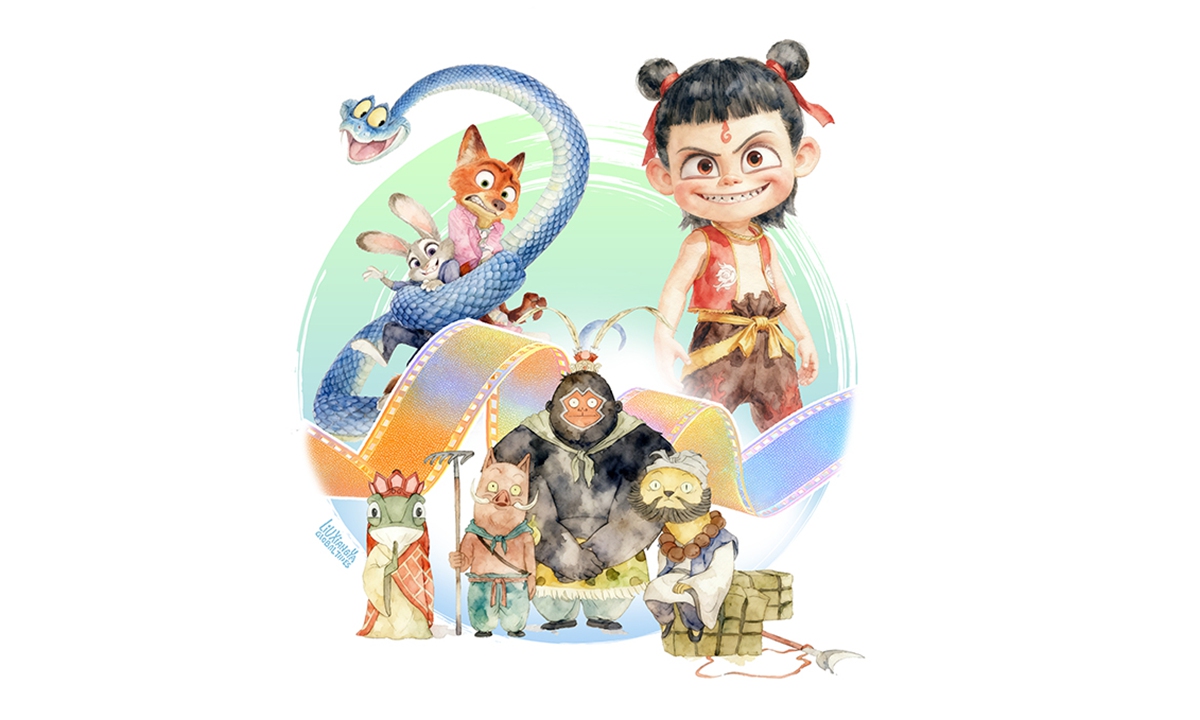
Illustration: Liu Xiangya/GT
Rabbit cop Judy Hopps and sly fox Nick Wilde are not just cute, but also good at winning hearts around the world, especially in China.Disney animated film Zootopia 2, starring the two, had earned over 3 billion yuan ($424 million) in box-office revenue as of Sunday, making it the highest-grossing imported animated film in Chinese cinema history.
Domestic animated film Ne Zha 2, which premiered during the 2025 Spring Festival season, became the highest-grossing film in Chinese cinema history with 15.446 billion yuan. The summer release Nobody earned 1.719 billion yuan, making it the highest-grossing 2D animated film in China, while The Legend of Hei 2, released during the same period, achieved 533 million yuan in box-office revenue and a high rating of 8.7/10 on China's rating site Douban.
As of Sunday, the combined box-office revenue of newly released and re-screened animated films this year accounted for over 50 percent of the total box office for 2025. The data also reflects shifts in audience preferences, leading to the question: Why have animated films gained so much popularity in 2025?
The rise of animated films in 2025 ultimately stems from their success in "telling good stories," which has won over audiences. While some live-action films increasingly rely on big-name stars, massive productions, special effects, and grand spectacles, animated films have remained committed to the essence of storytelling.
Given the need to cater to the comprehension of younger audiences, animated films tend to avoid the overly complex narrative structures and obscure symbolic elements often found in live-action movies. This "simplification" allows creators to focus more on telling a complete and compelling story.
In other words, animators must rely on more robust character development, clearer story conflict setups, and more complete character arcs to drive the plot, thereby meeting the audience's most fundamental viewing expectations. This has been particularly evident in the blockbuster animated films of 2025.
Zootopia 2 continues the racial themes of its predecessor. Within the classic trope of the main team uniting to defeat a villain, Disney reaffirms the enduring yet increasingly scarce values of "courage and justice" in the adult world. However, by framing this message within an adventurous tale of furry animals, it becomes immensely appealing to audiences.
This is precisely the charm of animation: The same story, if acted out by live performers, might lack this unique appeal. These animated works do not deliberately cater to adults. Instead, through imagery and narratives unique to animation, they touch upon those hard-to-express emotions within adults.
In these animated films, character growth often serves as the central axis driving the plot forward, and emotions unfold naturally rather than being force-fed to the audience through slogan-like dialogue or overly sentimental background music. The forced settings, overwhelming emotions, and abrupt twists commonly seen in live-action films are toned down in animation, giving way to a more coherent narrative and subtler emotional depth.
Therefore, it is not that animated films inherently have an easier time telling a good story; rather, they must tell a good story to succeed. This narrative imperative, in turn, makes animation the genre currently most capable of delivering "quality content" in the film market.
If animated films win by maintaining their ability to "tell a good story," their widespread popularity in the market is also inseparable from the audience's growing reliance on "content certainty."
As streaming platforms, short videos, and AI-generated content flood people's daily lives, viewers' choices have multiplied - and so have the challenges of making them. Faced with increasingly fragmented time, people need an absolute reason to spend an hour or two in a cinema. Highly praised animated sequels provide precisely this kind of "certainty" for audiences.
The decline of live-action films is often not a technical issue, but rather a case of previously effective methods losing their potency. Many live-action films tend to rely on star-studded casts and spectacular special effects to cover weak narratives, and may even employ forced plot twists or sensationalist elements to create cheap "emotional highs" for the audience.
However, viewers are becoming harder to impress. Through repeated viewing experiences that leave them feeling like they've "wasted two hours," audiences have grown more cautious.
The blockbuster animated films of 2025 such as Ne Zha 2, The Legend of Hei 2, and Zootopia 2 are mostly sequels to previously successful works or well-known IPs, providing audiences with a sense of "certainty" in terms of quality and style.
Animated films provide a more stable, lower-risk viewing choice. They are not preachy nor do they impose a cognitive burden on viewers. Instead, they simply use plot and characters to construct a story world that audiences can safely immerse themselves in.
Meanwhile, the rise of domestic animation has greatly benefited from the creative transformation and innovative development of China's fine traditional culture. Numerous works are rooted in this profound culture, integrating traditional aesthetics with modern technology to form a unique Eastern charm and market competitiveness.
For instance, Nobody blends the freehand brushwork of ink wash painting with the detailed precision of fine-brush techniques, while Curious Tales of a Temple innovatively uses materials and methods such as watercolor blending in its segments to emulate the texture of traditional art forms.
This approach of "adapting technology to serve aesthetic goals" allows visual spectacles to carry cultural memory and spiritual depth, thereby strengthening the cultural confidence and sense of identity among domestic audiences.
All in all, the outstanding animation works of 2025 did not succeed merely by riding on the momentum of past achievements; instead, they broke new ground by offering greater narrative depth, more profound emotional expression, and a fresh response that resonated with audiences.
The author is a reporter with the Global Times. life@globaltimes.com.cn
RELATED ARTICLES