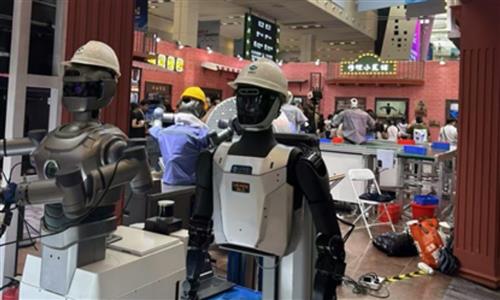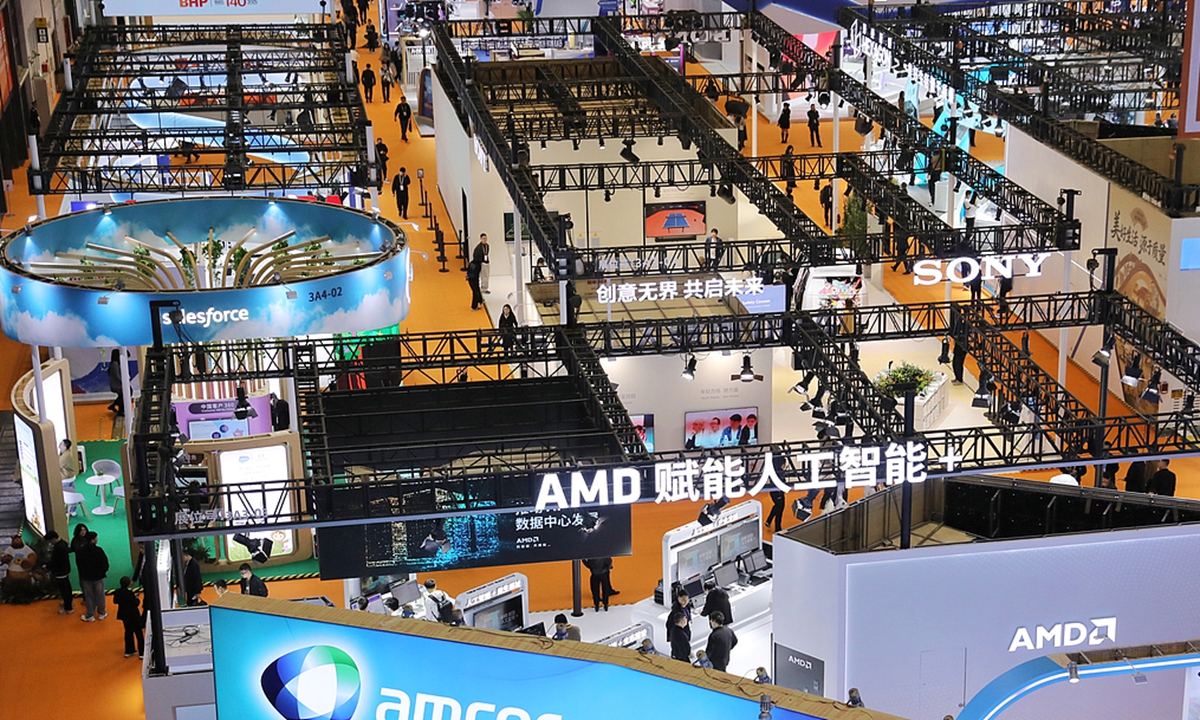
Visitors gather at the AI section of the equipment and technology hall at the 8th CIIE in Shanghai on November 5, 2025. Photo: VCG
Several Chinese regions including Shanghai, Southwest China's Sichuan Province, and South China's Guangxi Zhuang Autonomous Region, have rolled out more "AI Plus" action lists and stepped up investment, vowing to accelerate the adoption of artificial intelligence (AI) across key industries and public services.
At an event held on Sunday, Shanghai's transport regulator unveiled its latest achievements in building a smart transportation system, with several major initiatives launched simultaneously, according to China Media Group.
Shanghai also expanded its autonomous driving test network, adding new roads in Pudong, Minhang and the Hongqiao hub. The city now has 3,173 test roads totaling 5,238.82 kilometers, about one-third of its urban area.
In addition, China's first megacity-wide traffic-signal data platform was launched, providing real-time data from 7,600 intersections to support advanced autonomous driving development and deployment.
At a provincial conference on AI application scenarios held on Friday, Sichuan released a list of 183 items, including 71 application-demand scenarios and 112 product-supply scenarios. The list spans fields such as advanced manufacturing, emergency response and public safety, as well as eldercare and rehabilitation services, the Sichuan Daily reported.
The application-demand list includes a "full-process digital twin platform for baijiu production," which uses AI models to build a digital system covering the entire lifecycle from starter making and fermentation to distillation, aging, blending and packaging, creating a "digital distillery" to support the industry's digital transformation, the report said.
On Sunday, Guangxi released recommendations for its 15th Five-Year Plan, outlining a development model of "R&D in Beijing-Shanghai-Guangzhou, integration in Guangxi, and application in ASEAN." The document calls for stronger efforts to expand the intelligent economy, accelerate AI industry clustering and advance major projects such as the China-ASEAN Countries AI Application Cooperation Center.
While AI is not given a standalone section, the "AI Plus" approach runs throughout the plan. It proposes actions such as promoting "AI + Manufacturing," deepening AI-industrial internet integration, and pushing for breakthroughs in key core technologies, including AI.
Unveiled by a government work report in 2024, the "AI Plus" initiative is gathering steam, emerging as a key priority for China's social and economic development. Most recently, a call to "advance the 'AI Plus' initiative across the board" was written into the Communist Party of China Central Committee's recommendations for formulating the 15th Five-Year Plan (2026-30), underscoring its importance for the country's future, according to the Xinhua News Agency.
Ma Jihua, a veteran industry expert, told the Global Times that China's AI development is being powered by two reinforcing forces: expanding infrastructure—such as computing power, algorithms and related software and hardware—and rapidly growing application demand. As more real-world scenarios adopt AI, the technology iterates faster and moves onto a "development fast track," creating a virtuous cycle of innovation and deployment, he said.
He noted that the nationwide rollout of "AI Plus" initiatives, now written into the 15th Five-Year Plan and actively promoted by provinces and cities, is giving AI a strong demand-side boost. From robotics to manufacturing and public services, more industries are using AI to upgrade operations, enabling rapid iteration in AI technologies and lifting the overall ecosystem.
Ma added that China's vast manufacturing base, along with its large population, rising healthcare needs and fast-growing new-energy vehicle sector, provides a broad foundation for AI adoption. With provinces leveraging their respective strengths, he expects "AI Plus" to form a complementary nationwide mosaic of development. But he cautioned against pushing AI into scenarios where current capabilities remain insufficient, suggesting that investment should be ambitious yet calibrated.
RELATED ARTICLES