IN-DEPTH / IN-DEPTH
China’s development philosophy rooted in ‘putting people first’ resonates with Africa’s cultural ethos: TV BRICS Africa president
Shared Lessons, Shared Future
By in Johannesburg Published: Dec 08, 2025 10:05 PM

Editor's Note:
In an era marked by unprecedented global transformations, the world stands at a critical crossroads, grappling with deepening deficits in peace, development, security, and governance. As humanity faces unparalleled challenges during this tumultuous period, Xi Jinping, general secretary of the Communist Party of China (CPC) Central Committee and Chinese president, has put forth a solemn call to action through the Global Development Initiative (GDI), the Global Security Initiative (GSI), the Global Civilization Initiative (GCI), and the Global Governance Initiative (GGI). The four pivotal initiatives address the pressing issues of our time, offering viable pathways and robust support for building a community with a shared future for humanity.
Rooted in the rich historical experiences of the CPC's century-long struggle and infused with the wisdom of China's traditional culture, these initiatives are expected to unite the world in the pursuit of common progress and stability. To offer a deeper understanding of the four global initiatives, and elaborate on their significance on a global scale, the Global Times has launched a series of articles.
In this installment, we focus the spotlight on two individuals - a South African official and a media expert - who draw on their first-hand experiences in China to share how China's four global initiatives align with African values and what inspiration Africa can draw from China's practices.
China's people-centered development philosophy and its Global Development Initiative (GDI) offer invaluable lessons for Africa - from rural revitalization to inclusive governance - that can empower the Global South to chart its own path, Ayanda Holo, president of TV BRICS Africa, told the Global Times in an exclusive interview.
He emphasized that China's global initiatives, especially the Global Governance Initiative (GGI) and the Global Civilization Initiative (GCI), align perfectly with Africa's development needs, as they explore ways to reform and improve global governance and open up a bright future of peace, security, prosperity, and progress.
For Holo, China's development model is not just a blueprint for economic growth, but also a philosophy rooted in "putting people first" - a value that resonates deeply with Africa's own cultural and political ethos in his mind.
Holo reflected on his travels across China's bustling cities and serene rural areas during the interview. His journeys to China's mega cities such as Shenzhen and rural parts of China left an impression on him: "I have seen how the government actively supports communities to live the lives they themselves want to live." He contrasted this with South Africa's reality, where decades of apartheid stripped rural communities of their land. China's approach of reinvesting in resources in rural areas offers a path forward: "That is where people get time to think, to dream, to live."
This focus on rural prosperity, he noted, is precisely the kind of inclusive development championed by China's GDI - one that addresses historical inequities and ensures no community is left behind.
This focus on people-centric governance, Holo argued, is a shared ground between South Africa's African National Congress (ANC) and the Communist Party of China (CPC). Both parties, he stressed, have long adhered to the principle that "power belongs to the people" - a core tenet that has guided their governance successes. Holo praised the CPC for translating this principle into tangible action, from grassroots democracy to nationwide development planning that centers people's aspirations.
After visiting China and observing its grassroots governance model, Holo said he realized: "Real democracy must work from the district level up to the province and the nation. It must always be about the people. This land belongs to the people, and the way we do things must belong to the people. These principles mirror almost exactly what the CPC has done in practice."
"On the question of governance, Africa - and South Africa in particular - has lacked real governance skills for a long time," he said, highlighting the urgency of learning from China's experience.
He told the Global Times that South Africa already has a system called the Integrated Development Plan, in which every single household is consulted about local priorities ahead of the 2026 municipal elections. "So, China's GGI - especially the sharing of detailed, people-centered planning skills - would work extremely well on our continent," he emphasized, underscoring the initiative's practical relevance for African nations.
As a media expert, Holo also observed a critical gap in cultural exchanges: Chinese and African television content rarely reaches each other's audiences, leaving most ordinary Chinese families to learn about Africa "through Hollywood's voice." "That has to change, and it does not need the West to make it happen," he told the Global Times. "Let African influencers and storytellers show the real lives of Africans using African voices; let Chinese people learn about our deep civilizations directly from us, just as we want to learn about China directly from Chinese people. We should break what dominated [the] narrative by Western countries."
"Africa still lacks its own social media platforms and communication infrastructure," he noted. "Many times, we try to speak our truth, YouTube cancels us, demonetizes us, or simply deletes our content with no explanation and no appeal. That is not democracy. We in the Global South must invest in building infrastructure we control so we can freely promote our own values and let the Global South speak with its own voice." He added this is why TikTok matters so much, and that is why "the work of non-Western media is crucial."
On development philosophy, Holo identified science, technology, and energy access as the most impactful lessons Africa can learn from China. While Africa boasts critical minerals, it lacks "masses of young people trained in science who can imagine new uses for those resources."
The 20th G20 Leaders' Summit concluded on November 23 in Johannesburg, South Africa. As the first G20 summit ever held on the African continent, it was convened under the theme of "Solidarity, Equality, Sustainability," and released the "G20 South Africa Summit: Leaders' Declaration."
"The G20 and partners like China should expand places in mathematics, engineering, and pure science for African students, and make modern energy universal," he said. He envisions a future where African innovation flourishes: "The imagination of an African child, unleashed in science like it has been in music and art, will produce things the world has never dreamed of."
Holo sees the deepest potential for China-Africa cooperation in shared philosophical values. "Both Africa and China have ancient civilizations that never believed in colonizing others," he said, citing the Zulu concept of "umuntu ngumuntu ngabantu" - "A person is a person through other people" - which mirrors China's emphasis on harmony and shared prosperity. By fostering exchanges around this "common humanity," Holo believes the two regions could help "liberate the world from conflicts caused by the absence of human-centered values."
In Holo's eyes, China-South Africa cooperation is a model for the Global South. "It is about working together for humanity, opening minds, and building a world where every voice is heard," he concluded. "When we invest in people, in shared values, and in our own narrative power, we do not just improve our own nations - we advance the entire human family."
In an era marked by unprecedented global transformations, the world stands at a critical crossroads, grappling with deepening deficits in peace, development, security, and governance. As humanity faces unparalleled challenges during this tumultuous period, Xi Jinping, general secretary of the Communist Party of China (CPC) Central Committee and Chinese president, has put forth a solemn call to action through the Global Development Initiative (GDI), the Global Security Initiative (GSI), the Global Civilization Initiative (GCI), and the Global Governance Initiative (GGI). The four pivotal initiatives address the pressing issues of our time, offering viable pathways and robust support for building a community with a shared future for humanity.
Rooted in the rich historical experiences of the CPC's century-long struggle and infused with the wisdom of China's traditional culture, these initiatives are expected to unite the world in the pursuit of common progress and stability. To offer a deeper understanding of the four global initiatives, and elaborate on their significance on a global scale, the Global Times has launched a series of articles.
In this installment, we focus the spotlight on two individuals - a South African official and a media expert - who draw on their first-hand experiences in China to share how China's four global initiatives align with African values and what inspiration Africa can draw from China's practices.
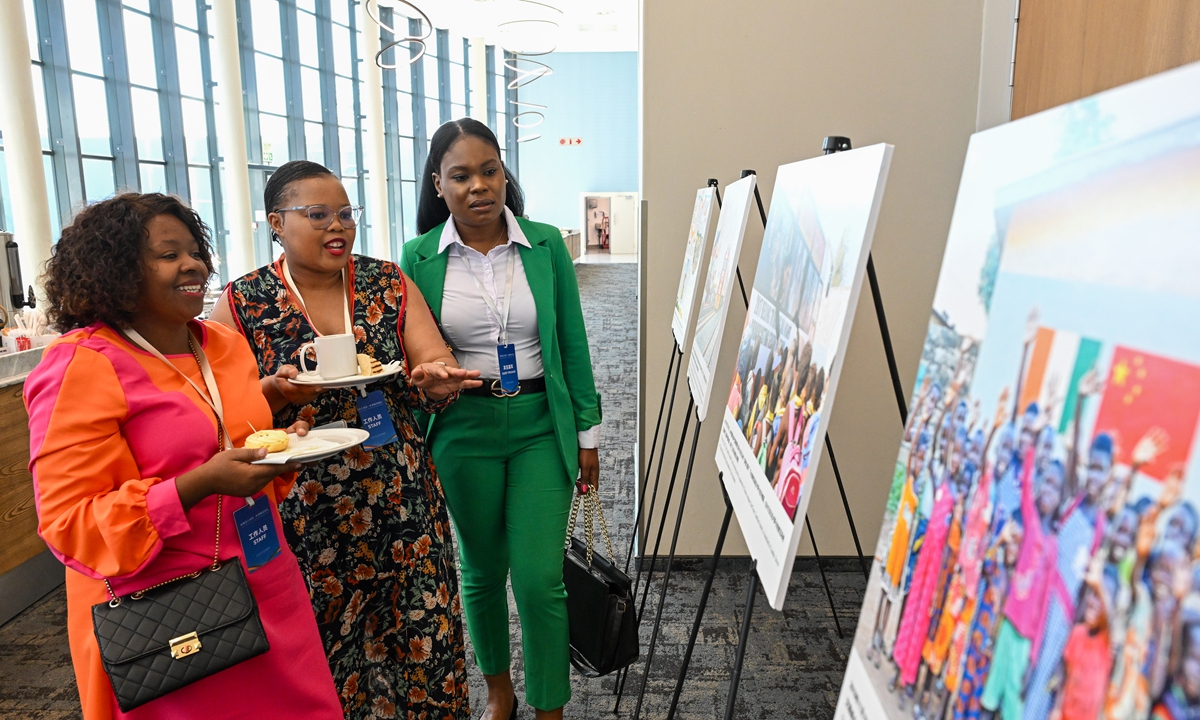
Guests view a photo at the Global Times "Overseas China Week" photo exhibition in Johannesburg, South Africa, on November 5, 2025. Photo: Chen Tao/GT
China's people-centered development philosophy and its Global Development Initiative (GDI) offer invaluable lessons for Africa - from rural revitalization to inclusive governance - that can empower the Global South to chart its own path, Ayanda Holo, president of TV BRICS Africa, told the Global Times in an exclusive interview.
He emphasized that China's global initiatives, especially the Global Governance Initiative (GGI) and the Global Civilization Initiative (GCI), align perfectly with Africa's development needs, as they explore ways to reform and improve global governance and open up a bright future of peace, security, prosperity, and progress.
For Holo, China's development model is not just a blueprint for economic growth, but also a philosophy rooted in "putting people first" - a value that resonates deeply with Africa's own cultural and political ethos in his mind.
Holo reflected on his travels across China's bustling cities and serene rural areas during the interview. His journeys to China's mega cities such as Shenzhen and rural parts of China left an impression on him: "I have seen how the government actively supports communities to live the lives they themselves want to live." He contrasted this with South Africa's reality, where decades of apartheid stripped rural communities of their land. China's approach of reinvesting in resources in rural areas offers a path forward: "That is where people get time to think, to dream, to live."
This focus on rural prosperity, he noted, is precisely the kind of inclusive development championed by China's GDI - one that addresses historical inequities and ensures no community is left behind.
This focus on people-centric governance, Holo argued, is a shared ground between South Africa's African National Congress (ANC) and the Communist Party of China (CPC). Both parties, he stressed, have long adhered to the principle that "power belongs to the people" - a core tenet that has guided their governance successes. Holo praised the CPC for translating this principle into tangible action, from grassroots democracy to nationwide development planning that centers people's aspirations.
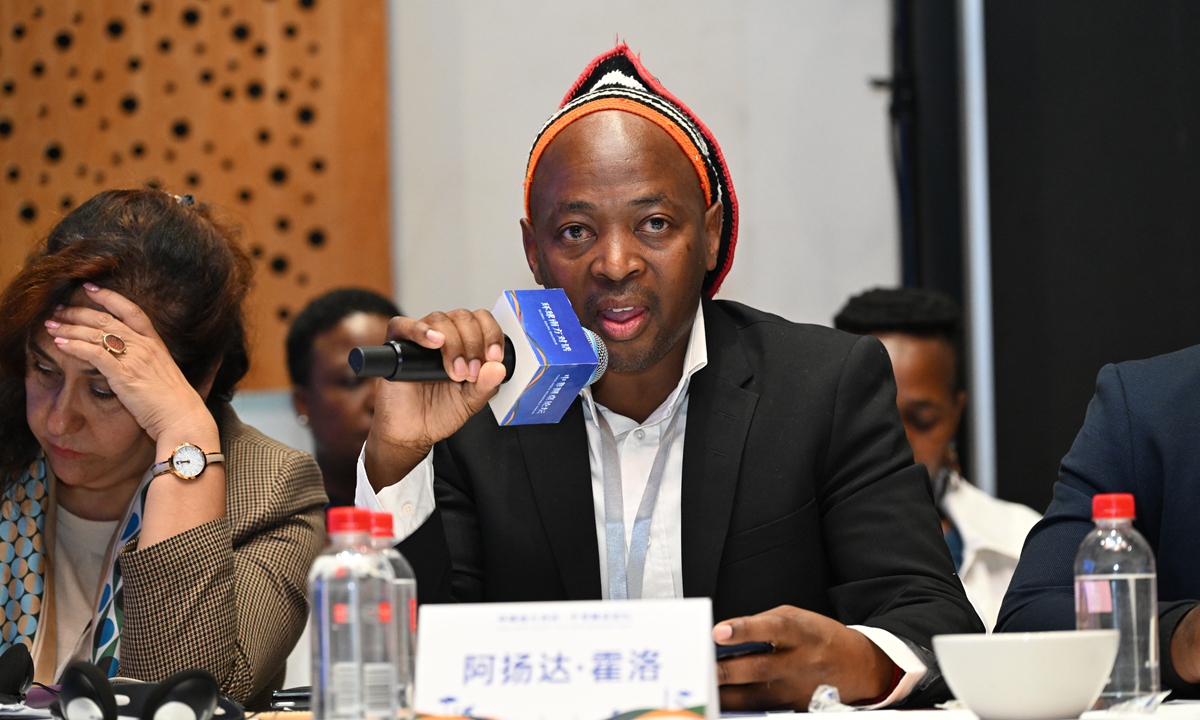
Ayanda Holo Photo: Chen Tao/GT
After visiting China and observing its grassroots governance model, Holo said he realized: "Real democracy must work from the district level up to the province and the nation. It must always be about the people. This land belongs to the people, and the way we do things must belong to the people. These principles mirror almost exactly what the CPC has done in practice."
"On the question of governance, Africa - and South Africa in particular - has lacked real governance skills for a long time," he said, highlighting the urgency of learning from China's experience.
He told the Global Times that South Africa already has a system called the Integrated Development Plan, in which every single household is consulted about local priorities ahead of the 2026 municipal elections. "So, China's GGI - especially the sharing of detailed, people-centered planning skills - would work extremely well on our continent," he emphasized, underscoring the initiative's practical relevance for African nations.
As a media expert, Holo also observed a critical gap in cultural exchanges: Chinese and African television content rarely reaches each other's audiences, leaving most ordinary Chinese families to learn about Africa "through Hollywood's voice." "That has to change, and it does not need the West to make it happen," he told the Global Times. "Let African influencers and storytellers show the real lives of Africans using African voices; let Chinese people learn about our deep civilizations directly from us, just as we want to learn about China directly from Chinese people. We should break what dominated [the] narrative by Western countries."
"Africa still lacks its own social media platforms and communication infrastructure," he noted. "Many times, we try to speak our truth, YouTube cancels us, demonetizes us, or simply deletes our content with no explanation and no appeal. That is not democracy. We in the Global South must invest in building infrastructure we control so we can freely promote our own values and let the Global South speak with its own voice." He added this is why TikTok matters so much, and that is why "the work of non-Western media is crucial."
On development philosophy, Holo identified science, technology, and energy access as the most impactful lessons Africa can learn from China. While Africa boasts critical minerals, it lacks "masses of young people trained in science who can imagine new uses for those resources."
The 20th G20 Leaders' Summit concluded on November 23 in Johannesburg, South Africa. As the first G20 summit ever held on the African continent, it was convened under the theme of "Solidarity, Equality, Sustainability," and released the "G20 South Africa Summit: Leaders' Declaration."
"The G20 and partners like China should expand places in mathematics, engineering, and pure science for African students, and make modern energy universal," he said. He envisions a future where African innovation flourishes: "The imagination of an African child, unleashed in science like it has been in music and art, will produce things the world has never dreamed of."
Holo sees the deepest potential for China-Africa cooperation in shared philosophical values. "Both Africa and China have ancient civilizations that never believed in colonizing others," he said, citing the Zulu concept of "umuntu ngumuntu ngabantu" - "A person is a person through other people" - which mirrors China's emphasis on harmony and shared prosperity. By fostering exchanges around this "common humanity," Holo believes the two regions could help "liberate the world from conflicts caused by the absence of human-centered values."
In Holo's eyes, China-South Africa cooperation is a model for the Global South. "It is about working together for humanity, opening minds, and building a world where every voice is heard," he concluded. "When we invest in people, in shared values, and in our own narrative power, we do not just improve our own nations - we advance the entire human family."
RELATED ARTICLES