SPORT / MISCELLANY
National Games for Persons with Disabilities, Special Olympics kick off
Sporting events’ accessibility guidelines issued
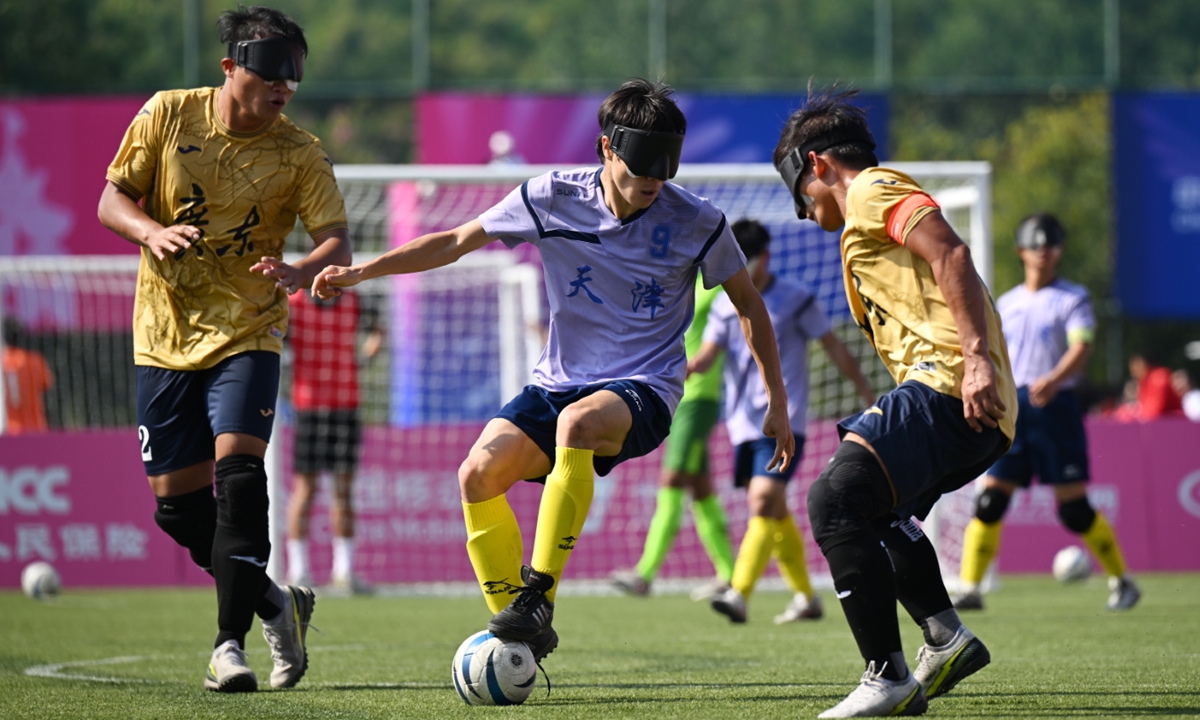
Photo: VCG
The 12th National Games for Persons with Disabilities and the 9th National Special Olympics Games, co-hosted by Guangdong, Hong Kong and Macao, officially opened on Monday, marking the start of a week-long sports gala that will run through December 15.Aside from the six winter events that concluded earlier, the Games feature 40 major events across four disability categories: physical, visual, hearing and intellectual, drawing 7,824 registered athletes from 34 delegations nationwide.
During the concentrated competition period alone, a total of 5,398 athletes, 2,746 referees, 115 classifiers, 2,772 coaches and staff will take part, pushing the overall scale to more than 11,000 participants - an increase of 30 percent compared with the previous edition.
The Games consist of a total of 1,876 events, among them 11 major public-participation events with 131 medal events, and nine Special Olympics events with 599 medal events. The program reflects both China's elite sports priorities for Paralympic preparations and its efforts to expand inclusive participation across communities.
Although the event does not feature a torch relay or opening ceremony, its significance remains undiminished. Cheng Kai, chairman of the China Disabled Persons' Federation and director of the organizing committee, told the Global Times that Guangzhou has provided athletes with an excellent competition environment. He expressed the hope that the athletes would give their best to compete fearlessly and strive for outstanding results.
He also encouraged the athletes to pursue further education, enhance their cultural and professional skills and better contribute to persons with disabilities and the broader cause of disability support.
Competitions are well underway. Events such as blind football and table tennis have already started, while athletics and swimming are scheduled to begin on Tuesday.
During a visit to the table tennis competition on Sunday, which is widely regarded as China's "national sport," Cheng noted that the format and atmosphere differ markedly from the able-bodied version commonly seen by the public.
In women's team event on Monday, the Guangdong women table tennis disabled team's coach Xiong Guiyan told the Global Times that the three young athletes who claimed the gold medal "all came from mountain villages," and that the youngest "fell in love with table tennis the moment she first touched a racket" and gradually worked her way to the national stage.
In the WD7 women's doubles event, teams from the Hong Kong Special Administrative Region and Beijing went head-to-head on Monday afternoon. After the match, Hong Kong athlete Wong Yu-ching told the Global Times that she cherished the chance to compete in Guangzhou.
"With many mainland provinces now professionalizing para table tennis programs,winning a medal at a national-level game can be even harder than at the World Championships or the Olympics," she said. Wong noted that the accessibility facilities are excellent and the volunteers incredibly friendly.
Guangdong is hosting competitions at 36 venues, 22 of which were shared with the just-concluded 15th National Games. No new venues were built, but accessibility standards were significantly upgraded.
During the Games, organizers also released China's first comprehensive accessibility construction guidelines for large-scale sporting events. Across the 36 venues, 2,398 accessible seating areas and 462 barrier-free restrooms have been installed.
Public-participation sports form another major theme of the event, with programs such as table tennis, badminton, darts, chess, wheelchair dancing, floor curling, football and basketball designed to encourage broader involvement among persons with disabilities and promote social inclusion.
A new event, cross-country roller skiing, expands winter-sports access by offering a discipline that is simple to learn, suited for various disability groups, and not restricted by season or terrain, aligning with China's "expanding southward, westward and eastward" ice-and-snow sports strategy.
Special Olympics events continue to emphasize integration between athletic and non-athletic activities, with competition groups organized scientifically by gender, age and ability level, encouraging participants to embody the Special Olympics spirit of courageous participation and pursuit of victory.
Beyond competition, the Games represent an unprecedented collaborative effort across the Guangdong-Hong Kong-Macao Greater Bay Area. Eleven cities are co-hosting events, more than any previous edition. Organizers highlighted improvements in urban infrastructure, transportation, and safety inspections, with 1,160 urban improvement projects completed and 623 traffic bottlenecks cleared. A total of 15,000 volunteers known as "little dolphins" have been deployed to assist delegations and spectators.
Technology-enabled accessibility is another standout feature. Assistive innovations have been embedded across training, rehabilitation, competition management and spectator services. During the cycling events in Shenzhen, 38 tech companies supplied 108 products to support event operations, athlete needs and accessibility services.
The Greater Bay Area's integrated development vision is also woven throughout the Games. Cultural symbols and visual identities, including the emblem, mascot and medals, incorporate elements from Guangdong, Hong Kong and Macao. Bilingual versions of the theme song Towards the Mountains and Seas are being promoted across the region with famous actor and singer Andy Lau's performance.
As competitions continue throughout the week, organizers say the Games aim not only to crown champions but also to advance China's broader goal of inclusive, high-quality development in disability sports, bringing accessibility, technology, and regional cooperation onto a shared stage.
RELATED ARTICLES