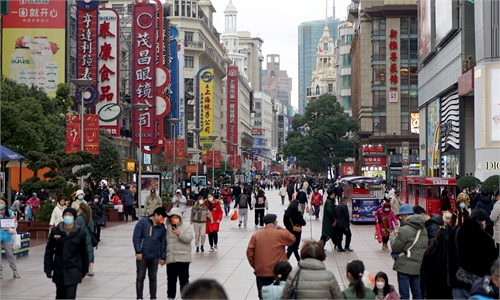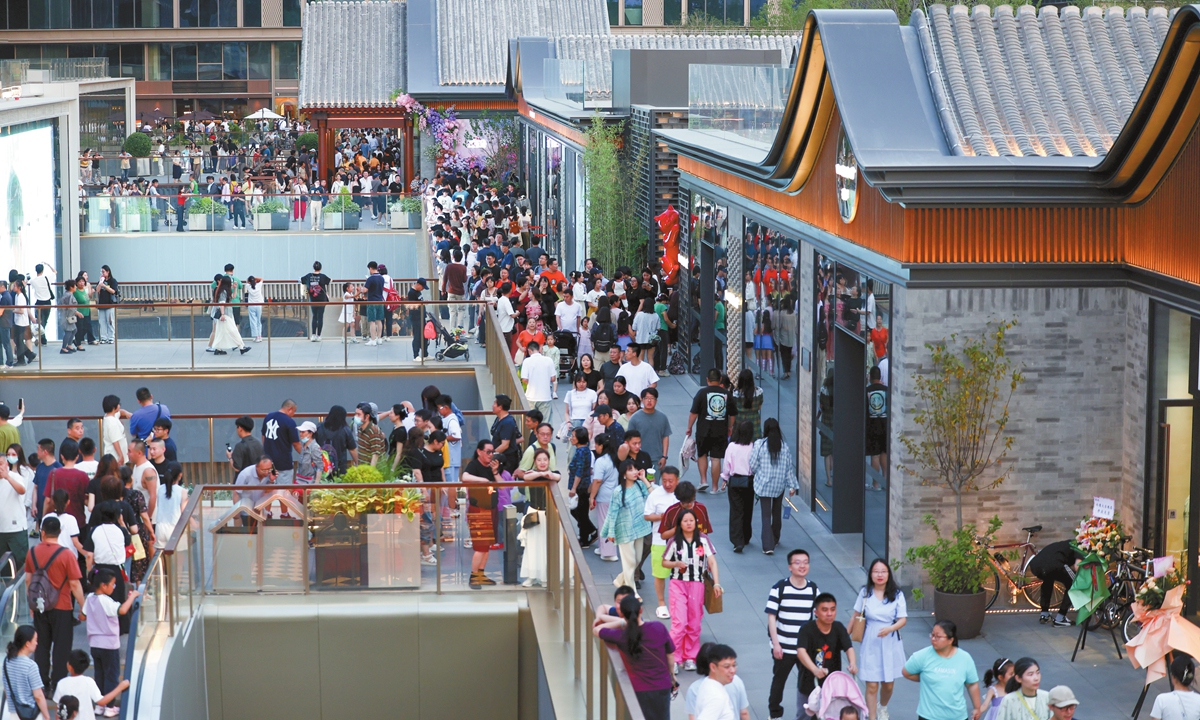
Consumers visit the Dajixiang commercial complex in Beijing on June 7, 2025. Photo: VCG
On recent sunny but cold winter morning, inside the Dajixiang, also known as Daji Alley, a commercial complex in Beijing's Xicheng District, a fragrance shop named "Song Chao" drew scores of costumers to check out its perfume products. While trying the perfume, customers can experience tea ceremony for free, which makes one experience the leisurely days of Song Dynasty.
At a MINISO store in Beijing Fun, a cultural hub in the capital, crowds gathered around a booth displaying co-branded merchandise of Disney's Zootopia 2. Some products were already sold out, the Global Times learned. This is yet another scene that depicts the explosive growth of China's "intellectual property (IP) economy" sparked by the global popularity of Chinese firm Pop Mart's Labubu collection.
Entering the snow season, the Songhua Lake Resort in Jilin City, Northeast China's Jilin Province, has already seen robust growth in bookings, with pre-sale volume already exceeding 100 million yuan, up 25 percent. This is just one example of China's thriving ice-and-snow industry, which is expected to exceed 1 trillion yuan this year, according to Xinhua News Agency.
These scenes each highlight a consumption trend, and together they paint a vibrant picture of China's consumption market this year. And strong growth in consumption have underpinned stable growth in the Chinese economy despite tremendous uncertainty in the global economy this year. Going forward, as the main growth driver, consumption will continue to support sustained, high-quality development of the world's second-largest-economy, while also offering immense opportunities for the world, experts noted.
Robust growth
The robust growth in China's consumption is also reflected in data. According to data from the State Post Bureau, China's parcel express delivery volume for 2025 had surpassed 180 billion as of November 30. This figure marked a milestone because it was the first time the annual volume had hit the 180-billion threshold, reflecting the vitality of the ultra-large market. China's retail sales of consumer goods rose 4.3 percent year-on-year in the first 10 months of 2025 reaching 41.22 trillion yuan ($5.82 trillion), according to data released by the National Bureau of Statistics on November 14. The growth rate was 0.8 percentage points higher than that of the same period last year and the overall growth rate of the previous year.
Such a growth did not come easily. Over the past year, in response to complex changes in the external environment, China has taken a slew of policy measures to boost consumption.
The 2024 Central Economic Work Conference listed "vigorously boosting consumption, improving investment efficiency, and expanding domestic demand on all fronts" at the top of the key tasks for 2025.
With this policy priority, Chinese authorities have rolled out a package of targeted policies that have effectively boosted the country's consumption vitality. In June, the People's Bank of China launched a dedicated 500 billion yuan relending facility aimed at stimulating service consumption and the elderly care sectors. In addition, fiscal support has been increased for consumer goods trade-in programs and initiatives that enhance people's well-being, including nationwide childcare subsidies, all aimed at empowering consumers.
Under the support of such policy measures, China's consumption market saw many booming segments, including the rise of China-chic - highlighted by the "Song Chao" store, the surge of the "IP economy" - evidenced by Labubu, and the ice-and-snow economy.
And there is more. Thanks to the trade-in programs, China's smart home appliance market is projected to exceed 800 billion yuan in 2025 and 1 trillion yuan in 2027, according to data from the Ministry of Industry and Information Technology. Meanwhile, thanks to the country's policy for industrial upgrade, the revenue of the country's robotics industry grew by 29.5 percent year-on-year in the first three quarters of 2025, while the production of industrial robots reached 595,000 units and service robot production reached 13.5 million units, both already exceeding the total volume in 2024, the Securities Daily reported.
"The data showed significant changes in consumer demand this year, with emerging consumption sectors growing rapidly and traditional models accelerating their transformation. With stronger policy support, including job stabilization and income growth, new consumption scenarios and applications are expected to further expand and continue to remain a key driver for consumption," Li Changan, a professor with the Academy of China Open Economy Studies at the University of International Business and Economics, told the Global Times.
Vast opportunities
More policy support is underway to ensure continuous development.
China's Ministry of Industry and Information Technology and five other departments released an action plan on November 26, mapping out key measures to better match the supply and demand for consumer goods and further stimulate consumption.
By 2027, the supply structure of consumer goods is expected to be significantly optimized, creating three trillion-yuan consumption sectors and ten 100-billion-yuan consumption hotspots, according to the plan. The plan also states that by 2030, the contribution rate of consumption to economic growth will rise steadily.
The Communist Party of China Central Committee's recommendations for formulating the 15th Five-Year Plan (2026-30) for China's economic and social development call for a notable increase in the GDP share of household consumption, and for strengthened inclusive policies that benefit consumers directly, among a series of measures to vigorously boost consumption, according to Xinhua News Agency.
China's household consumption rate remains below that of developed countries, with significant growth potential in the service consumption sector, Zhang Yi, CEO of the iiMedia Research Institute, told the Global Times on Monday.
With a population of over 1.4 billion, a globally unparalleled industrial system, and a per capita GDP surpassing $10,000, China is the world's most promising consumer market, according to Zhang. China's ultra-large market is also a huge opportunity for the world. In 2025, China rolled out multiple policies to further open up its service sector and held various major trade fairs to help foreign-funded enterprises tap domestic market. In a key move in China's opening-up drive, the Hainan Free Trade Port will begin independent customs operations on December 18, which will provide vast opportunities for global businesses to further explore the Chinese market.
RELATED ARTICLES