ARTS / CULTURE & LEISURE
Su Bingtian ends career that redefined Asian sprinting
Farewell to 9.83
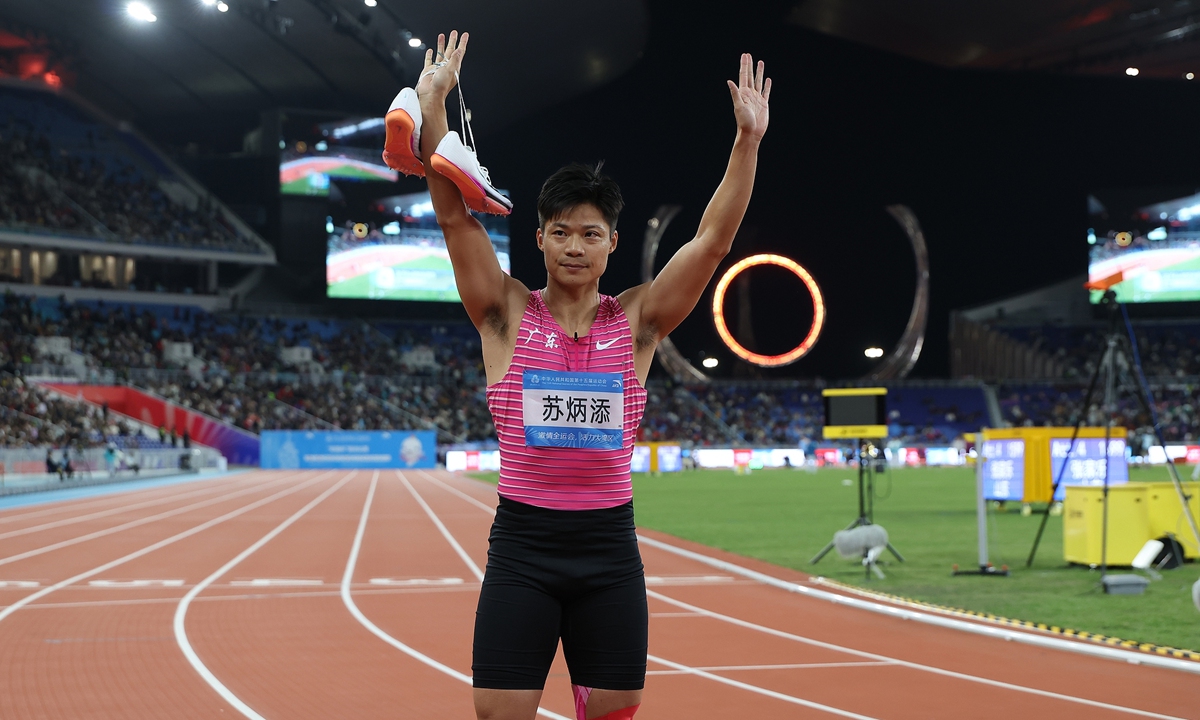
Su Bingtian competes in the men's 4x100m relay final at China's 15th National Games in Guangzhou, South China's Guangdong Province, on November 20, 2025. Photo: VCG
Asia's men's 100 meter record-holder and China's sprint icon Su Bingtian officially announced his retirement from athletics on Tuesday, ending a storied 21-year career that reshaped Chinese and Asian sprinting.In a reflective statement posted on Sina Weibo, Su wrote: "When I lifted my spikes, I knew it was time to draw a line under this long chapter of running. The 21 years felt like the moment from start to finish on a 100-meter track. Looking back at this track, every footprint is stained with sweat, tears, regrets and glory. My heart is full of emotions, but more than anything, gratitude."
The timing of the announcement was deliberately chosen, Su said in an interview with CCTV Sports , as he began his career on December 9, 2004.
The posting time of 10:10 am also marks Su achieving 10 below 10-second finishes over his career.
Su set the Asian record in the men's 100 meters with a sensational 9.83 seconds during the semifinals at the Tokyo Olympics in 2021.
"9.83 seconds is not just a number. It is proof that 'anything is possible,' and it is also a beam of light that I hope can illuminate the path for more young Chinese sprinters, helping them believe that limits are meant to be broken," Su wrote.
Injuries sidelined Su from progressing further. He skipped the Hangzhou Asian Games in 2023 and Paris Olympics in 2024, when fans were expecting he could lower his personal best.
"My body has told me that it is time to pass the baton to a younger, stronger generation of athletes. Watching them continue to sprint forward on the road of Chinese sprinting fills me with pride and joy," Su wrote.
His announcement immediately triggered a wave of emotional responses. Athletes and celebrities flooded the comment section of Su's Sina Weibo posts, thanking him for the inspiring athletic achievements and wishing him good fortune in his new career.
"Your perseverance and breakthroughs have illuminated the path for Chinese sprinting," emerging Chinese female sprinter Liu Xiajun, 20, wrote on Sina Weibo.
"Thank you for inspiring the next generation with belief and courage. We will strive to honor the passion and legacy you've passed on."
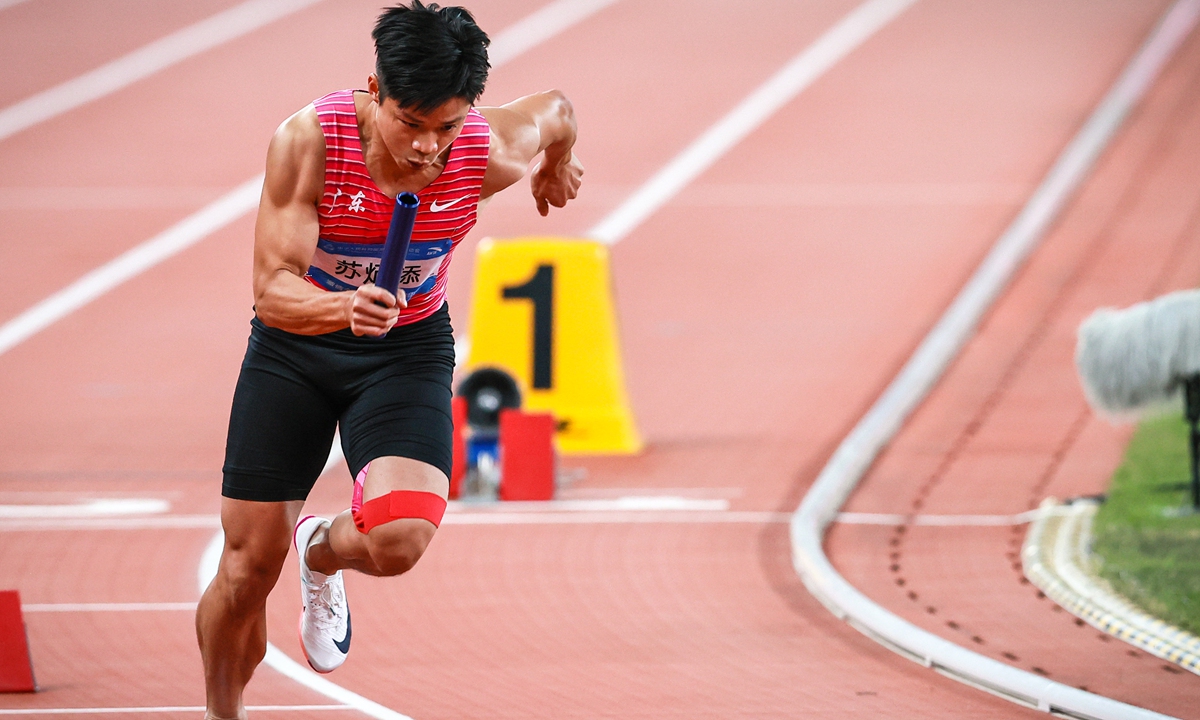
On November 20, 2025, representing his home province Guangdong, Su ran the first leg of the men's 4x100 m relay. Photo: VCG
Sprinting journeyFew could have predicted that the skinny teenager from Zhongshan would go on to rewrite what was thought possible for Asian sprinters.
Born in August 1989 in Zhongshan, South China's Guangdong Province, Su was barely 15 when he first left home to join the provincial athletics system in December 2004.
For a long time, Asia lacked male sprinters capable of challenging the "sub-10-second" barrier, that invisible line separating the world's elite from the rest. It was Su that led the change of that narrative.
In May 2015, at the Diamond League meeting in Eugene, the US, he became the first Chinese athlete to break 10 seconds, clocking in 9.99 seconds.
The world athletics championships in Beijing that year also saw him and his teammates win a historic silver medal in the men's 4x100 meters relay.
The breakthroughs were no fluke. In 2018, he twice ran 9.91 seconds in June, first at a meet in Madrid, then again in Paris, equaling the previous Asian record.
Though Su placed in sixth place in the final at the Tokyo Olympics, his 9.83-second finish in the semis was enough to put him on the Top 10 Fastest Men List at the Olympics.
But the man who once carried China's sprinting dreams to new heights soon found his progress halted by injuries.
Career twists
Standing 1.72 meters tall, Su was never considered a talent in the physically demanding 100 meters sprinting discipline, which was dominated by 1.95-meter-tall Usain Bolt for over a decade.
Behind Su's glory were years of hard work, self-doubt, technical re-learning and injuries.
"Throughout my career, the road was far from smooth. Facing technical bottlenecks, psychological battles at major competitions and the torment of injuries, my body, muscles, joints, waist and legs were my silent 'teammates,' but also my most painful 'enemies,'" Su wrote.
Su once admitted that in earlier years, when his times hovered over 10 seconds, he was considering quitting racing.
In one of the boldest moves of his career, he changed his lead leg for starts, switching from his habitual left leg to right, essentially rewriting years of muscle memory and racing technique.
The early days after the switch were brutal: For a time he was running 10.80 seconds, far off his best, even lagging behind less experienced athletes.
That difficult transition laid the foundation for what came next. By 2015, the start of his breakthroughs finally came.
Home farewell
It was an image many fans will remember: Su, barefoot, spikes in hand, acknowledging a crowd that had watched him grow from a promising teenager to Asia's fastest man.
On November 20, 2025, representing his home province Guangdong, Su ran the first leg of the men's 4x100 m relay. Though the team finished fourth, the moment transcended the result.
After the race, Su took off his spikes, raised them high and did a lap around the track, barefoot, waving to the crowd, an emotional farewell to the fans and the track.
In his statement at the Guangdong Olympic Sports Center after finishing the relay, Su made clear that although he is stepping away from competition, he is not walking away from athletics.
"I believe that as long as you persevere, you will surely succeed, and only those who remain strong and unyielding can see their dreams come true," Su said.
"I am not leaving the track and field that I love. I hope that in the future, I can continue to contribute to our country, and, for more young people who love sprinting, help them create and fulfill their dreams."
RELATED ARTICLES