China’s trade surplus tops $1 trillion for first time; global trade situation a result of market forces: expert
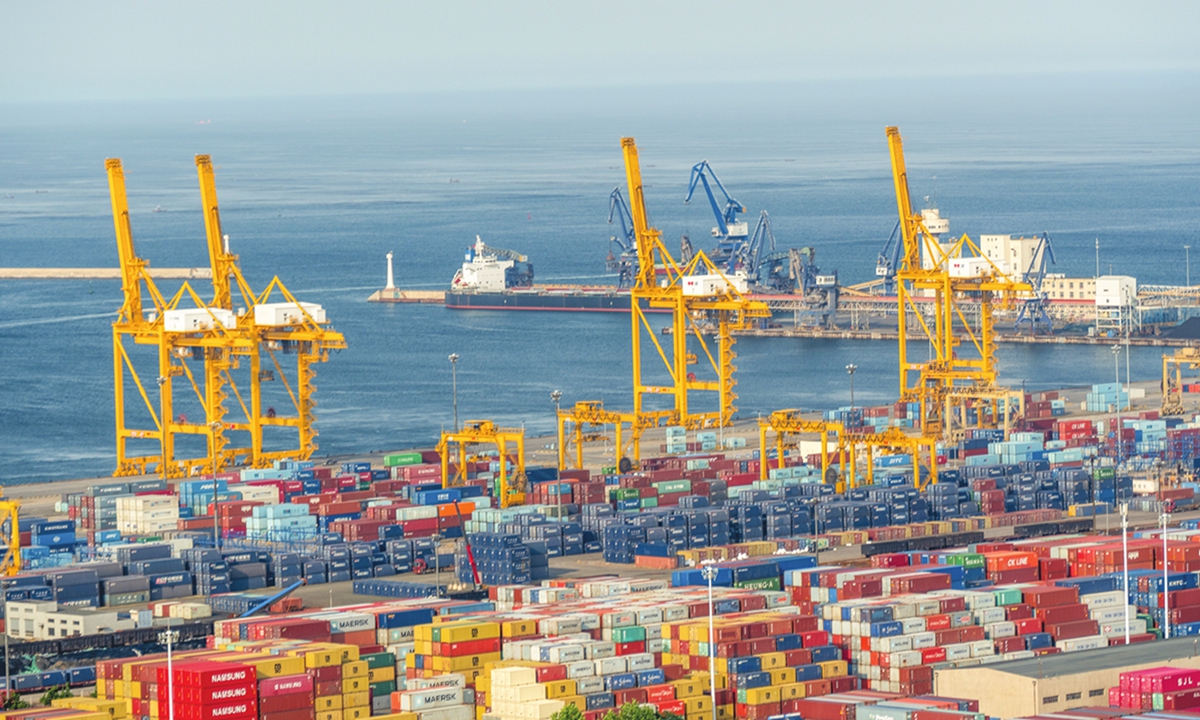
An aerial view of Dalian Port, Northeast China's Liaoning Province. Photos: VCG
Data released by the General Administration of Customs (GAC) on Monday showed that China's trade surplus reached $1.08 trillion in the first 11 months of 2025. A report from The New York Times noted that "China's trade surplus climbing past $1 trillion for the first time." The Wall Street Journal said that this "milestone" underscores the dominance that the country has attained in everything from high-end electric vehicles to low-end T-shirts.
Against the backdrop of the US' "tariff war" against China, why China's imports and exports can still achieve growth in the first 11 months? Experts interviewed by the Global Times said that the global trade situation is the result of market forces, and Chinese products remain in strong demand worldwide due to their competitiveness. China's pivotal role in global manufacturing and supply chains, they stressed, is likewise the result of market forces and fair competitions.
Diversified markets
Multiple experts said that the record trade surplus primarily reflects the strong resilience of China's foreign trade. Exports to ASEAN and the EU continued to expand and fully offset the decline in exports to the US; meanwhile, China's overseas markets further diversified, with exports to Africa surging by 26.3 percent. Rapid growth in high-tech exports also provided major momentum. In addition, the decline in global commodity prices this year slowed the growth of China's imports, contributing to the growth of the surplus.
GAC data showed that during the first 11 months, China's exports to the EU reached $508.048 billion, up 8.1 percent year-on-year, an increase of $38.4 billion from a year earlier. Exports to ASEAN totaled $599.034 billion, up 13.7 percent, an increase of $72.376 billion. As China's third-largest trading partner, China's exports to the US reached $385.907 billion, down 18.9 percent year-on-year, or $89.76 billion less than that during the same period in 2024.
Calculations show that the increase in China's exports to the EU and ASEAN fully offset the decline in exports to the US. Exports to Africa and Latin America also expanded rapidly. Exports to Africa reached $201.715 billion, up 26.3 percent year-on-year. According to a research note by Tao Chuan, chief economist at Soochow Securities, Africa has become a key new growth point for China's exports amid US tariff pressures and global supply chain restructuring. He noted that Africa's contribution to China's export growth jumped from a negligible 0.2 percent last year to 1.3 percent this year, accounting for roughly a quarter of overall export growth.
The Wall Street Journal report said China now is "an indispensable cog in global supply chains spanning technology, transport, medicine and consumer goods." Despite higher US tariffs, China's overall exports continued to expand, with shipments to Africa, Southeast Asia and Latin America rising by 26 percent, 14 percent and 7.1 percent, respectively.
Notably, China's high-tech exports accelerated markedly this year, underscoring the rise of new drivers of foreign trade. Feng Lin, an analyst at Golden Credit Rating, told the Global Times that surging global investment in AI and China's industrial upgrading have fueled rapid export growth in chips and new-energy vehicles, providing strong support to overall exports. Customs data show that in the first 11 months, China exported 1.29 trillion yuan ($181.7 billion) worth of integrated circuits, up 25.6 percent, and 896.91 billion yuan worth of automobiles, up 17.6 percent.
"China's exports have shown remarkable resilience," Wan Zhe, a professor at Beijing Normal University and researcher at the Belt and Road School, told the Global Times on Monday. China's efforts to diversify its export markets, she noted, have achieved "clear and tangible" results and effectively cushioned the volatility in shipments to the US.
Lower prices of major imported commodities also played a significant role in boosting the surplus. According to a research note by China Merchants Securities analyst Zhang Jingjing, global prices for crude oil, coal, natural gas and other key commodities fell in 2025, causing China's import bill to grow more slowly even as import volumes increased, thereby inadvertently widening the surplus.
GAC data showed that in the first 11 months, China imported 1.139 billion tons of iron ore, up 1.4 percent, with the average price down 9.4 percent; 522 million tons of crude oil, up 3.2 percent, with prices down 12.1 percent; 432 million tons of coal, down 12 percent, with prices down 23.9 percent; and 114 million tons of natural gas, down 4.7 percent, with prices down 9.4 percent. Soybean imports reached 104 million tons, up 6.9 percent, with prices down 10.7 percent. Imports of refined oil products fell 14.5 percent to 38.433 million tons, with prices down 4.9 percent.
Market forces
Global Times reporters noted that China's trade surplus data has sparked discussions in foreign media about trade imbalances. The Wall Street Journal quoted Jens Eskelund, president of the European Union Chamber of Commerce in China, as claiming that "it is so big that it's obvious that it's not just the United States or Europe but the whole world that will have to fund that gap."
"The notion that buying something means suffering a loss doesn't hold water in any market," Wan told the Global Times, explaining that trade is inherently about mutual benefit and win-win outcomes, and if buyers believe trade is not worthwhile, an effective market cannot form.
In fact, Chinese goods not only provide high-quality options for the world, reduce global inflationary pressures, and improve the living standards of people worldwide, but also create markets and job opportunities for trade partners, Wan noted.
Wan further pointed out that the global trade situation is the result of market forces. Currently, China plays a crucial role in the manufacturing segment of the global industrial and value chain, which is also an outcome of market forces and fair competition.
"A large surplus indicates that Chinese products are highly competitive and widely distributed. In the current environment, every country has different needs. For some products, if they are not imported from China, the result might be paying a higher cost for an inferior-quality product," Zhou Mi, a senior researcher at the Chinese Academy of International Trade and Economic Cooperation, told the Global Times.
It is worth noting that China has been driving the common development of countries worldwide through foreign investment. Data recently released by the Ministry of Commerce showed that in the first 10 months of this year, China's outbound direct investment across all sectors reached 1.03 billion yuan, a year-on-year increase of 7 percent.
Expanding imports
Multiple foreign media outlets said that China's industrial competitiveness and manufacturing strength ensure the export of Chinese goods.
The New York Times reported that from cars to solar panels to consumer electronics, Chinese exports are reaching Southeast Asia, Africa, Europe and Latin America. Carmakers and other exporters in traditional manufacturing powerhouses like Germany, Japan and South Korea are losing customers to Chinese rivals, it claimed.
The Wall Street Journal noted that despite the mounting geopolitical headwinds and efforts by the US and other economies to diversify away from China, few economists expect China's trade momentum to meaningfully slow in the months and years ahead.
Morgan Stanley economists predict that by around 2030, China's share of global merchandise exports will rise from the current approximately 15 percent to 16.5 percent. This growth will be supported by China's leading advantages in advanced manufacturing. In a report to clients, Morgan Stanley economists stated that China has the ability to anticipate changes in global demand trends and proactively mobilize resources to expand production capacity.
"Chinese products are not a threat but rather an opportunity for development. China's demand market will also become increasingly vast," Gao Lingyun, a researcher at the Chinese Academy of Social Sciences, told the Global Times on Monday.
In November, China's Ministry of Commerce launched a series of activities in Shanghai, focusing on continuously expanding the circle of partners and allowing Chinese opportunities to benefit the world, and multi-dimensionally building channels for connectivity to bring more goods "into China."
"We need to promote balanced development of imports and exports, intensify efforts to expand imports, meeting the needs of industrial transformation and upgrading, as well as the people's demands for a better life," Commerce Minister Wang Wentao said recently.
RELATED ARTICLES