Some EU politicians, media claim China hardly imports from bloc; facts tell different story
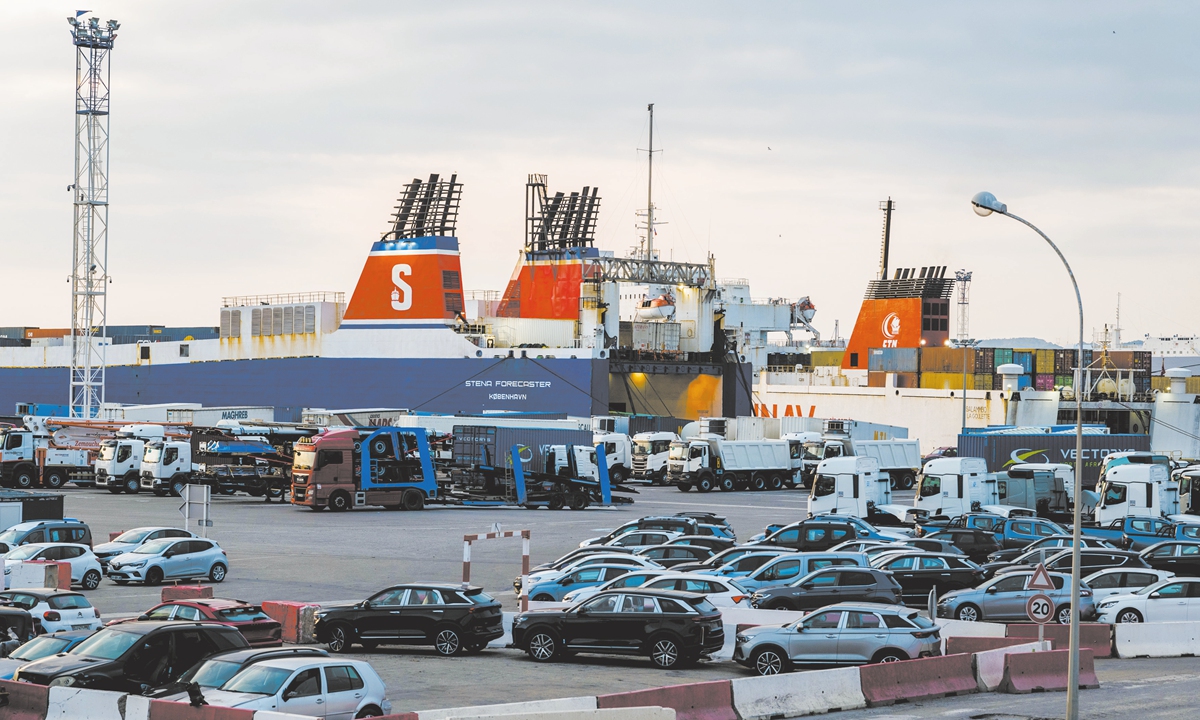
Container ships dock at the port of Marseille, France, on February 18, 2025. Photo: VCG
Recently, certain European politicians and media outlets have been peddling the narrative that China hardly imports anything from the EU, and even threatened that the bloc could take punitive actions to address the so-called "trade imbalance."
However, a closer look into relevant data reveals a completely different story: While China maintains a surplus with the EU in terms of trade in goods, it imports hundreds of billions of dollars' worth of products from the bloc; The EU maintains a huge surplus with China in terms of trade in services; Moreover, EU businesses - from makers of planes and cars to fashion houses - make a windfall from the Chinese market each year.
Assertions that China has deliberately reduced imports from the EU or any other region are not only divorced from economic reality, but also represent a malicious attempt to create pretexts for more protectionist actions that will further undermine mutually beneficial cooperation, Chinese experts said on Tuesday.
Data speak louder
Contrary to the claim that China hardly imports anything from the EU, data showed that China remains one of the EU's largest trading partners and a top buyer of European high-end machinery, precision instruments, and agricultural products.
In the first 11 months of 2025, China imported more than $241.29 billion worth of goods from the EU, according to data released by China's General Administration of Customs (GAC) on Monday. This means China buys nearly $22 billion worth of products from the EU each month on average - that is certainly not "hardly anything."
The EU's own statistics also painted a similar picture. China is the EU's second-largest trading partner for trade in goods alone, after the US, with bilateral trade in goods reaching 732 billion euros in 2024, according to the official website of the European Commission (EC). EU exports to China amounted to 213.3 billion euros ($851.7 billion), the EC's data showed.
While data showed that the EU maintains a relatively big surplus with China in terms of trade in goods, analysts have pointed out that this is the natural outcome of global division of labor, and it does not mean that one party is taking advantage of the other.
"China's trade surplus is the result of genuine comparative advantages of its complete industrial system, successful industrial upgrading and growing contribution in trade of intermediate products," Zhu Qiucheng, CEO of Ningbo New Oriental Electric Industrial Development, also a veteran industry observer, told the Global Times on Tuesday.
With such comparative advantages, China has provided consumers around the world, including those in the EU, with more affordable, high-quality products that are essential to their daily lives, analysts noted.
Meanwhile, some European politicians and media outlets' fixation on the surplus in trade in goods also fails to tell the full story of China-EU trade ties. The EU has actually maintained a huge surplus with China in terms of trade in services for years, with that figure hitting 21.7 billion euros in 2024, according to official data from the EC. China is the EU's fourth-largest services trading partner, after the US, the UK, and Switzerland.
Furthermore, these European politicians and media outlets tend to ignore the massive amount of profits EU businesses make each year from the Chinese market. According to an analysis on EU businesses in China released by the Atlantic Council, a US think tank, continental European companies collectively generated nearly $160 billion in revenue from China in 2024, roughly the size of Kuwait's economy.
It's also important to note that many foreign businesses operating in China, including those from the EU, often produce for both local consumption and export, which also contributes to China's trade surplus, according to media reports.
Expanding imports
Contrary to claims that China is deliberately reducing imports, the country has actually taken concrete measures to expand imports from countries and regions around the world, including those from the EU. One prime example: China has held the China International Import Expo (CIIE), the world's first national-level import-themed expo, for eight years.
At the just-concluded 8th CIIE, China once again proved with actions that it is a buyer for the world. The intended deals reached $83.49 billion, up 4.4 percent from the previous edition, according to official data from the organizer.
Signed procurement contracts totaled $40.9 billion with 34 partners from 17 countries or regions, covering 24 product types across 10 categories including crude oil, chemicals and equipment.
The total intended deals reached during the past eight editions of the CIIE reached $587.7 billion, making the CIIE far more than a trade fair - it is China's written pledge to expand domestic demand and open its market to the world.
A long list of EU businesses - from German automakers like Volkswagen to French fashion companies such as LVMH - have participated in the CIIE to explore the Chinese market, according to media reports and press releases. For example, LVMH said in a press release that it reaffirms its long-term partnership and friendship with China through its 6th year of participation at the CIIE in Shanghai.
The CIIE is just one example. A slew of other major trade shows, including the China International Consumer Products Expo, the China International Fair for Trade in Services, Canton Fair and similar trade platforms, also provides businesses from around the world, including those from the EU, to explore and expand in the vast Chinese market.
China has remained as the second-largest importer in the world for many consecutive years. In the first 11 months of 2025, for example, China's total imports reached about $2.34 trillion, according to the GAC data on Monday.
Trade barriers
However, even as China has taken proactive efforts to expand imports, certain countries and regions, including the EU, have moved to put restrictions on the exports of certain products to China under various artificial pretexts or have taken protectionist actions against China that undermine bilateral cooperation.
For example, extreme ultraviolet lithography machines from Dutch firm ASML remain effectively banned from normal export to China under US pressure. Some high-end optical instruments and precision machine tools from Europe are routinely delayed or denied by the EU on "national security" grounds, according to media reports.
In an interview with an Irish TV station on August 18, Chinese Ambassador to Ireland Zhao Xiyuan said that China-Ireland economic and trade cooperation has maintained steady growth over the past few decades, but Ireland's exports to China saw a significant decline in 2023 due to restrictions on semiconductor exports imposed by the US. "A Dutch company exporting a lithography machine to China earns a profit roughly equivalent to exporting 200,000 tons of pork to China," Zhao said, according to the website of the embassy.
If the West lifted these high-tech export controls, China's imports would surge and the trade surplus would naturally shrink, analysts pointed out.
"Europe seems unwilling to export many of its high-value-added products to China and has chosen political interference instead. This means it is not China deliberately widening the trade surplus - the EU is doing it to itself," Jian Junbo, director of the Center for China-Europe Relations at Fudan University's Institute of International Studies, told the Global Times on Tuesday.
"The EU should stop viewing everything through an ideological lens or invoking baseless claims of security risks. It possesses plenty of high-tech goods with huge untapped export potential to China," Jian said, adding that the EU needs to reflect on the real reason for its declining competitiveness and start the change at home: produce more competitive products, respect market competition, and abandon trade protectionism, which often backfires.
RELATED ARTICLES