GT Voice: Global clean-energy co-op must not be hijacked by noise of ‘double-standards’
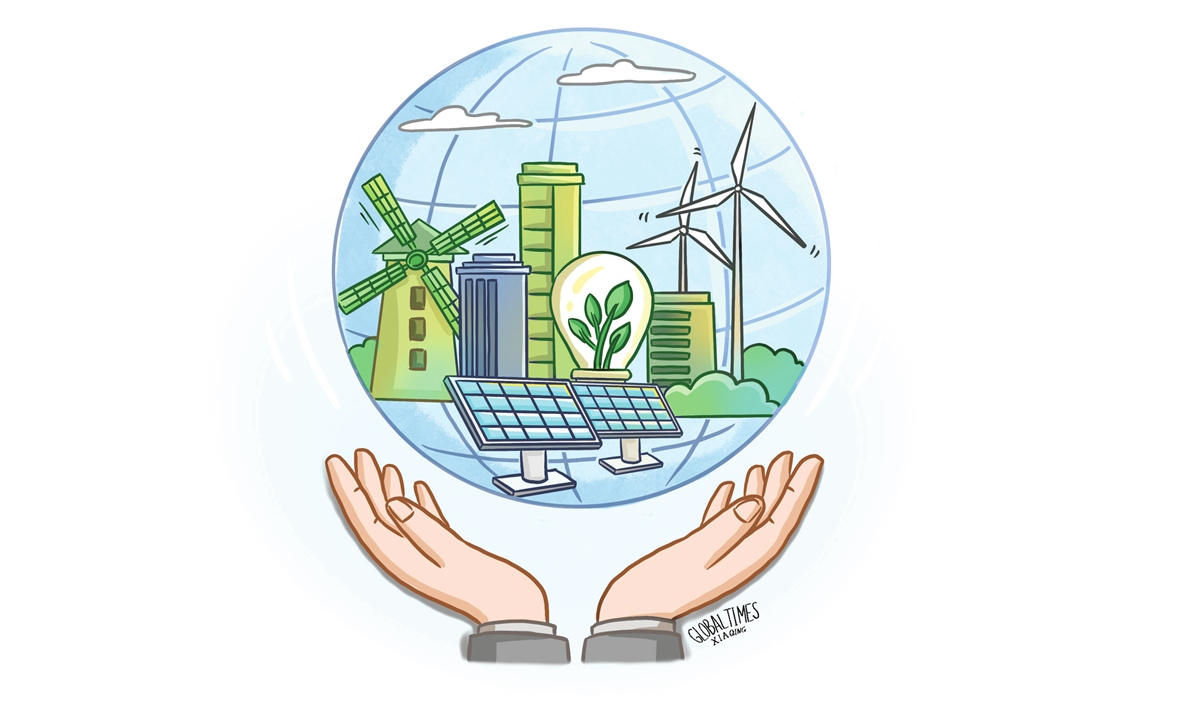
Illustration: Xia Qing/GT
In the global transition toward green and sustainable energy, China's pivotal role in clean-energy investment has increasingly become the focus of worldwide attention.According to a report released by Australian research group Climate Energy Finance (CEF) on Monday, Chinese firms have committed more than $180 billion of outward direct investment in clean technology since the start of 2023, up 80 percent since CEF's Green Capital Tsunami report a year ago. Behind these figures lie the steadfast efforts of Chinese companies actively participating in global clean-energy development.
However, some Western media outlets, in their coverage of this CEF report, have deliberately emphasized the narrative that Chinese companies "sought new markets to absorb a supply glut." Such an approach reflects not only a biased portrayal of China's clean-energy sector but also a "double-standards" attitude toward the global energy transition.
China's efforts and achievements in clean energy are widely recognized, even in the West. The International Energy Agency (IEA) said in its annual World Energy Investment report that a surge in clean-energy spending is expected to drive a record $3.3 trillion in global energy investment in 2025, while clean energy technologies, including renewables, nuclear, and energy storage, are set to attract $2.2 trillion in investment, twice the amount expected for fossil fuels.
China alone is contributing approximately $630 billion, accounting for 29 percent of the total. Meanwhile, China's energy investment expenditure has reached twice that of the EU, and is approaching the combined total of the EU and the US.
These investments stem from years of technological accumulation within China's clean-energy industry, aligning with growing global demand for green development. More importantly, they highlight the vast potential and necessity of international cooperation in clean energy.
While the global energy transition has gained momentum, uneven development across regions remains a prominent issue. Many developing countries are rich in renewable resources yet constrained by shortages in funding, technology, and industrial chains. China's investments effectively fill these critical gaps.
Examples abound: in Southeast Asia, Chinese-built solar power plants bring stable electricity to remote areas, while in Africa, wind power projects create thousands of local jobs.
Through persistent dedication over the years in solar, wind, energy storage, and related fields, Chinese companies have established a complete industrial chain from research and development to manufacturing, forming a competitive edge characterized by technological sophistication and cost efficiency. These strengths are now being channeled into tangible outcomes through overseas investments, which not only enhance host countries' self-sufficiency in clean energy but also bolster global action against climate change.
Against this backdrop, Western narratives that dismiss China's green investments as merely "absorbing a supply glut" are essentially an extension of the previous "overcapacity" rhetoric. Viewed from a global perspective, high-quality new-energy capacity is not in excess; instead, there is a significant shortfall.
The IEA predicted in October that global renewable power capacity is on track to double by 2030, with nearly 60 percent of the growth projected to come from China. This clearly demonstrates that global new-energy capacity is far from surplus, and the market potential remains enormous.
When discussing global warming, those in the West have actively advocated the development of clean energy. But when Chinese companies are achieving fast growth and contributing high-quality production capacity to global green development, they label it as "overcapacity." Fundamentally, this action is largely an attempt by some countries to curb China's industrial rise and safeguard their own competitive positions.
Under the traditional energy system, some developed countries have long held dominant positions in technology and capital. However, the rapid progress of Chinese companies in the clean-energy transition has reshaped that landscape. Some now attempt to interfere with the normal overseas expansion of Chinese companies through distorted rhetoric. Such an approach runs counter to the principles of multilateralism in global energy governance and undermines international efforts to address climate change.
Faced with the increasingly severe global climate challenge, accelerating clean-energy development and deepening international cooperation have become shared global imperatives. China's investments and partnerships in clean energy are pragmatic initiatives that align with this global trend and serve the common interests of all countries. The world needs more and faster clean-energy investment and cooperation, not the noise that hinders such collaboration.
RELATED ARTICLES