It is important to understand China’s trade surplus correctly: Global Times editorial
China trade economy File photo: VCG
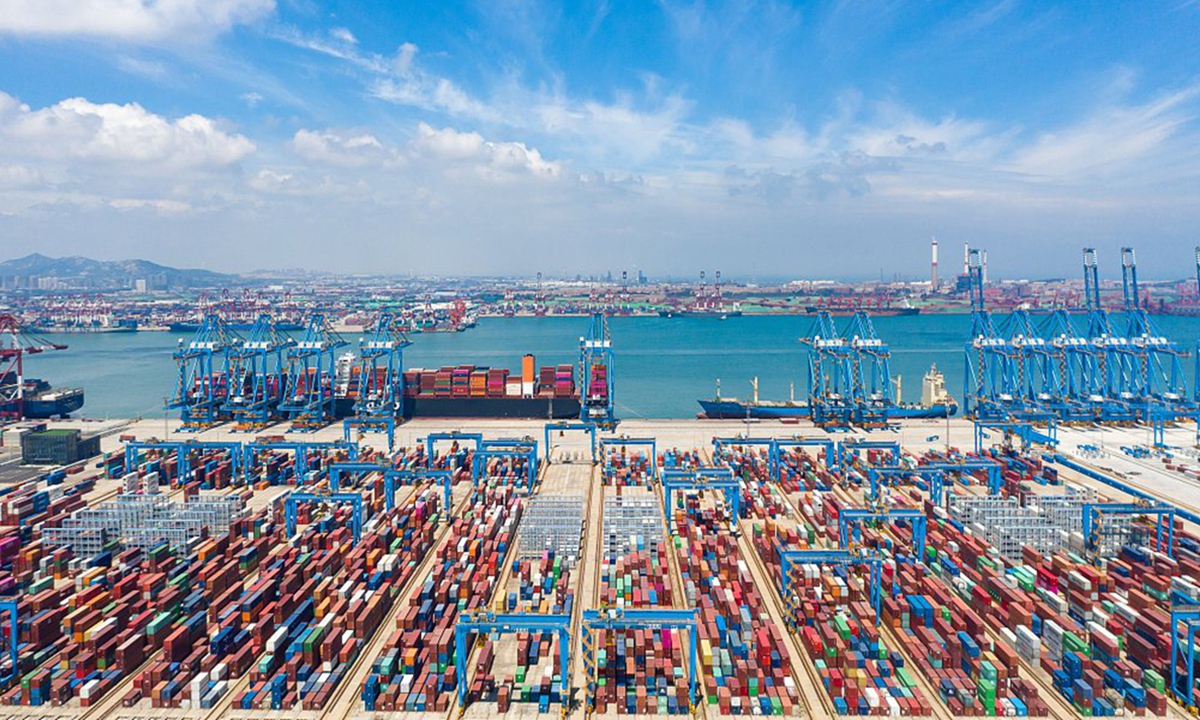
China's goods trade surplus has surpassed $1 trillion for the first time, drawing significant international attention. Some Western media outlets deliberately amplify the narrative of a "historic high" in their reporting, linking China's surplus with false labels such as "dumping" and "overcapacity." They attempt to frame an economic phenomenon as a geopolitical risk, distorting the normal international division of labor into a structural threat. This is a misinterpretation of China's development model and the global division of labor that reflects irrational anxiety and prejudice.Correctly understanding China's trade surplus requires a return to fundamental economic principles and an acknowledgment of the laws of international division of labor and cooperation. A surplus does not equate to "squeezing others out"; rather, China's surplus is the outcome of mutually beneficial cooperation among countries. A significant portion of China's exports represents the model of "produced globally, assembled in China and sold worldwide." A product labeled "Made in China" often incorporates European and US designs, Japanese and South Korean components and raw materials sourced from countries around the globe. According to data from the General Administration of Customs of China, in the first 11 months of 2025, the import and export volume of foreign-invested enterprises accounts for 29.3 percent of China's total foreign trade value, while the import and export volume of processing trade, closely related to global division of labor and cooperation, accounts for 18.8 percent of China's total foreign trade value. This proportion is even higher in highly globalized sectors like electronics and automobiles. This indicates that China's trade surplus also drives production and services in other countries.
Both parties in the import and export process benefit from trade, which is a fundamental requirement for the occurrence of international trade. The generation of the surplus follows economic laws, yet some Western media outlets selectively ignore this and lack a rational understanding of history and these laws. Historically, every era has produced major surplus countries. In the early 19th century, British economist David Ricardo proposed the theory of comparative advantage, emphasizing that countries should leverage their strengths to engage in international division of labor and cooperation. Subsequently, adhering to this economic principle, manufacturing powerhouses, such as Britain, the US, Japan and Germany, became major global exporters of manufactured goods and primary sources of trade surpluses. In reality, China's trade surplus stems from its enhanced manufacturing capabilities, reflecting the rational choices of multinational companies. In fact, China has a deficit in the service trade sector, and for agricultural products and mineral products, imports also exceed exports. Behind these surplus figures lies a highly interconnected global industrial network - not a zero-sum game where one country unilaterally "squeezes others out."
The resilience of China's exports stems from trade partners viewing it as a more stable and reliable choice amid global market uncertainties. The discomfort Western public opinion expresses about China's surplus is, to a large extent, not really about surpluses themselves, but about who is running the surplus. They can tolerate a handful of developed countries long enjoying the dividends of international division of labor and cooperation, yet refuse to acknowledge the comparative advantage earned by a major developing country through its own efforts. They also refuse to face up to the reality of their own structural issues - industrial hollowing-out, excessive financial expansion and social fragmentation. As a result, trade surpluses are no longer viewed as a natural outcome of a particular phase in the global division of labor, but are instead framed as a "symbol of threat."
China's surplus is not something China "enjoys alone"; it also benefits the world. From an innovation perspective, with a comprehensive industrial system and extremely high supply chain coordination efficiency, global innovation entities can quickly complete the entire process from idea and design to prototype, pilot production, and mass production in China. From an industrial perspective, amid geopolitical tensions and other uncertainties, supply chains with China as a key node have maintained strong resilience and recovery capacity, ensuring continued global supplies of pharmaceuticals, essential consumer goods, and critical intermediate products. This has alleviated the supply shocks experienced globally. From a consumer perspective, a large number of Chinese-made daily consumer goods, home appliances, and electronic devices enter households in various countries at high quality and affordable prices, increasing the purchasing power of low- and middle-income groups globally and buffering against multiple rounds of inflationary impacts in recent years.
As a participant in global trade and an active practitioner of multilateral rules, China has never deliberately pursued a trade surplus. However, we also cannot proactively interfere with market choices or hinder exports. Effectively promoting the balance between supply and demand requires all parties in the international community to respect multilateral rules, honor international commitments, reduce various international trade costs - including tariffs and administrative interventions - and create a favorable environment for the efficient allocation of resources. Meanwhile, the strategic focus of China's economic development is to expand domestic demand. To foster a new pattern of development that is focused on the domestic economy and features positive interplay between domestic and international economic flows, one of its key principles is to make the domestic market the primary source of final demand. China is not only the "world's factory" but is also rapidly growing into the "world's market." This process itself is a significant boost to global aggregate demand, providing growth momentum for businesses in various countries.
China's trade surplus has exceeded $1 trillion, reflecting the country's deep engagement in globalization rather than casting a shadow that threatens the world. The surplus itself does not determine the world's direction; rather, it's shaped by how people understand the surplus, how they confront interdependence, and how they choose to deepen cooperation amid structural changes. The debate surrounding China's surplus is essentially a contest of facts and values regarding economic globalization. As long as we return to the underlying economic laws, respect comparative advantage and market logic, and collectively address imbalances through reform and improvement of global governance, China's current surplus can become a significant driving force for revitalizing the world economy and moving toward higher-quality growth.
RELATED ARTICLES