Japanese Defense Minister resorts to sophistry over Chinese notifications during carrier Liaoning’s training; JASDF aircraft intrusion incident’s root cause: expert
By and Liang Rui Published: Dec 10, 2025 01:26 PM

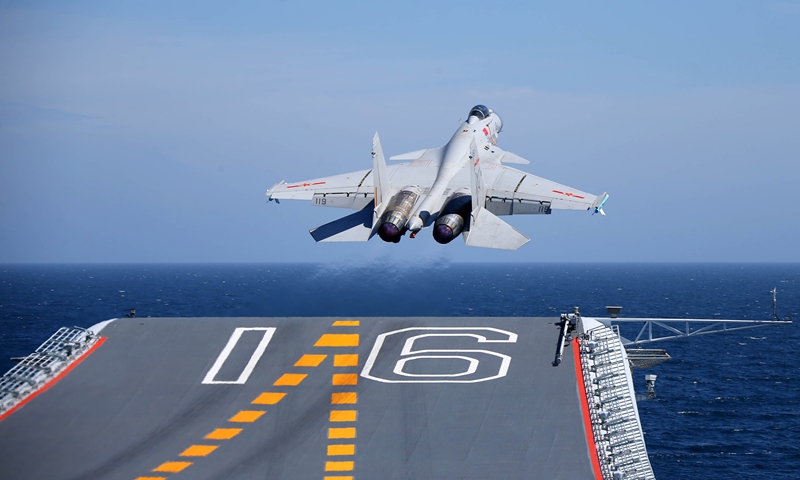
A J-15 carrier-borne fighter jet takes off from the flight deck of the aircraft carrier Liaoning during a maritime training exercise on July 1, 2017. The Chinese aircraft carrier Liaoning and its carrier strike group carried out realistic training in an undisclosed sea area on July 1, 2017. (eng.chinamil.com.cn/Photo by Li Tang)
After official Chinese media released on-site audio about the Chinese side’s notifications from China’s Liaoning aircraft carrier formation ahead of its training, Japanese Defense Minister Shinjiro Koizumi claimed at a press conference on Wednesday that while there were notifications about the start of flight training, they provided insufficient information about the scale or area that could be used for avoiding danger, Japanese media outlet Sankei Shimbun reported on Wednesday.
Wang Yunfei, a Chinese military affairs expert, told the Global Times on Wednesday that the root cause of the incident is the intrusion of Japanese fighter jets into the Chinese side’s legitimate training area, and the Japanese side is resorting to sophistry to misguide the public.
He noted that the Chinese notifications gave detailed information about the location and duration, which are completely professional and conform to international common practices.
Yuyuantantian, a social media account affiliated to China's state broadcaster China Central Television, reported on Tuesday that China provided on-site notifications to the Japanese vessels in the nearby waters in advance, and the Japanese warship confirmed receipt via radio communication.
According to the Yuyuantantian report, at 2:10 pm on Saturday, the Liaoning formation organized the Warship 101 to issue a notification with the message: "Our formation organizes shipborne aircraft flight training as planned." The Japanese destroyer Teruzuki confirmed receipt of the Chinese notification via radio. Then at 2:28 pm, the Liaoning formation organized the Warship 101 to issue another, more detailed notification: "Our formation plans to conduct carrier-based aircraft flight training, expected to commence at 3 pm, lasting approximately 6 hours, primarily in the area south of the aircraft carrier." Subsequently, the Japanese destroyer Teruzuki once again confirmed receipt of our notification via radio.
The Japanese Defense Minister also claimed that the incident was not about whether there were notifications beforehand, but about the “radar illumination,” according to the Sankei Shimbun report.
In response to a question about the so-called “radar illumination,” Guo Jiakun, a Chinese Foreign Ministry spokesperson, said at a regular press conference on Tuesday that “the facts are very clear. China’s exercise and training in relevant waters and airspace fully complies with the international law and international practice. Our maneuvers are professional, standard, and beyond reproach.”
To activate search radar during flight training is commonly done by carrier-based aircraft of all countries. It’s also a normal measure to ensure flight safety, Guo said.
Wang noted that search radar is very different from fire control radar. Unlike fire control radar that enables locking on and weapons guidance, search radar only enables vague detection. He stressed that China’s use of search radar is completely up to standard and does not pose any danger.
The root cause of the whole incident is the Japanese side’s approach and harassment on the Chinese side’s normal and legitimate training, rather than what the Japanese side has claimed, Wang said.
The incident arose from Japanese jets’ deliberate intrusion into China’s exercise and training zones and close-in reconnaissance and disruptions on China’s normal military activities. Yet, the Japanese side blamed it on China and sought to mislead the world by falsely accusing China of “radar illumination.” China deplores and opposes the false accusation and has strongly protested to the Japanese side, said Guo, the Chinese Foreign Ministry spokesperson.
RELATED ARTICLES