IMF raises forecast for China’s 2025 growth to 5%, saying driven by ‘welcome macroeconomic policy stimulus’
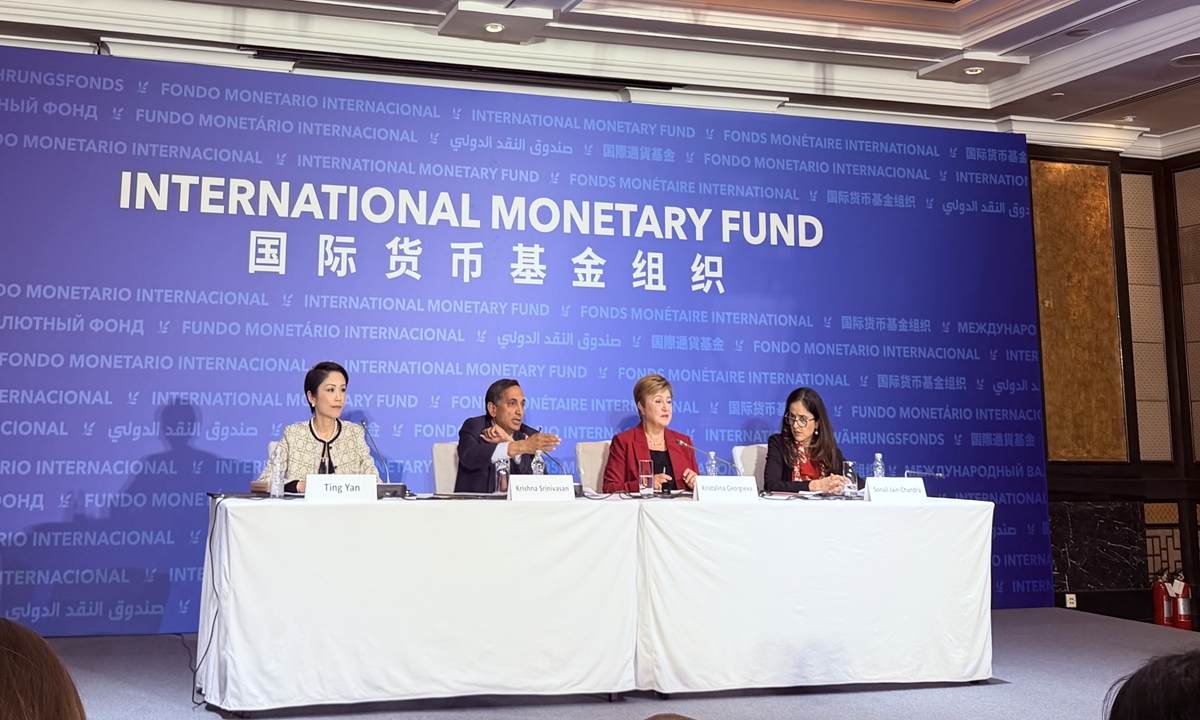
IMF officials attend a press briefing at the conclusion of the 2025 China Article IV Mission in Beijing on December 10, 2025. Photo: Ma Tong/GT
The International Monetary Fund (IMF) has raised its forecast for China's economic growth to 5.0 percent in 2025 and 4.5 percent in 2026, up by 0.2 and 0.3 percentage points from its October World Economic Outlook, IMF Managing Director Kristalina Georgieva said at a press conference in Beijing on Wednesday.
The improved outlook was driven by welcome macroeconomic policy stimulus measures and lower-than-expected tariffs on China's exports, according to IMF.
The announcement came after the IMF team concluded its 2025 Article IV consultation mission to China on Wednesday, following visits to Beijing and Shanghai from December 1 to 10. The team held constructive discussions with senior officials from the government, the People's Bank of China, private sector representatives, and academics on economic developments, risks, and policy priorities, according to an IMF news release sent to the Global Times.
According to the IMF's official description on its website, Article IV consultations are the regular health check of member economies conducted under the IMF's surveillance framework, covering areas such as fiscal, monetary, exchange rate, and financial issues.
"China's economy has shown notable resilience despite facing multiple shocks in recent years. We project growth at 5.0 percent in 2025 and 4.5 percent in 2026. These reflect upward revisions of 0.2 and 0.3 percentage points, respectively, from the IMF's October WEO, driven by recently-announced policy measures and reduced US-China bilateral tariffs," Georgieva said following discussions with Chinese officials on the consultation.
A better balance of Chinese economy internally and externally, also means a stronger and healthier global economy, Georgieva said at the briefing. "China has the opportunity to reach a new stage of development in which its growth edges, which is from investment and exports, to domestic consumption and its economy reorient from goods to services," she noted.
Responding to a question raised by the Global Times about what the IMF sees as the main driver of China's economic growth this year, Georgieva said that the main factor for reaching the around 5 percent growth rate in 2025 remains exports and China's diversified trade partners. "What we have seen is China increasing exports across the board to most regions, with the weak exception of the United States, and doing so on the basis of favorable conditions, including the real exchange rate depreciation that helps Chinese exports become more competitive in 2025," the IMF chief said.
"Anything in 2025 that helps tremendously for good economic performance" will continue to work together with China's fiscal and monetary policy measures, Georgieva said when commenting on another Global Times question about China's "more proactive fiscal policy alongside a moderately loose monetary policy."
The IMF strongly supports the government coming up with fiscal and monetary policy measures to secure the performance of the economy and support the shift toward more domestic consumption, Georgieva said.
"IMF staff agrees that the key policy priority for China is to transition to a consumption-led growth model, away from an overreliance on exports and investment. To support this transition, we recommend a more forceful policy package - implemented with greater urgency, while safeguarding financial stability and tackling debt vulnerabilities," the IMF chief said following discussions with Chinese officials, according to the IMF release.
Two days earlier, IMF on Monday officially launched the operations of its new center in Shanghai, saying the center will play an important role in enhancing the Fund's engagement with the dynamic Asia and Pacific region.
RELATED ARTICLES