Development of new quality productive forces to inject strong momentum to Chinese economy in 2026: experts
By and Zhang Weilan Published: Dec 10, 2025 05:34 PM

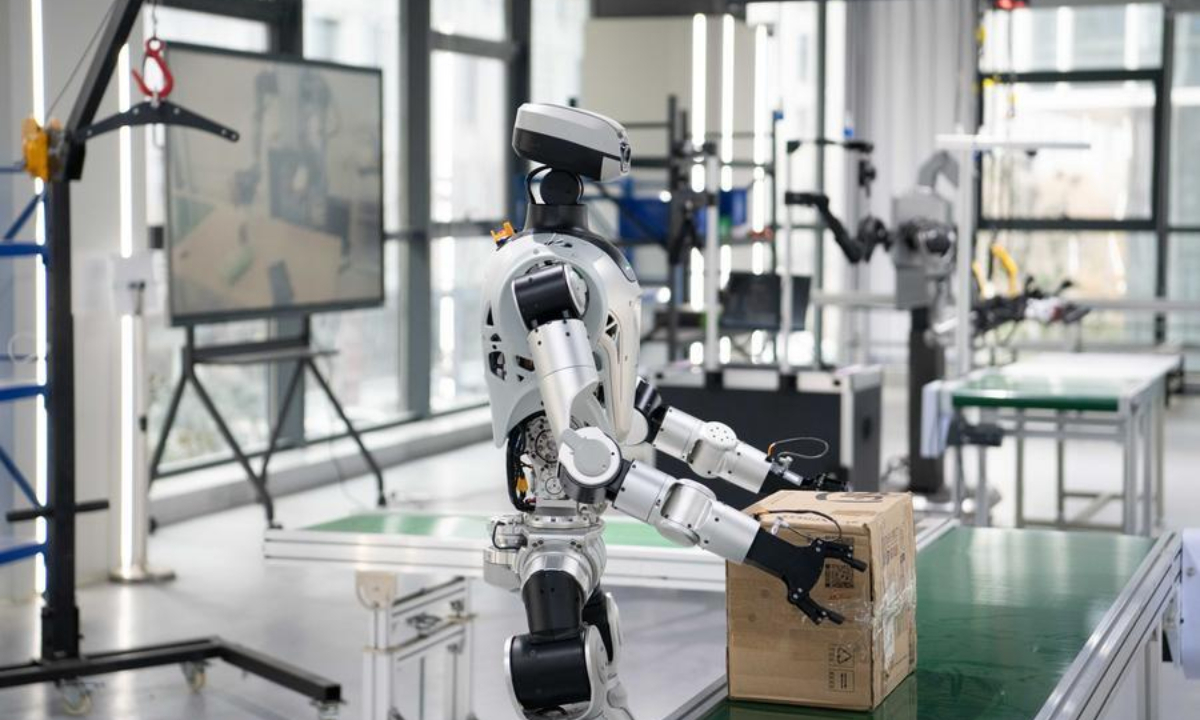
A humanoid robot conducts box-carrying training at a data collection pre-training center for humanoid robots in Hefei, east China's Anhui Province, Dec. 4, 2025. (Xinhua/Zhang Duan)
In Shenzhen, South China's Guangdong Province, full-size industrial humanoid robots are rolling off assembly lines and heading straight to factories — a scene once seen only in the sci-fi film I, Robot.
The same level of dexterity was showcased at the beginning of 2025, when dozens of humanoid robots manage handkerchiefs, a classic element of Yangko dance, on the stage of China's Spring Festival Gala on state broadcaster CCTV. These milestones vividly illustrate the explosive growth and maturing strength of China's robotics industry.
In Hefei, East China's Anhui Province, inside a humming laboratory, stands a striking all-white behemoth — Origin Wukong, China's third-generation domestically developed superconducting quantum computer.
Now running stably, the system has achieved an overall localization rate exceeding 80 percent, which signals that China has essentially forged a complete, independent industrial chain for superconducting quantum computers.
In November, Chinese tech company Alibaba captivated global investors and developers with the launch of Qwen personal artificial intelligence (AI) assistant app - a full-featured, multimodal large language model (LLM) application that represents a sweeping deployment of AI across a range of manufacturing lines. That was only roughly 10 months after DeepSeek's groundbreaking debut at the start of the year, a "Sputnik moment" when the Chinese company's low-cost, high-performance AI model rocked the Silicon Valley.
Likewise, the year of 2025 has witnessed the unprecedented rapid rise of China's homegrown tech innovations, painting a vivid picture of how the world's second-largest economy is ramping up the development of new quality productive forces in the course of its high-quality development journey.
Looking to the new year of 2026, amid the turbulent changes unseen in a century and the accelerating new round of scientific-technological revolution, the country is set to further leverage its unique whole-nation system advantage and concentrate resources on tackling core technologies in multiple fields, industry insiders said.
2025, a milestone
The 2024 Central Economic Work Conference stressed that China should step up efforts to make innovations drive the development of new quality productive forces and build a fairly modernized industrial system.
Wang Peng, an associate researcher at the Beijing Academy of Social Sciences, told the Global Times on Tuesday that 2025 has proven to be the pivotal year for cultivating and developing new quality productive forces.
In the year, China's major technological achievements have dramatically shifted from "scattered sprouts" to "system-wide breakthroughs," Wang said.
China's fast-rising AI industry offers one of the best examples gauging how the development of new quality productive force has been injecting new impetus to the economy.
China has nurtured over 400 national-level "little giant" AI enterprises. Across the country, more than 30,000 basic-level, 1,200 advanced-level, and 230 world-class smart factories have been built, spanning over 80 percent of manufacturing sectors.
These factories have cut average product development cycle by 28.4 percent and boosted production efficiency by 22.3 percent, according to a report on the development of generative AI applications, issued by the China Internet Network Information Center in October.
"The year of 2025 has in fact become the pivotal year for the deeper AI application in China, following the breakthrough development of large-scale models. This year, we have achieved remarkably significant results, with the application of AI delivering outstanding outcomes in a wide range of sectors such as industrial and manufacturing sectors, automobile, healthcare, and education, which in turn profoundly transformed the way of production," Liu Gang, chief economist of the Chinese Institute of New Generation Artificial Intelligence Development Strategies (CINGAI), told the Global Times on Wednesday.
Industry insiders pointed out that in developing new quality productive forces, China has forged a unique roadmap that leverages the country's system advantages to the full play.
In August, China issued a guideline to implement the "AI Plus" initiative, promoting the extensive and in-depth integration of AI across various fields to accelerate the cultivation of new quality productive forces.
The government initiatives also channeled high-quality production factors toward the rapid development of new quality productive forces from a comprehensive perspective.
In 2025, for the first time, China introduced a systematic national framework for cultivating and opening real-time application scenarios — a vital bridge linking scientific discovery with industrial innovation. Also, to garner more talents, Chinese authorities are pushing universities to swiftly launch critically needed programs in AI, quantum technology and other strategic fields, according to a report by state broadcaster CCTV.
"This whole-nation innovation system plays a decisive role in driving growth as it diverts and concentrates resources on making true original innovation and homegrown applications. It helps establish mechanisms that coordinate industrial collaboration and speed up both technological innovation and real-world deployment," Liu said.
A global leader
China is now a global leader in many frontier technologies. According to the World Intellectual Property Organization (WIPO) Global Innovation Index (GII) 2025 report, China has risen to the 10th position in the global innovation ranking in 2025, up one spot from 2024, marking its first entry into the top 10.
"We could see more 'Deepseek moment' for Chinese industries involving new quality productive forces in 2026 - not only in AI LLM but also across other high-tech industries such as semiconductor and intelligent robot as China seeks greater self-reliance on core technology," Tian Feng, president of the Fast Think Institute and former dean of Chinese AI software giant SenseTime's Intelligence Industry Research Institute, told the Global Times on Tuesday.
Tian predicted that, in 2026, China could see the world's first AI agent that surpasses 300 million monthly active users, which is capable of searching and instantly delivering any information of interest, as well as autonomously executing complex, cross-app composite services on behalf of the user.
China has recently unveiled a pivotal document outlining priorities for its 15th Five-Year Plan (2026-30), which emphasizes "achieving greater self-reliance and strength in science and technology" and "steering the development of new quality productive forces" as key objectives for the coming five years, according to a report by the Xinhua News Agency.
Observers said that as a pillar of China's high-quality development, the cultivation and development of new quality productive forces is expected to play an unprecedented prominent role in fuelling high-quality growth in 2026, the beginning year of the 15th Five-Year Plan period (2026-30).
"We will see a markedly mature and well-coordinated modern industrial system taking shape, in which traditional industries are being comprehensively upgraded, strategic emerging industries are scaling up rapidly, and future-oriented industries are being laid out ahead of global peers," Wang noted.
RELATED ARTICLES