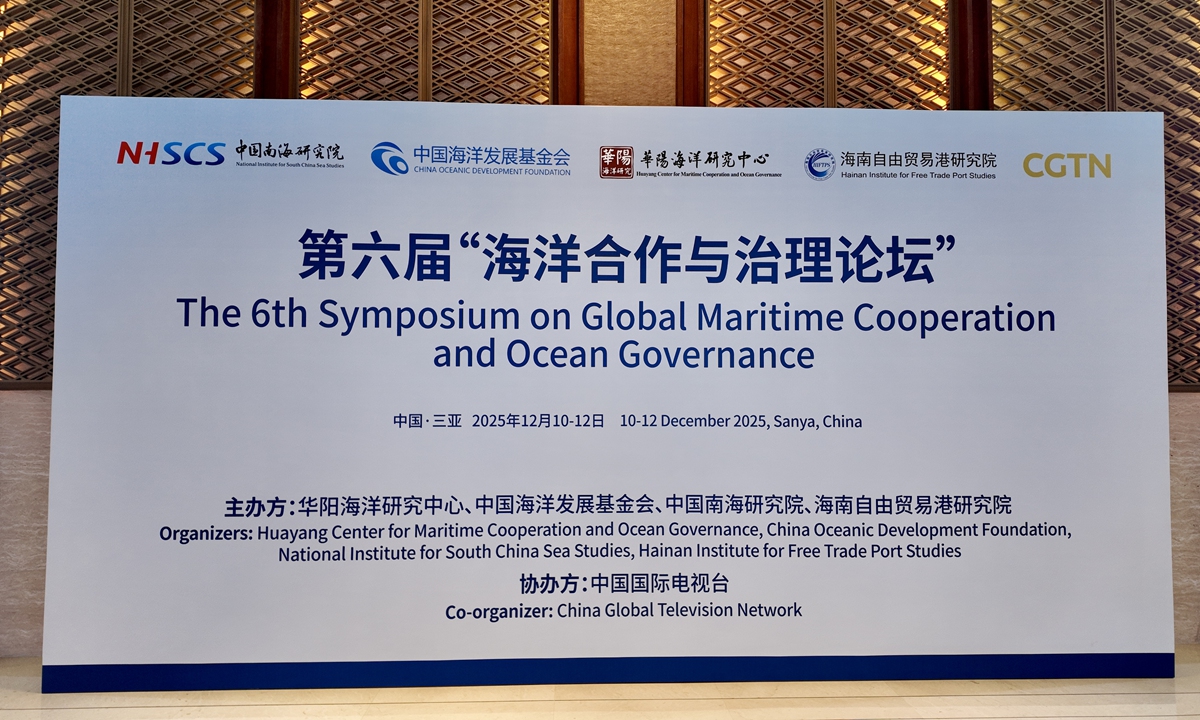
The 6th Symposium on Global Maritime Cooperation and Ocean Governance kicks off on December 10, 2024. Photo: Liu Xuandi/GT
Global ocean governance is one area benefiting from the momentum generated from the Global Governance Initiative (GGI), Chinese Vice Foreign Minister Sun Weidong said in his keynote speech at the 6th Symposium on Global Maritime Cooperation and Ocean Governance in Sanya, South China's Hainan Province, on Wednesday.
Sun stressed the need to uphold international rule of law and build a fair and just maritime order, noting that China has always been a firm defender of and contributor to the rule of law in international maritime affairs. China is taking real actions to realize fair and reasonable regional maritime governance by working with ASEAN countries to fully implement the Declaration on the Conduct of Parties in the South China Sea and to accelerate consultations toward the goal of reaching the Code of Conduct by 2026.
He also emphasized the need to adhere to a people-centered approach. "For the well-being of humanity and the interests of all people, China has been promoting common development of the oceans and upholding common maritime security," Sun said.
Sun further underscored the principle of prioritizing action and deepening mutually beneficial maritime cooperation. He pointed out that China advocates the approach of "setting aside disputes and pursuing joint development," promoting joint maritime development with all its maritime neighbors, as well as practical cooperation in various ocean-related areas.
The Symposium, which kicked off on Wednesday in Sanya, attracted more than 300 participants from over 30 countries and regions, including experts, scholars, former political leaders, senior diplomats from foreign embassies in China and representatives from international organizations and maritime agencies.
During a session titled "Building a Stable and Sustainable Global Ocean Governance System," participating experts agreed that ocean governance must pursue inclusive, win-win outcomes rather than zero-sum competition, and that the principles of the GGI can help strengthen global ocean governance.
"The principles of the GGI serve as important umbrella concepts for multilateral cooperation. Ocean governance had already made considerable progress before the GGI was introduced, and the initiative advances efforts in the same direction," Brantly Womack, senior fellow at the Miller Center of the University of Virginia, told the Global Times on Wednesday.
Womack noted that in a global context where traditional multilateral mechanisms are weakening, initiatives such as the GGI are needed to build a stable and peaceful maritime order that benefits the entire world.
Habib Abiyan Dzakwan, a researcher at the Department of International Relations at the Center for Strategic and International Studies in Indonesia, emphasized that the key task for countries is to translate these principles into actions, which is a shared responsibility for China and other ASEAN member states.
"A lot of activities have been carried out by China in contributing ideas to the development of global maritime norms, including capacity-building programs for many developing countries," said Dzakwan.
"The GGI is a model for the Global South. We should take a people-centered approach, working together toward our shared future instead of drawing lines. Taking climate-related policies for ocean governance as an example, such efforts will benefit people across all sectors and countries," Hugo Santos, an analyst at the Asian Century Philippines Strategic Studies Institute, told the Global Times on Wednesday.
Former Indian Navy vice admiral Shekhar Sinha noted that the GGI aligns with the purposes and principles of the United Nations Charter.
"The GGI proposed by China is a good idea. China has the capability to bring countries together. At the same time, it is very important that whatever is to be done for governance, including global ocean governance, must be done under the UN mechanism, to ensure that everyone's consent is taken," Sinha told the Global Times.
RELATED ARTICLES