ARTS / CULTURE & LEISURE
Leopard cats lived with early inhabitants, domestic cats came via the Silk Road
Tracing China’s earliest ‘feline neighbors’
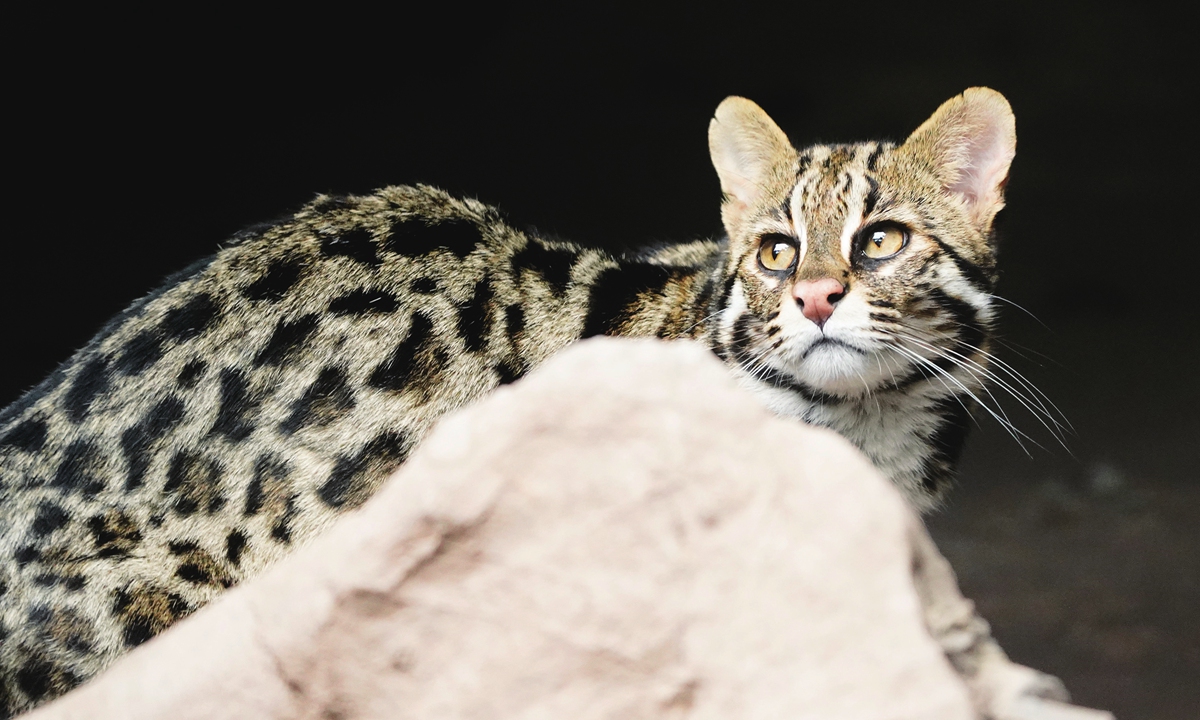
A leopard cat, which is under second-class state protection in China, is seen in Southwest China's Chongqing Municipality on February 26, 2024. Photos: VCG
Today, domestic cats have long become one of the most common pets in Chinese households, in both cities and rural areas.Yet a newly published study of ancient DNA reminds us that the "era of domestic cats" in China may have begun much later than previously imagined.
On November 27, Luo Shujin's team from the School of Life Sciences at Peking University, together with domestic and international collaborators, published in Cell Genomics a study that sequenced 22 ancient cat specimens from 14 Chinese archaeological sites, providing the first comprehensive glimpse into China's "ancient cat history."
"From the Neolithic period 5,400 years ago to the end of the Eastern Han Dynasty (25-220), the 'feline companions' living around China's earlier inhabitants were almost exclusively leopard cats (Prionailurus bengalensis), not domestic cats (Felis catus)," Luo said on Monday.
5,000-year-old cat bone
The story begins in Quanhucun, Northwest China's Shaanxi Province. There, archaeologists uncovered a small cat skeleton dating back more than 5,000 years. The bones were found near houses and grain storage areas, suggesting a close connection with human settlements. For a time, many in the academic community speculated that this might be China's "earliest domestic cat."
However, ancient DNA research led by Luo Shujin's team tells a very different story. Subsequent analyses confirmed that the specimen was not a domestic cat but a leopard cat, a species similar in size to domestic cats and widely distributed across Asia.
To further explore the relationship between ancient cats and humans, the team collected and analyzed 22 small cat bone samples spanning over 5,000 years, from human settlements across China, representing the majority of known ancient feline remains. Using ancient DNA techniques, they successfully sequenced all 22 mitochondrial genomes and seven full genomes.
"Seven of these samples were identified as leopard cats, with dates ranging from 5,400 years ago in the Late Neolithic Yangshao period to 1,800 years ago at the end of the Eastern Han Dynasty. This reveals a close and continuous relationship between leopard cats and humans lasting over 3,500 years," Luo noted.
Yet the leopard cat's presence in the archaeological records was not uninterrupted. Between the end of the Eastern Han Dynasty and the Sui-Tang dynasties (581-907) periods, cat remains suddenly vanish for more than three centuries - a gap that drew the researchers' attention.
"The wars at the end of the Eastern Han Dynasty, coupled with a sharp population decline and the collapse of agricultural systems, likely caused a severe contraction of the habitats on which leopard cats relied," Luo explained. "Leopard cats were never fully domesticated. When their ecological niche disappeared, they naturally retreated to the forests."
Leopard cats then departed, and domestic cats had not yet arrived. This hiatus, in a sense, left room for a new species to enter.
"The true era of domestic cats in China did not begin until the Tang Dynasty (618-907), when they were introduced via Silk Road traders," Luo said.
Arrival of domestic cats
Luo and her team identified 14 domestic cat specimens among their samples, all of which originated from archaeological layers dating to the Tang Dynasty or later, without exception.
The earliest known domestic cat in China was unearthed at the Tongwancheng site in Jingbian, Northwest China's Shaanxi Province. Radiocarbon dating places it as between 706 and 883, spanning the reign of Emperor Xuanzong to the late Tang period - approximately 1,200 years ago, according to the study by the School of Life Sciences and the Institute of Ecology of Peking University.
"Based on historical records and archaeological imagery, it's safe to say the introduction of domestic cats into China likely predates these remains, probably around the 6th to 7th centuries CE," Luo explained.
Where did these cats come from? Genetic analyses reveal a remarkably clear migration path.
"We found that Tang Dynasty domestic cats in China were closely related to contemporaneous domestic cats from the Zankent site in Kazakhstan, as well as African wildcats and domestic cats from the Levant. They form a nearly seamless genetic chain. In other words, China's domestic cats may truly have been Tang Dynasty's 'Silk Road arrivals,'" Luo said.

Primary school students check out a leopard cat specimen during a tour in the Xianju Biodiversity Museum, in Taizhou, East China's Zhejiang Province on July 31, 2022.
Divergent pathsThe research reveals that Leopard cats coexisted with China's early inhabitants for more than 3,500 years, yet they never became domesticated. In contrast, African wildcats were tamed in the Near East and eventually gave rise to the global domestic cat.
"Both species interacted with humans in the early periods, but their fates diverged sharply. Leopard cats ultimately withdrew from human settlements, while domestic cats spread across the globe," Li Ziyao, a Shanghai-based biologist and paleobiology researcher, told the Global Times.
"Ancient DNA results do confirm that these Tang Dynasty samples are indeed domestic cats, but the sample size is still limited, covering only a few archaeological sites. This means our understanding of when domestic cats appeared across all of China may still have gaps," Li noted.
"We cannot rule out the possibility that during the blank period from the late Eastern Han Dynasty to early Tang Dynasty, domestic cats had already quietly appeared in other villages or towns that have yet to be excavated; we just haven't uncovered the archaeological evidence," he said.
Li emphasized that biological research is inherently iterative and self-correcting.
"This study provides extremely valuable clues, but it is more like opening a window onto history rather than offering a final, definitive account of the truth."
"Our research is the first to use ancient genomics to reveal the long-term commensal relationship between leopard cats and ancient Chinese humans," Luo summarized.
"The research highlights the Silk Road's pivotal role in the spread of species."
RELATED ARTICLES