China rides wave of AI-driven smartphone fever
Company open-source AI agent capable of fully operating on smartphone

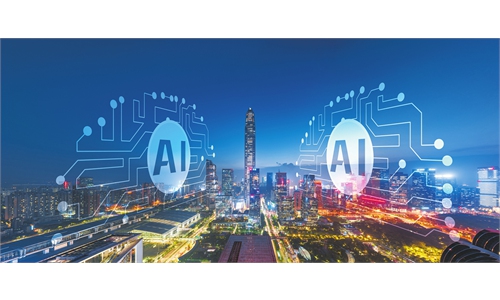
Conceptual diagram of AI Photo: VCG
"One thing we keep closest to us is our smartphone. With AI, it is no longer just 'smart,' and that is exciting. It may even become a friend in the truest sense," a user wrote on Sina Weibo as discussion over phone-based artificial intelligence (AI) surged. But another voice was just as loud: "When I talk about what I need to my phone, will its AI tell everything about me to someone else?"
The discussion followed a Chinese computing firm's move to open-source what it claimed was the first AI agent capable of fully operating a smartphone.
Industry insiders said that the nation's agent-based AI development is shifting from isolated breakthroughs toward broader ecosystem building, though regulatory frameworks will need to keep pace.
Z.AI, a Chinese computing company, on Tuesday open-sourced its core AI agent model known as AutoGLM, according to its official WeChat account. The model is regarded by industry observers as the world's first AI agent with full "phone-use" capabilities, able to reliably execute complex multi-step tasks such as placing food delivery orders or booking flights.
The open-sourcing move allows hardware producers, smartphone vendors and developers to build their own AI assistants on top of AutoGLM, systems capable of interpreting on-screen content and simulating human actions such as tapping, typing and swiping.
This move to open sourcing marks a pivotal shift in China's agent-based AI development from isolated breakthroughs to ecosystem building, said Chen Jing, vice-president of the Technology and Strategy Research Institute. In the AI agent field, China has developed a systemic edge characterized by technological autonomy, application leadership, and open-source momentum, though challenges remain, including ecosystem fragmentation and intensifying global competition, Chen told the Global Times on Wednesday.
This is not the only market sensation surrounding smartphone-based AI in the country this month. The releases built on the momentum generated by the recent launch of AI-enabled smartphones and pushed consumer enthusiasm for discussion to a new peak.
On December 1, ByteDance, in partnership with ZTE Corp, unveiled an AI-powered Doubao phone priced at 3,499 yuan ($492).
The first batch of 30,000 engineering units sold out quickly after release, drawing widespread attention, a source confirmed to the media, according to Chinese technology news outlet IThome.
Doubao is an AI tool developed by ByteDance based on its Lark model architecture.
The launch sparked extensive discussion across the market, with many buyers sharing trial experiences and expressing surprise at the breadth of its capabilities. Others, however, raised concerns about security risks associated with system-level AI on smartphones.
"One time I asked my phone to order pig-trotter noodles, and it complained that I interrupted its process and said the restaurant I preferred 'wasn't good,' then went on to choose another one on its own," a user said in a video posted on Chinese social platform RedNote. Some netizens have even faced challenges to use their phones without touching the screen.
At the same time, many voiced concerns that such a "radically new" experience is not yet governed by sufficient rules. As consumers, they worry that an AI system capable of opening apps at will could expose them to privacy and data-leak risks, especially financial risks.
On December 5, Doubao mobile phone assistant said in a statement that it plans to introduce standardized adjustments to its AI phone-operation capabilities in certain scenarios and will work with manufacturers to develop clearer guidelines, the Beijing News reported.
According to the official statement, the adjustments focus on three areas: limiting automated actions used to boost scores or rewards in various apps to preserve "genuine user interaction"; further restricting AI-assisted operations in banking and online payment applications; and suspending AI use in certain competitive gaming scenarios to safeguard fairness, said the Beijing News.
System-level AI agents operating in highly sensitive scenarios must be governed under principles of technical controllability, legal clarity and ethical constraints, with a dynamic regulatory framework built around them, Chen noted. "This will require industry practice and regulatory exploration to advance in parallel, rather than expecting a one-step solution."
Chen suggested several principles for future governance. One approach is to establish explicit authorization mechanisms. For example, when an AI system invokes accessibility permissions, it should require dual consent — both at the system level and the application level. Sensitive actions involving payments or financial services should rely on whitelists and secondary confirmations, with silent execution strictly prohibited.
Chen said that the next two to three years will be a critical window in shaping China's smartphone AI ecosystem. With unified protocol standards, stronger autonomy in foundational models and faster application-level adoption, China is well-positioned to secure a leading role in the global AI agent race, he noted.
As of Tuesday, AutoGLM already supported core scenarios across more than 50 high-frequency Chinese apps, including WeChat, Taobao, Douyin and Meituan, IThome reported.
RELATED ARTICLES