Multiple global institutions lift China’s GDP forecasts; Projections underscore nation’s stabilizing role in global economy: expert
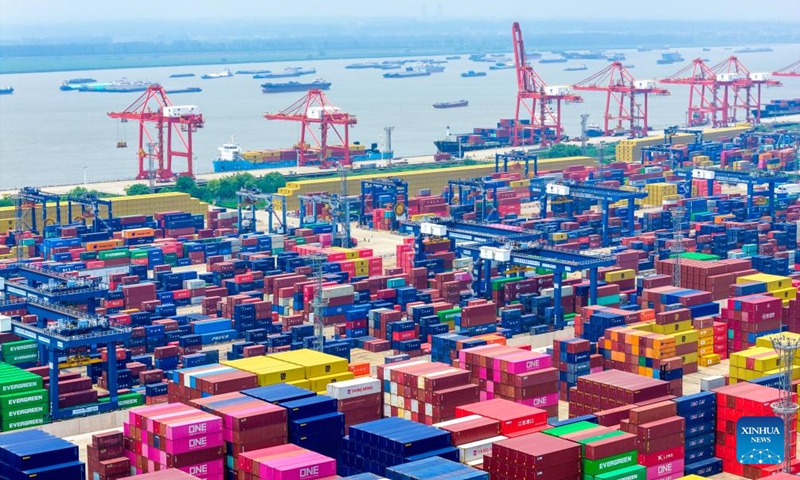
This aerial drone photo taken on July 10, 2025 shows a view of Longtan Container Terminal of Nanjing Port in Nanjing, east China's Jiangsu Province. China's maritime industry now handles nearly one-third of global maritime shipping volume, according to the 2025 China Maritime Day Forum held in the coastal town of Boao in south China's Hainan Province on Friday. China's booming marine economy is driving sustained and stable growth in global trade and development. (Photo: Xinhua)
As year 2025 comes to an end, a growing number of international organizations and foreign financial institutions have successively upgraded China GDP forecasts, underlining increasing confidence in the world's second-largest economy. Chinese economists believe that China will continue to be an anchor of certainty and a driving force in the global economy that faces heighted uncertainties in 2026, injecting valuable certainties and stability to the world with its solid economic fundamentals, sufficient policy tools and structural upgrading.
The International Monetary Fund (IMF) on Wednesday released its latest World Economic Outlook report in Beijing, upgrading China's economy to 5.0 percent in 2025 and 4.5 percent in 2026. These projections reflect an upward revision of 0.2 and 0.3 percentage points respectively, compared to its forecast made in October, which the organization said is driven by the country's welcome macroeconomic policy stimulus measures and lower-than-expected tariffs on China's exports.
The Asian Development Bank (ADB) on Wednesday raised its 2025 economic growth forecast for China by 0.1 percentage points, citing resilient exports and continued fiscal stimulus in the world's second-largest economy, the Xinhua News Agency reported.
Earlier on December 2, the Organization for Economic Cooperation and Development (OECD) raised China's GDP forecast for 2025 to 5 percent, up by 0.1 percentage point compared with its previous projection in September.
Looking ahead to 2026 - the first year of the 15th Five-Year Plan (2026-30) - financial heavyweight Standard Chartered raised its forecast for China's 2026 GDP growth to 4.6 percent from 4.3 percent, supported by the country's gains in total factor productivity (TFP) and resilient exports, according to a note the bank sent to the Global Times.
"We expect exports to stay resilient and policy to continue to support domestic demand, especially consumption," analysts wrote in the note. China's TFP gains should continue to fuel growth, aided by rapid artificial intelligence (AI) adoption, it noted.
"These adjustments highlight those international organizations' recognition of China as an anchor of certainty for global economic growth, supported by the country's unique advantages in many areas, strong resilience and great potential," Yu Miaojie, president of Liaoning University, told the Global Times on Wednesday.
Unique advantages
China's economy has institutional advantages as a socialist market economy, demand advantages due to its vast market, supply advantages thanks to a well-developed industrial system, and talent advantages with an annual output of five million STEM (science, technology, engineering and mathematics) graduates, which ensure the sustainable development of the world's second-largest economy and make it an anchor of certainty and stability for the world economy, Yu said.
The institutional strength of socialism with Chinese characteristics - underpinned by the Communist Party of China (CPC)'s overall leadership - the ability to mobilize resources for major undertakings, and the combination of an efficient market and a well-functioning governance provide a strong guarantee for high-quality development, Yu said.
The Political Bureau of the CPC Central Committee on Monday held a meeting to analyze and study the economic work of 2026 and review a set of regulations on the CPC's leadership of law-based governance in all respects, according to Xinhua.
The meeting emphasized that next year's economic work should adhere to the principles of pursuing progress while ensuring stability and improving both quality and effectiveness, and continue to implement a more proactive fiscal policy alongside a moderately loose monetary policy.
"China's targeted macro policies, along with economic structural upgrading driven by the accelerated development of new quality productive forces, are expected to underpin the stable and sound development of China's economy in 2026 and longer term," Cao Heping, an economist at Peking University, told the Global Times on Wednesday.
China's technological advancements have also made foreign financial institutions re-assess China assets. "China's tech sector stands out as a top global opportunity. Strong liquidity, retail flow, and earnings expected to rise to 37 percent in 2026, should sustain momentum for Chinese equities," according to a note from UBS Global Wealth Management's Chief Investment Office on Wednesday.
Talking about the advantages and significance of the Chinese market for foreign enterprises, Chris Torrens, Chair of the British Chamber of Commerce in China, told the Global Times in an interview on Tuesday that China has scale. It is a huge market with extensive manufacturing, and there is a major advantage to "having your consumer close to your production."
"In a period marked by market volatility and growing protectionist tendencies in certain economies, China's commitment to multilateralism, free trade, inclusiveness and support for WTO reform offers crucial strategic stability to the international system," Denis Depoux, global managing director of consulting firm Roland Berger, told the Global Times on Wednesday.
Despite rising geopolitical tensions and trade barriers from certain Western countries, China maintains its dominance position in global manufacturing supply chains, accounting for around 30 percent of global manufacturing output, and exports remain a critical driver for China's growth, Depoux said.
Despite global uncertainties, China's total goods imports and exports in yuan-denominated terms rose to 41.21 trillion yuan ($5.82 trillion) in the first 11 months of 2025, up 3.6 percent year-on-year, according to the General Administration of Customs.
Certainty from policy-making
The predictability of the Chinese economy through top-down planning is also encouraging. For Torrens, part of that predictability comes from the foundations of the Chinese economy, which he says are "based on a planned economic system," reflected in the five-year plans.
"When I first started working in China in the late 1980s and early 1990s, the Five-Year Plan was not a document I paid close attention to... Today, however, the predictability and sense of stability it provides are widely welcomed around the world," Torrens said.
During the 14th Five-Year Plan (2021-25), China's total economic volume successively surpassed the thresholds of 110 trillion yuan, 120 trillion yuan and 130 trillion yuan, and is projected to reach around 140 trillion yuan this year, maintaining a contribution rate of about 30 percent to global economic growth. Behind this remarkable performance lies the confidence and composure of the CPC in governing this super-large country through five-year plans, according to an article in the People's Daily on Wednesday.
In late October, the CPC leadership adopted its recommendations for formulating the 15th Five-Year Plan, outlining seven-pronged objectives to steer the country's development through 2030. These objectives span high-quality development, scientific and technological innovation, reform, cultural and ethical progress, people's well-being, ecological conservation, and national security, according to Xinhua.
"China's five-year economic plans are a powerful embodiment of the continuity of its policies and a prominent strength of China's governance. By formulating and implementing five-year plans, the CPC is better positioned to seize the initiative in history, and continue to advance Chinese modernization in depth with unwavering strategic resolve, a holistic strategic vision and the determined drive to deliver on set goals," Cao said.
RELATED ARTICLES