IN-DEPTH / IN-DEPTH
Ecological Code of the Snowy Plateau: Ecological migrants on Qinghai-Xizang Plateau chase happiness, nurture green harmony with nature
By in Yushu Published: Dec 11, 2025 09:52 PM

Editor's Note:
Xi Jinping, general secretary of the Communist Party of China (CPC) Central Committee and Chinese president, has stressed that the environment concerns the well-being of people in all countries. Xi has always paid great attention to ecosystems, spanning from cities to rural areas, and from enterprises to communities.
Under the guidance of Xi's thought on ecological civilization, China has been advancing the green transition of its economy over the last decade. Regions across the country are actively promoting the construction of ecological civilization and advancing Chinese modernization featuring harmony between humanity and nature. These efforts are creating a "Beautiful China."
Therefore, the Global Times is launching a series of stories to explore the progress of ecological civilization projects that Xi is concerned with, delving into the positive environmental changes occurring now, and offering valuable insights and references for both national and global efforts. From these practical examples, we can see how Xi's thought on ecological civilization is put into practice and further inspires public action.
In this issue, we turn our attention to the "roof of the world" - the Qinghai-Xizang Plateau - to examine the state of ecological conservation there in this three-part series titled "Ecological Code of the Snowy Plateau - Decoding China's Real Answers on Protecting the Qinghai-Xizang Plateau." In response to the biased perspectives and deliberate distortions in international discourse regarding the region's ecology and environment, this series is the result of an independently planned and systematically organized effort, grounded in firsthand field research and vivid stories.
In the first installment, we visit the homes of ecological migrants in the Sanjiangyuan area to learn how they coexist with nature.

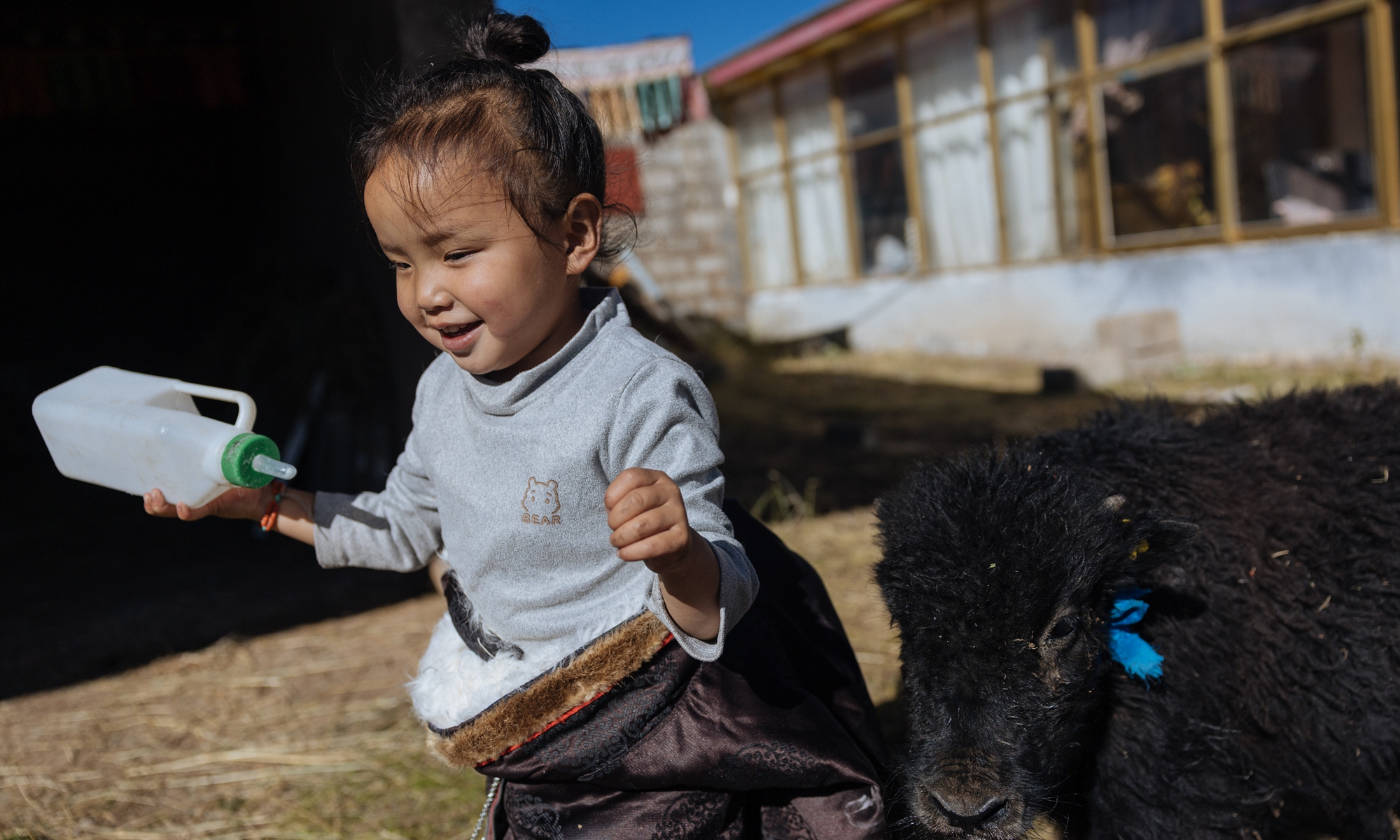
Small plumes of smoke gently rise from a kitchen, carried along by the early morning breeze, while Purung Qiaqa, who is in his 60s, feeds firewood into the stove. In the yard, a months-old yak calf moos, while Purung's four-year-old granddaughter, Yutso, clumsily yet earnestly moves a milk bottle toward the calf's mouth.
To the little girl, the yak is her best playmate. To Purung, it is a memory from the high-altitude pasturelands - one that has now been brought into the town.
Purung and his family have lived in their new home on the outskirts of Zhidoi County for over a decade. In 2007, the family sold part of their livestock and pasture, relocating from Yaqu village in Sokya Township - at an altitude of more than 4,700 meters - to an ecological relocation community on the eastern edge of Zhidoi County, Yushu Tibetan Autonomous Prefecture in Northwest China's Qinghai Province.
That year marked a critical phase in the ecological protection of Sanjiangyuan and the beginning of large-scale ecological relocation for herders from Sokya Township.
Purung recalls that the government had already built uniformly planned houses and courtyards for them in advance. Each household received a 25,000-yuan ($3,500) subsidy for retiring from herding and returning from the grasslands, along with fuel and living allowances.
"I never doubted the policy, and I've never regretted it," he told the Global Times.
For his family, this move represented not only a shift in lifestyle, but also a rearrangement of fate for the next generation. The children no longer need to cross frozen mountain passes to attend school, and seniors no longer have to endure days of bumpy travel to receive medical care. With stable incomes, convenient living conditions, and a familiar community, Purung believes "this was the right path."
Beyond the household level, the relocation carries a broader significance - it returns grasslands to nature, creating space for ecological restoration in Sanjiangyuan.
Chinese President Xi Jinping underlined the importance of preserving the Sanjiangyuan and the "water tower of China" to make sure water there is clear when joining a deliberation with lawmakers from Qinghai at the annual meeting of the National People's Congress in 2016, the Xinhua News Agency reported. "We should protect the environment like we protect our eyes, and treat the environment like we treat our lives," he said during the deliberation.
According to information provided to the Global Times by the administration bureau of the Sanjiangyuan National Park, since the launch of the national park pilot program in 2016, grassland vegetation coverage has increased by 8.6 percentage points, forage yield during the growing season has risen by 13.1 percent, and the area of typical lakes has expanded by about 11.5 percent. The source region, known as the "water tower of China," is gradually regaining its ecological resilience.
In Sanjiangyuan, ecological relocation is not merely a change in lifestyle - it is a "guardian's choice."
A family's journey
The yak calf, now well-fed, quiets down in the sun.
It was born this year in the pastureland of Sokya Township, at an average elevation of 4,700 meters. Due to its weakness, the family brought it down to town for better care. The granddaughter walks into the house and picks an orange from a plate to give to her grandfather. Purung accepts it, his face lighting up with a satisfied smile that reflects his contentment with life at present.
In 2007, the family relocated from Yaqu village to the new community on the eastern edge of Zhidoi. At the time, his family owned over 500 sheep and more than 100 yaks. For the move, most of the livestock were sold, and only a few dozen yaks remained. Their pastureland was reduced by 50 to 60 percent. "Retiring from herding and returning grasslands is national policy - we all followed it," he said.
Purung said that in the past, life on the pasture meant hardships in accessing education and medical care. Now, both services have improved significantly, and their home has expanded from over 60 square meters to more than 100 square meters, fully equipped with modern amenities. Traditional Tibetan furniture remains, but now shares space with a TV, refrigerator, and other modern appliances.
Their relocation community is now home to more than 200 herding families.
To Purung, the changes over the past decade can be summed up in one word: "Satisfaction." His only wish now is for his recently graduated daughter to quickly "find a job in town."
New roles in green development
From Purung courtyard, facing westward leads to the road toward Hoh Xil in the heart of Sanjiangyuan. Many people took this road to move into the town. For many herders, leaving the pasture didn't mean saying goodbye to the grasslands - but rather the beginning of a new way to protect them.
Thirty-year-old Changpa is an ecological ranger from Sokya Township. Wearing his navy blue Sanjiangyuan National Park jacket year-round, he travels between the county seat and the pastures to monitor ecological changes like grassland degradation and water pollution. The journey that now takes three hours by car used to take five to six days on foot in his childhood.
"My family and some relatives have moved to the county seat. Everyone feels that the policies are getting better, and life is becoming more convenient," Xiangba said. After graduating from university, he chose to return home to work in ecological protection. "I hope my children will also get to see the grasslands at their most beautiful."
His story is a microcosm of the broader ecological governance system in Sanjiangyuan. To strengthen herders' primary role in ecological protection, the national park pilot program established a "one position per household" model for public-benefit ecological ranger posts.
More than 17,000 herders have laid down their herding tools to become ecological guardians, each earning an additional 21,600 yuan per year.
Ecological relocation has not only eased grassland overcapacity, but also created development opportunities for herders. Citing a plan by the State Council referenced in the journal Ethno-National Studies, over 55,000 herders relocated in the early stages of the pilot, through a model of "government guidance, herder voluntarism." This institutional arrangement has helped them transition away from extensive nomadic lifestyles toward penned livestock raising and engagement in the secondary and tertiary industries.
In Moqu village, a cooperative in ecological animal husbandry transformed the traditional family-based herding model into a shareholding operation. Herders contribute their livestock as shares, receiving dividends or wages by working in the cooperative.
Guarding a pristine land
In some external narratives, ecological relocation is deliberately smeared as a "forced departure" from ancestral lands, as though herders must painfully choose between tradition and modernity. In reality, retiring from herding has allowed grasslands to breathe, and relocation has brought hope to many. With new roles, cooperatives, and technology, herders have not been "marginalized" - they've become indispensable to ecological protection.
At the center pillar of Purung's living room hangs a portrait of Sonam Dargye - a common sight in nearly every household in Sokya Township. Sonam Dargye, a native of Moqu village, once served as secretary of the western working committee in Zhidoi County.
In the 1990s, he ventured deep into Hoh Xil to combat poaching and protect Tibetan antelopes. He was tragically killed during one such mission at the age of 32 and is hailed as the "ecological guardian of the Qinghai-Tibet Plateau."
"Our generation grew up hearing his story," said Karwang Dorje, deputy Party secretary of Sokya Township. "People here know that these grasslands and water sources were protected at the cost of others' lives. That's why Sonam Dargye's spirit deserves to be passed down from generation to generation."
Located in the core area of the Sanjiangyuan National Nature Reserve, Sokya Township sits at an altitude of 4,500 to 5,000 meters. Harsh as the climate is, the land nurtures abundant natural resources. Local officials and residents alike uphold the principle of ecological priority.
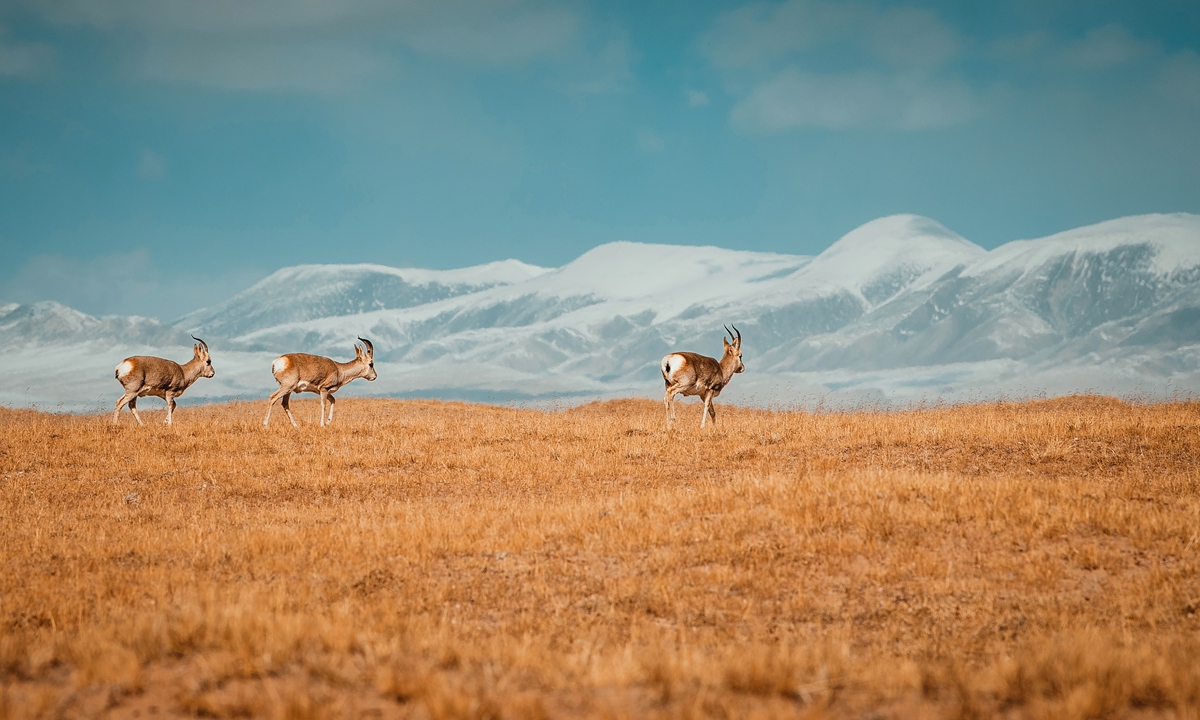
Such emotional ties, stretching from families to communities, help herders understand and embrace policies such as retiring from herding, ecological ranger jobs, and ecological relocation.
According to the administrative bureau, in the past decade, biodiversity in the Sanjiangyuan region has significantly improved, with populations of rare and endangered species increasing markedly: Tibetan antelopes have rebounded from fewer than 20,000 to over 70,000, Przewalski's gazelles from over 300 to more than 2,700.
The story of Sanjiangyuan continues, like the river waters flowing endlessly. For herders in Sokya Township, the legacy - from Sonam Dargye's devotion to generations of ecological rangers - has become a shared sense of responsibility passed down through time.
In Purung's courtyard, the calf from the pasture is growing strong. For his granddaughter, Yutso, "ecological relocation" may still be an unfamiliar term, but she knows the calf will grow, the grasslands will turn green again, and one day, she will gain knowledge in school - enough to tell the story of her homeland to people far and wide.
Xi Jinping, general secretary of the Communist Party of China (CPC) Central Committee and Chinese president, has stressed that the environment concerns the well-being of people in all countries. Xi has always paid great attention to ecosystems, spanning from cities to rural areas, and from enterprises to communities.
Under the guidance of Xi's thought on ecological civilization, China has been advancing the green transition of its economy over the last decade. Regions across the country are actively promoting the construction of ecological civilization and advancing Chinese modernization featuring harmony between humanity and nature. These efforts are creating a "Beautiful China."
Therefore, the Global Times is launching a series of stories to explore the progress of ecological civilization projects that Xi is concerned with, delving into the positive environmental changes occurring now, and offering valuable insights and references for both national and global efforts. From these practical examples, we can see how Xi's thought on ecological civilization is put into practice and further inspires public action.
In this issue, we turn our attention to the "roof of the world" - the Qinghai-Xizang Plateau - to examine the state of ecological conservation there in this three-part series titled "Ecological Code of the Snowy Plateau - Decoding China's Real Answers on Protecting the Qinghai-Xizang Plateau." In response to the biased perspectives and deliberate distortions in international discourse regarding the region's ecology and environment, this series is the result of an independently planned and systematically organized effort, grounded in firsthand field research and vivid stories.
In the first installment, we visit the homes of ecological migrants in the Sanjiangyuan area to learn how they coexist with nature.
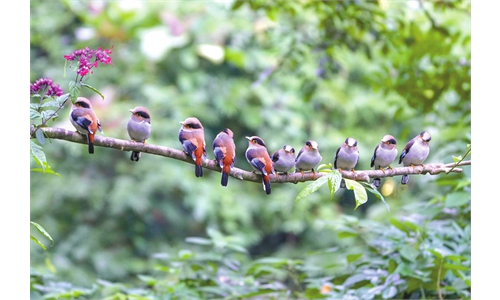
A scenic view of Sanjiangyuan, the source region of the Yangtze, Yellow, and Lancang rivers, in Northwest China's Qinghai Province. Photo: VCG
In the eastern part of Zhidoi County in late autumn, as the morning mist lingers, a warm little courtyard is already awake.Small plumes of smoke gently rise from a kitchen, carried along by the early morning breeze, while Purung Qiaqa, who is in his 60s, feeds firewood into the stove. In the yard, a months-old yak calf moos, while Purung's four-year-old granddaughter, Yutso, clumsily yet earnestly moves a milk bottle toward the calf's mouth.
To the little girl, the yak is her best playmate. To Purung, it is a memory from the high-altitude pasturelands - one that has now been brought into the town.
Purung and his family have lived in their new home on the outskirts of Zhidoi County for over a decade. In 2007, the family sold part of their livestock and pasture, relocating from Yaqu village in Sokya Township - at an altitude of more than 4,700 meters - to an ecological relocation community on the eastern edge of Zhidoi County, Yushu Tibetan Autonomous Prefecture in Northwest China's Qinghai Province.
That year marked a critical phase in the ecological protection of Sanjiangyuan and the beginning of large-scale ecological relocation for herders from Sokya Township.
Purung recalls that the government had already built uniformly planned houses and courtyards for them in advance. Each household received a 25,000-yuan ($3,500) subsidy for retiring from herding and returning from the grasslands, along with fuel and living allowances.
"I never doubted the policy, and I've never regretted it," he told the Global Times.
For his family, this move represented not only a shift in lifestyle, but also a rearrangement of fate for the next generation. The children no longer need to cross frozen mountain passes to attend school, and seniors no longer have to endure days of bumpy travel to receive medical care. With stable incomes, convenient living conditions, and a familiar community, Purung believes "this was the right path."
Beyond the household level, the relocation carries a broader significance - it returns grasslands to nature, creating space for ecological restoration in Sanjiangyuan.
Chinese President Xi Jinping underlined the importance of preserving the Sanjiangyuan and the "water tower of China" to make sure water there is clear when joining a deliberation with lawmakers from Qinghai at the annual meeting of the National People's Congress in 2016, the Xinhua News Agency reported. "We should protect the environment like we protect our eyes, and treat the environment like we treat our lives," he said during the deliberation.
According to information provided to the Global Times by the administration bureau of the Sanjiangyuan National Park, since the launch of the national park pilot program in 2016, grassland vegetation coverage has increased by 8.6 percentage points, forage yield during the growing season has risen by 13.1 percent, and the area of typical lakes has expanded by about 11.5 percent. The source region, known as the "water tower of China," is gradually regaining its ecological resilience.
In Sanjiangyuan, ecological relocation is not merely a change in lifestyle - it is a "guardian's choice."
A family's journey
The yak calf, now well-fed, quiets down in the sun.
It was born this year in the pastureland of Sokya Township, at an average elevation of 4,700 meters. Due to its weakness, the family brought it down to town for better care. The granddaughter walks into the house and picks an orange from a plate to give to her grandfather. Purung accepts it, his face lighting up with a satisfied smile that reflects his contentment with life at present.
In 2007, the family relocated from Yaqu village to the new community on the eastern edge of Zhidoi. At the time, his family owned over 500 sheep and more than 100 yaks. For the move, most of the livestock were sold, and only a few dozen yaks remained. Their pastureland was reduced by 50 to 60 percent. "Retiring from herding and returning grasslands is national policy - we all followed it," he said.
Four-year-old Yutso plays with a yak calf in the courtyard of her family in Zhidoi County, Northwest China's Qinghai Province, in October 2025. Photo: Li Hao/GT
Now, the seven-member household enjoys a stable life. His two sons still work on the pasture in their hometown. One of them has become an ecological ranger under the national park pilot program, responsible for patrolling and documenting wildlife and water source changes, earning an annual income of 21,600 yuan. Seniors and minors in the family receive annual subsidies of 5,600 yuan per person, and additional fuel subsidies during winter.Purung said that in the past, life on the pasture meant hardships in accessing education and medical care. Now, both services have improved significantly, and their home has expanded from over 60 square meters to more than 100 square meters, fully equipped with modern amenities. Traditional Tibetan furniture remains, but now shares space with a TV, refrigerator, and other modern appliances.
Their relocation community is now home to more than 200 herding families.
To Purung, the changes over the past decade can be summed up in one word: "Satisfaction." His only wish now is for his recently graduated daughter to quickly "find a job in town."
New roles in green development
From Purung courtyard, facing westward leads to the road toward Hoh Xil in the heart of Sanjiangyuan. Many people took this road to move into the town. For many herders, leaving the pasture didn't mean saying goodbye to the grasslands - but rather the beginning of a new way to protect them.
Thirty-year-old Changpa is an ecological ranger from Sokya Township. Wearing his navy blue Sanjiangyuan National Park jacket year-round, he travels between the county seat and the pastures to monitor ecological changes like grassland degradation and water pollution. The journey that now takes three hours by car used to take five to six days on foot in his childhood.
"My family and some relatives have moved to the county seat. Everyone feels that the policies are getting better, and life is becoming more convenient," Xiangba said. After graduating from university, he chose to return home to work in ecological protection. "I hope my children will also get to see the grasslands at their most beautiful."
His story is a microcosm of the broader ecological governance system in Sanjiangyuan. To strengthen herders' primary role in ecological protection, the national park pilot program established a "one position per household" model for public-benefit ecological ranger posts.
More than 17,000 herders have laid down their herding tools to become ecological guardians, each earning an additional 21,600 yuan per year.
Ecological relocation has not only eased grassland overcapacity, but also created development opportunities for herders. Citing a plan by the State Council referenced in the journal Ethno-National Studies, over 55,000 herders relocated in the early stages of the pilot, through a model of "government guidance, herder voluntarism." This institutional arrangement has helped them transition away from extensive nomadic lifestyles toward penned livestock raising and engagement in the secondary and tertiary industries.
In Moqu village, a cooperative in ecological animal husbandry transformed the traditional family-based herding model into a shareholding operation. Herders contribute their livestock as shares, receiving dividends or wages by working in the cooperative.
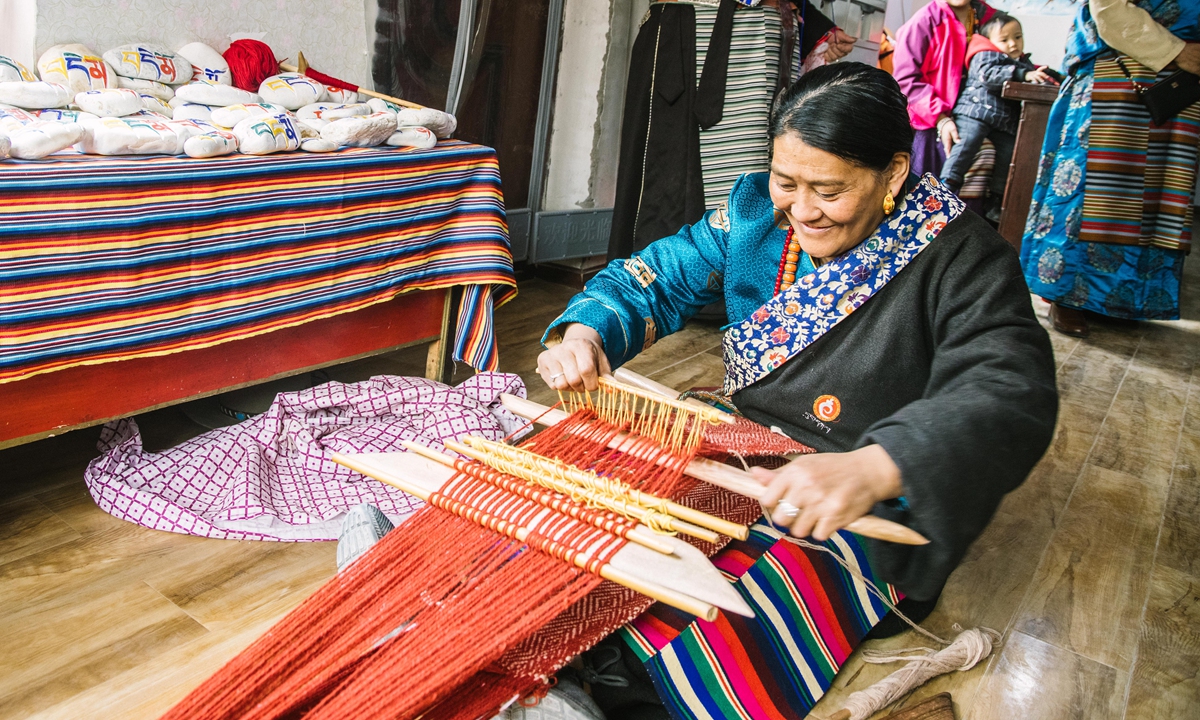
A villager weaves Pulu - a Tibetan traditional woolen fabric - in Changjiangyuan Village, an eco-migration settlement in Golmud, Northwest China's Qinghai Province in March 2019. Photo: Li Hao/GT
Guarding a pristine land
In some external narratives, ecological relocation is deliberately smeared as a "forced departure" from ancestral lands, as though herders must painfully choose between tradition and modernity. In reality, retiring from herding has allowed grasslands to breathe, and relocation has brought hope to many. With new roles, cooperatives, and technology, herders have not been "marginalized" - they've become indispensable to ecological protection.
At the center pillar of Purung's living room hangs a portrait of Sonam Dargye - a common sight in nearly every household in Sokya Township. Sonam Dargye, a native of Moqu village, once served as secretary of the western working committee in Zhidoi County.
In the 1990s, he ventured deep into Hoh Xil to combat poaching and protect Tibetan antelopes. He was tragically killed during one such mission at the age of 32 and is hailed as the "ecological guardian of the Qinghai-Tibet Plateau."
"Our generation grew up hearing his story," said Karwang Dorje, deputy Party secretary of Sokya Township. "People here know that these grasslands and water sources were protected at the cost of others' lives. That's why Sonam Dargye's spirit deserves to be passed down from generation to generation."
Located in the core area of the Sanjiangyuan National Nature Reserve, Sokya Township sits at an altitude of 4,500 to 5,000 meters. Harsh as the climate is, the land nurtures abundant natural resources. Local officials and residents alike uphold the principle of ecological priority.
A scenic view of Sanjiangyuan, the source region of the Yangtze, Yellow, and Lancang rivers, in Northwest China's Qinghai Province. Photo: VCG
Such emotional ties, stretching from families to communities, help herders understand and embrace policies such as retiring from herding, ecological ranger jobs, and ecological relocation.
According to the administrative bureau, in the past decade, biodiversity in the Sanjiangyuan region has significantly improved, with populations of rare and endangered species increasing markedly: Tibetan antelopes have rebounded from fewer than 20,000 to over 70,000, Przewalski's gazelles from over 300 to more than 2,700.
The story of Sanjiangyuan continues, like the river waters flowing endlessly. For herders in Sokya Township, the legacy - from Sonam Dargye's devotion to generations of ecological rangers - has become a shared sense of responsibility passed down through time.
In Purung's courtyard, the calf from the pasture is growing strong. For his granddaughter, Yutso, "ecological relocation" may still be an unfamiliar term, but she knows the calf will grow, the grasslands will turn green again, and one day, she will gain knowledge in school - enough to tell the story of her homeland to people far and wide.
RELATED ARTICLES