Korean Air sees surge in South Korea-China travel, Shanghai top choice for Korean travelers
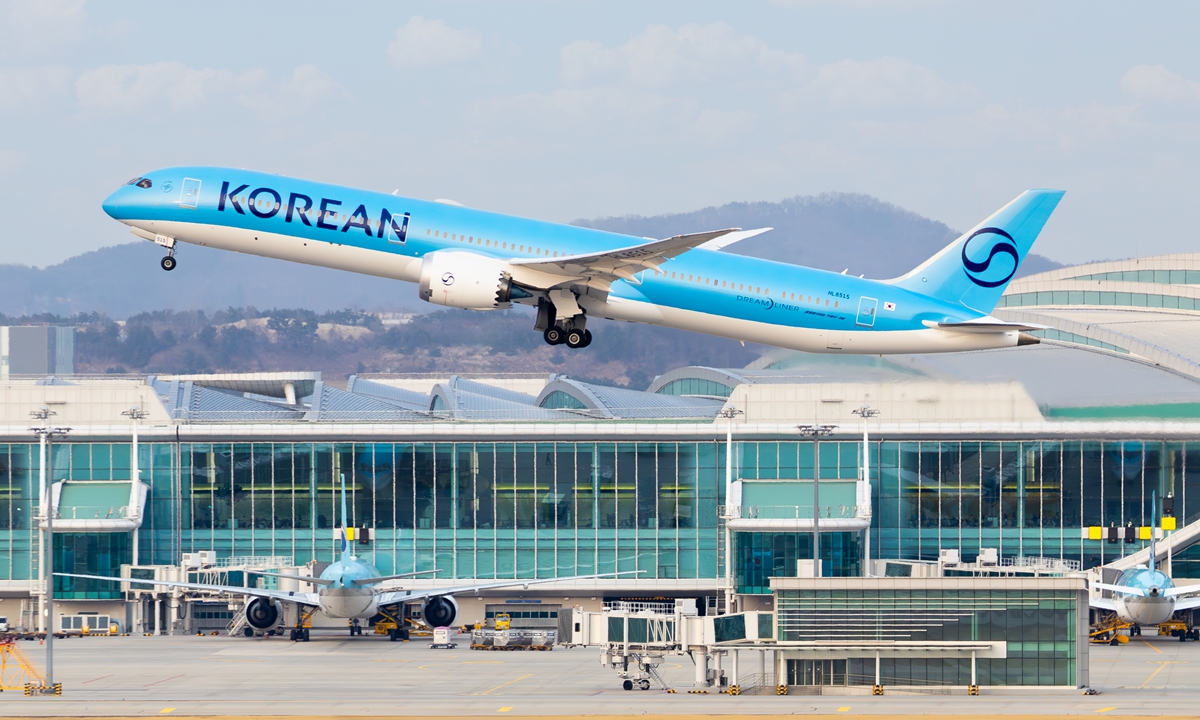
Photo: Courtesy of Korean Air
Korean Air announced on Thursday a significant year-on-year increase in passenger numbers on its South Korea-China routes for 2025, with Shanghai emerging as the most favored destination for Korean travelers.
According to the airline's annual report published on its website, passenger volume from South Korea to Shanghai alone rose by 128,000 year-on-year.
The number of passengers traveling from South Korea to Beijing increased by 71,000, while the number heading to Qingdao increased by 63,000.
By the end of 2025, Korean Air is expected to transport a total of 16.49 million passengers this year, with a total flight distance of 280 million kilometers.
On August 6, South Korean Prime Minister Kim Min-seok presided over a meeting to revitalize domestic tourism, deciding to allow Chinese group tourists to be exempted from visas from September 29 this year to June 30 next year, the Xinhua News Agency reported on the same day.
The South Korean prime minister's office expected the visa-free policy to bolster domestic demand to visit the Asian country, with the local tourism market recovering rapidly.
Chinese Ambassador to the Republic of Korea Dai Bing said on social media that the decision is good news for Chinese travelers visiting South Korea. China has unilaterally granted visa-free entry to South Korean citizens since November last year, and data showed that people-to-people exchanges between China and South Korea have since grown rapidly.

Chinese tourists shop at a store in the Shilla Duty Free Shop in Jeju, South Korea on July 9, 2025. Photo: Liu Yang/GT
Within one month of the implementation of the policy, the number of Chinese visitors to the Shinsegae Duty Free Shop in the Myeongdong area of Seoul had increased by 90 percent year-on-year, with sales increasing by 40 percent, South Korean media outlets reported.
On December 21, Qingdao Airlines will launch a direct scheduled flight route between Qingdao and Daegu, South Korea. As the only direct flight from East China's Shandong Province to Daegu, the opening of this route marks a comprehensive upgrade of the air corridor between the two regions.
In information provided to the Global Times, Qingdao airport stated that since China's visa-exemption policy for South Korean nationals took effect, the airport had handled a total of 1.806 million passenger trips involving South Korean travelers as of November 7, representing a year-on-year increase of 23.6 percent.
Among these, inbound South Korean passenger trips reached 360,000, accounting for about 71 percent of the total inbound foreign passengers to the airport, with year-on-year growth of 63.3 percent. Passenger volume on routes to and from Seoul remained among the top across China.
An " alternative to Japan" trend is taking shape in the year-end outbound travel market, with South Korea, Southeast Asia and Europe emerging as top options.
According to data released by Tongcheng Travel on December 2, hotel bookings in South Korea grew by more than 240 percent year-on-year in the last two weeks of November. Popular destinations in South Korea were mainly concentrated in Seoul, Jeju and Busan.
The research institute under Tongcheng Travel said that the trend of Chinese residents avoiding travel to Japan has accelerated since late November, with major Asian economies such as South Korea and Indonesia being the biggest beneficiaries. South Korea's tourism popularity is expected to reach a new multi-year high.
Global Times
RELATED ARTICLES