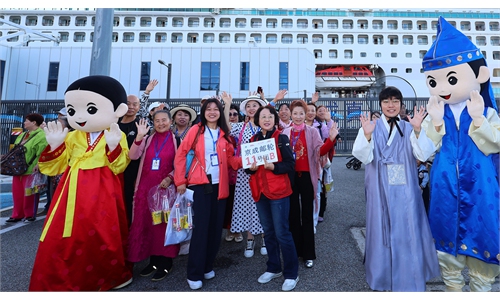
Chinese tourists shop at a store in the Shilla Duty Free Shop in Jeju, South Korea on July 9, 2025. Photo: Liu Yang/GT
A "Japan alternative" trend is taking shape in the year-end outbound travel market, with South Korea, Southeast Asia and Europe emerging as top options.
According to data released by Tongcheng Travel on Tuesday, hotel booking popularity in South Korea surpassed 240 percent year-on-year in the last two weeks of November. Similarly, hotel bookings in Southeast Asian destinations, like Vietnam and Indonesia, also experienced year-on-year growth exceeding 100 percent.
In European destinations such as Germany and Spain, hotel booking popularity increased by more than 300 percent year-on-year, while Nordic countries like Denmark and Switzerland saw year-on-year growth of over 200 percent, the platform said.
Popular destinations in South Korea are mainly concentrated in Seoul, Jeju and Busan. Hotel booking demand in Vietnam has increased by over 110 percent year-on-year, with its most sought-after destinations centered on Ho Chi Minh City, Hanoi and Da Nang. Hotel booking popularity in Indonesia has increased by over 130 percent year-on-year.
The research institute under Tongcheng Travel said that the trend of Chinese residents avoiding traveling to Japan has got accelerated since late November, with major Asian economies such as South Korea and Indonesia being the biggest beneficiaries. South Korea's tourism popularity is expected to reach a new high in recent years.
Recently, South Korean tourism industry has proposed extending the visa-free policy for Chinese group tourists to the government in recent weeks.
Since South Korea implemented its visa-free policy for Chinese group tourists - effective from September 29 this year to June 30 next year - the measure has fostered positive interactions with China's responding visa-free policy for South Korean visitors.
After one month of the policy's implementation, the number of Chinese visitors to the Shinsegae Duty Free Shop in Myeongdong increased by 90 year-on-year, with sales increasing by 40 percent, South Korean media reported. The South Korean tourism industry's request to extend the visa-free period reflects a respect for economic principles and commitment to promoting development, said the institute.
In addition, the platform said that the ski vacation demand previously directed toward Japan will shift more to Kazakhstan, while ski resorts in Nordic regions will also attract some Chinese tourists.
Domestic ski resorts across Heilongjiang, Xinjiang, Inner Mongolia, Hebei and other regions are poised to be popular viable alternatives to Japan's Hokkaido.
The shift came after China issued a travel advisory warning its citizens of risks in visiting Japan, a move triggered by Japanese Prime Minister Sanae Takaichi's erroneous remarks on China's Taiwan island and her refusal to retract them.
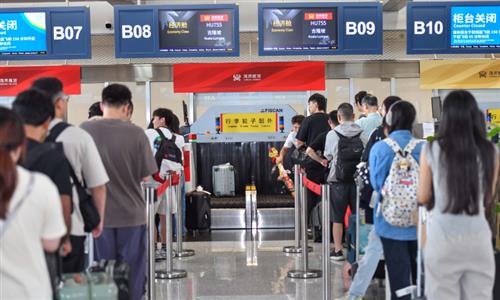
As a result, over 40 percent of planned flights from the Chinese mainland to Japan for December have been canceled, totaling more than 1,900 flights, according to aviation data provider Umetrip sent to the Global Times on Tuesday.
South Korea has emerged as the top outbound destination for Chinese travelers in terms of the volume of international flight tickets booked, data from online travel agency Qunar showed on November 17, citing the data over the past weekend.
Global Times
RELATED ARTICLES