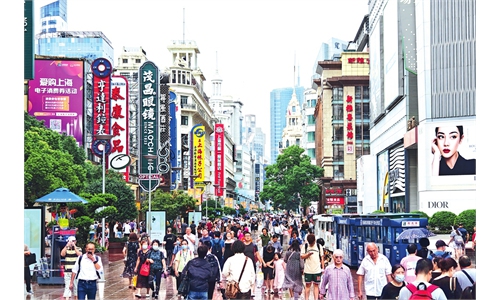
Consumers choose goods in a duty-free store in Haikou, South China's Hainan Province, on November 2, 2025. Photo: VCG
While announcing a higher forecast for China's economic growth on Wednesday, IMF Managing Director Kristalina Georgieva noted that "as the second-largest economy in the world, China is simply too big to generate much growth from exports, and continuing to depend on export-led growth risks furthering global trade tensions."While Georgieva also spoke positively of many aspects of China's economy, the remark about export-led growth drew much attention from some Western media outlets, which have long been peddling negative narratives against Chinese exports. Recently, amid profound turmoil in global trade, some Western media outlets have been hyping claims that "China exports too much, and imports too little." Needless to say, such claims are baseless. Furthermore, they ignore China's ongoing economic transformation from export-driven growth to consumption-led development.
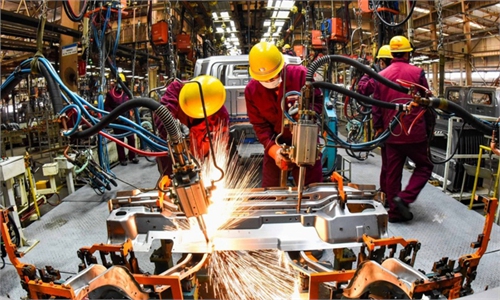
Abundant labor resources and a complete industrial supporting system once enabled China to actively integrate into the global industrial chain, and exports made significant contributions to its economic growth. However, with the expansion of its economic scale and changes in international markets, China has continuously emphasized the expansion of domestic demand for a long period of time.
The 14th Five-Year Plan (2021-25) further clarified the goal of "forging a strong domestic market and fostering a new development pattern," and the recommendations for formulating the 15th Five-Year Plan (2026-30) call for "vigorously boosting consumption." This consistent policy framework focuses on shifting the primary engine of growth from investment and exports toward domestic consumption.
This transformation is strongly validated by data. The proportion of exports in China's GDP has steadily declined from 30.61 percent in 2004 to 23.07 percent in 2014, and it further dropped to 20.02 percent in 2024, according to financial data platform YCharts, citing figures from the World Bank. The continuous and steady decrease over two decades clearly indicates that China's economy is gradually reducing its reliance on exports, while domestic demand, especially consumption, is playing an increasingly prominent role.
Consumption has firmly established itself as the central pillar of China's economic growth. Over the past four years, retail sales grew at an average annual rate of 5.5 percent, and are expected to surpass 50 trillion yuan ($7.08 trillion) in 2025. Beyond scale, China's consumption structure is also constantly upgrading. Services consumption has entered a stage of rapid growth, with household spending on services increasing at an average annual rate of 9.6 percent between 2020 and 2024.
Meanwhile, policies such as the consumer goods trade-in program have effectively stimulated market vitality, driving 2.9 trillion yuan in sales as of the end of the first half of 2025. These developments vividly demonstrate the systematic unleashing of China's vast domestic market potential, which not only meets people's aspirations for a better life but also injects robust and stable endogenous momentum into the economy.
It is this ongoing transformation that formed a key basis for international institutions such as the IMF and the World Bank to recently raise their growth forecasts for China. For instance, Georgieva specifically noted that China prioritized increasing consumption as a driver of growth in the 15th Five-Year Plan (2026-30) and recognized the importance of reorienting the economy from goods to services. This reflects recognition of the resilience in the Chinese economy and the progress of its structural transformation.
While some Western media remain stuck in the outdated narrative of "export dependence," China's economy is already navigating a sustainable path that relies on its own market potential while participating in the global division of labor. Crucially, a rapidly growing Chinese consumer market presents enormous opportunities for goods and services from around the world, and China, through continuous opening-up efforts, is actively expanding imports of high-quality products.
By recognizing this structural transformation with an objective perspective, the international community will be better positioned to understand and seize the opportunities presented by China's development.
RELATED ARTICLES