US launches ‘Pax Silica’ alliance to secure AI supply chains, counter China; move distorts market principles, bound to fail: analysts
By Published: Dec 12, 2025 07:45 PM


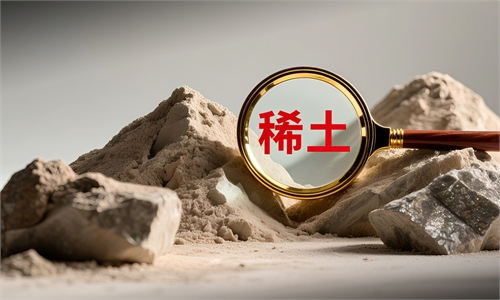
Rare earth Photo:VCG
The US is forming a coalition at a summit on Friday to counter China's dominant control of critical minerals and growing role as a center of artificial intelligence (AI) and other tech sectors, according to media reports. The move follows signing of a preamble agreement on Thursday between the US and Japan on such a partnership.
Chinese analysts noted that the moves, still scant on details and subject to a conflict of interests among its partners, are unlikely to achieve its stated goal, as such a practice essentially distorts the international division of labor.
The US is reportedly launching a coalition of partners with the signing on Friday of the Pax Silica Declaration, bringing Singapore, Australia, Japan, South Korea and Israel in a collaboration intended to address deficits in critical mineral access and counter China's massive investment in its critical minerals and the tech sector, US news portal politico.com reported on Thursday (US time). It is also seeking to enlist other countries to join the group, the report said.
When asked to comment on the agreement signed by the US, Japan and others regarding the securing of rare-earth supply chains to reduce dependence on China for developing AI technologies, Foreign Ministry Spokesperson Guo Jiakun stated at a regular press conference on Friday that "We have noted relevant reports."
"All parties should adhere to the principles of a market economy and fair competition and work together to maintain the stability of the global supply chain," Guo said.
'Pax Silica'
The "Pax Silica" partnership, which seeks to counter China's growing heft in the fields, aims to reduce what it claims as "coercive" dependencies and protect materials and capabilities foundational to AI, includes South Korea, according to the Yonhap News Agency.
"Our goal is not to close ourselves off from the rest of the world, but to build and deploy supply chains and information networks free from undue influence or control by countries or entities of concern," Deputy Secretary of State Christopher Landau claimed during a reception on the eve of the summit.
The declaration paves the way for joint research and development, manufacturing and infrastructure project intended to rival China's Belt and Road Initiative, US Under Secretary of State for Economic Affairs Jacob Helberg told politico.com.
The move is one of the latest efforts by the US to secure its dominance in AI by focusing on critical minerals, Chinese experts said. Despite the claim of "not closing off," the move is essentially aimed at decoupling with China in the semiconductor supply chain, a scenario that disrupts the global supply chain, and through confrontational approach, is set to raise costs for chips and other materials, experts warned.
However, while the US has a clear objective to expand its resource advantages under current conditions and reduce constraints on its economy and innovation caused by factors such as rare-earth chokeholds, things may not work out as planned due to conflicts of interests among alliance members, analysts said.
Zhou Mi, a senior researcher at the Chinese Academy of International Trade and Economic Cooperation, told the Global Times on Friday that the so-called alliance reflected the US' desire to leverage the advantages of its "allies and partner" countries to bolster its own development by guiding these nations to align with US interests in trade, investment and industrial development, thereby safeguarding America's capacity for innovation.
However, while such efforts may create some opportunities for participating parties - and may even include the easing of so-called reciprocal tariffs as bargaining chips - these measures may not necessarily translate into tangible corporate action, Zhou said.
The US administration is forming an overarching alliance to enlist as many as countries as possible by extending the scope of cooperation across the whole segment of the global semiconductor supply chain, an industry expert surnamed Gao told the Global Times on Friday.
The move is essentially aimed at decoupling from China from the global semiconductor supply chain, and it is unlikely to succeed due to China's deep level of integration, according to Gao, who declined to be named.
It is a set of geopolitical games in which countries walk a tightrope in the coming age of AI, at the expense of rising costs resulting from the fragmentation this entails, Gao said.
Zhou said that moving forward, even with government involvement from certain countries, it remains uncertain whether the initiative will translate into active corporate participation and implementation.
Existing related investment projects in the US have not progressed smoothly, and companies must weigh profits against risks. Without a stable environment, enterprises are unwilling to participate if doing so jeopardizes their profits or limits their development. Companies are also naturally reluctant to freely share their core technologies and resources with other US firms, Zhou said.
"Companies are likely to proceed cautiously. The transformation of this alliance from government-led to market-driven remains questionable," Zhou said.
At the industry and company levels, the world still needs globalization for the chip industry to prosper, with its unified standards, an international division of labor, the tapping of different countries' competitive advantages and the free flow of ideas and talent, Gao said.
China has long been a key participant in critical minerals and semiconductors, Zhou said. "China is the largest producer, processor and exporter of certain mineral resources, as well as a major consumer market. Excluding China effectively removes a significant portion of the global market."
"Even if parties are willing to collaborate within the remaining market segment, profitability is difficult to ensure, and the lack of economies of scale undermines competitiveness. To sustain development under such conditions, barriers against the Chinese market would need to be heightened - an approach that may conflict with the fundamental principles of other alliance members," Zhou said.
"China's dual role as both a supplier and a consumer market cannot be overlooked. The effectiveness and stability of the alliance remain precarious," Zhou said.
The US-led move follows an announcement by the Group of Seven (G7), which on November 1 unveiled a total of 26 new investments and partnerships under the so-called Critical Minerals Production Alliance with nine allied countries to secure critical minerals supply chains.
Before the G7 announcement, Foreign Ministry spokesperson Guo urged the G7 to earnestly observe the principles of a market economy and international trade rules, stop disrupting the international trade order with self-made group rules, and work jointly for a stable global economy.
RELATED ARTICLES