IN-DEPTH / IN-DEPTH
From foundational to international way, foreign family across four generations bears witness to China’s educational progress
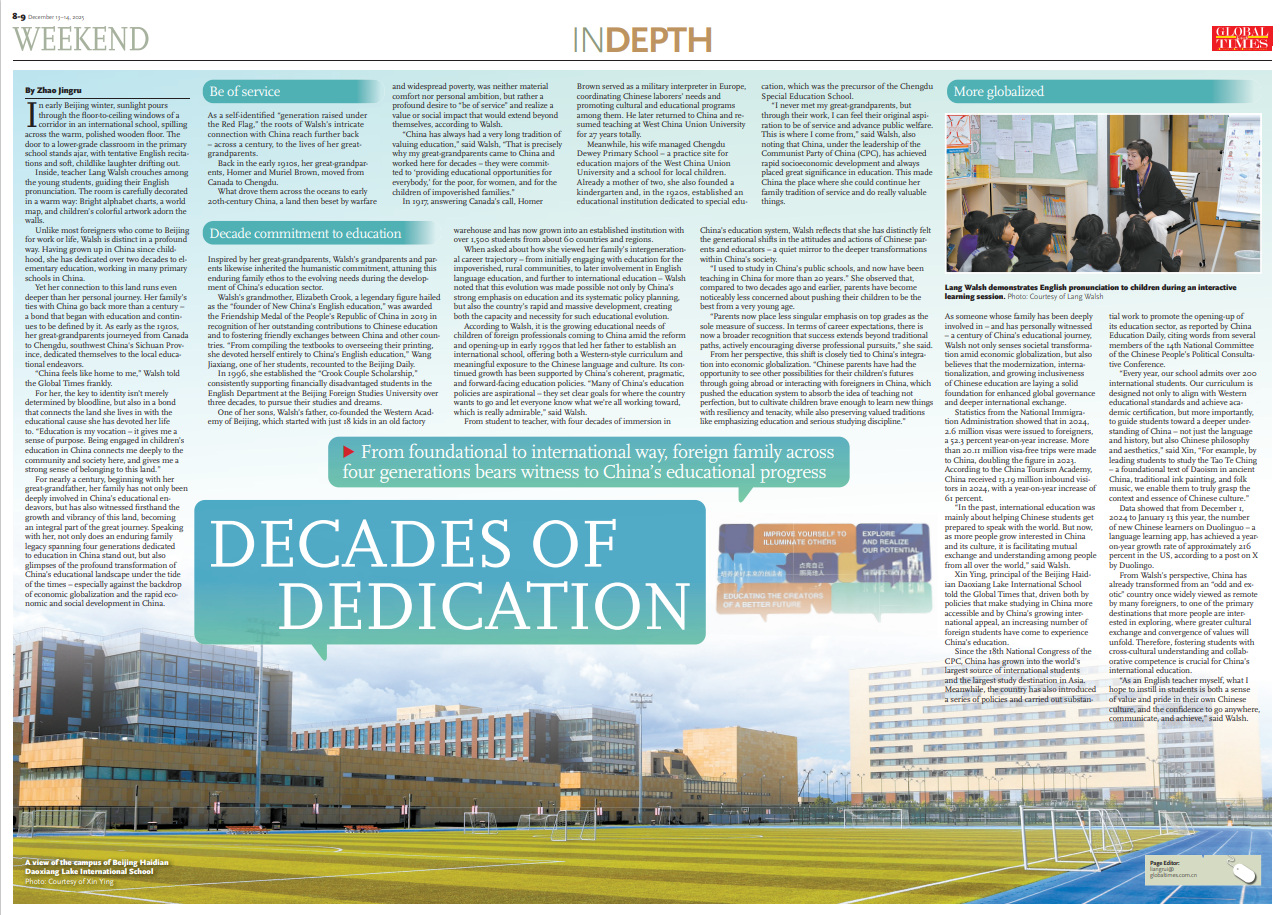
Decades of dedication
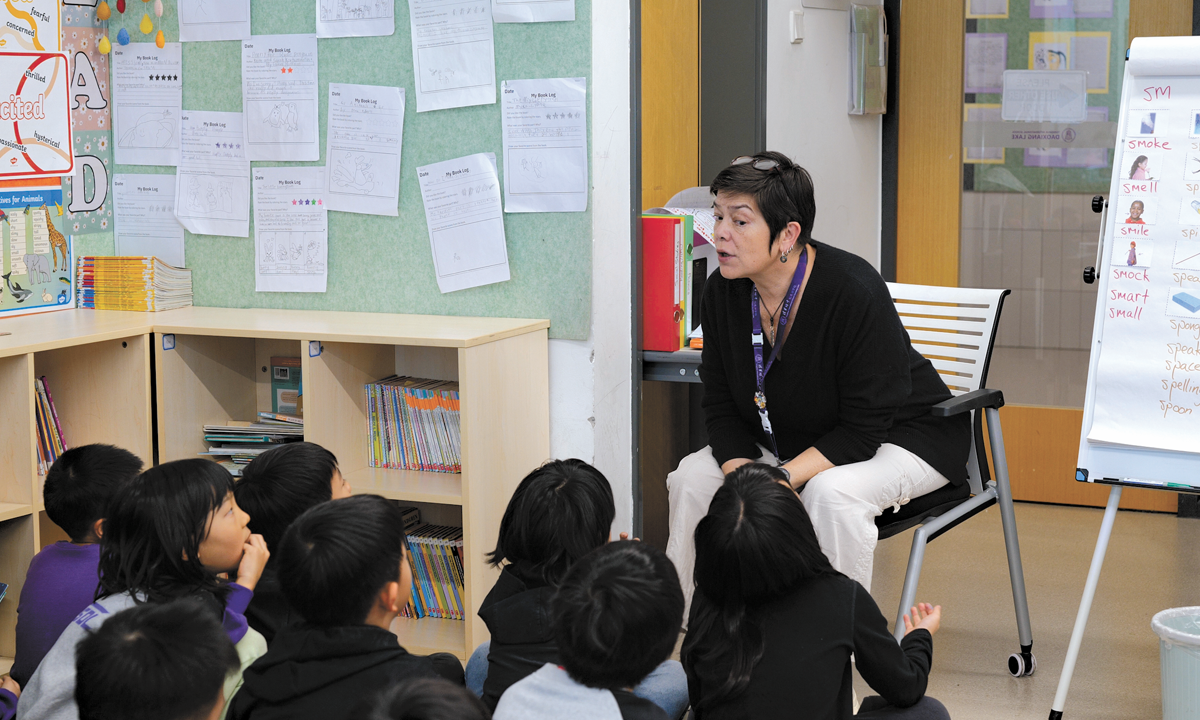
Lang Walsh demonstrates English pronunciation to children during an interactive learning session. Photo: Courtesy of Lang Walsh
In early Beijing winter, sunlight pours through the floor-to-ceiling windows of a corridor in an international school, spilling across the warm, polished wooden floor. The door to a lower-grade classroom in the primary school stands ajar, with tentative English recitations and soft, childlike laughter drifting out.
Inside, teacher Lang Walsh crouches among the young students, guiding their English pronunciation. The room is carefully decorated in a warm way: Bright alphabet charts, a world map, and children's colorful artwork adorn the walls.
Unlike most foreigners who come to Beijing for work or life, Walsh is distinct in a profound way. Having grown up in China since childhood, she has dedicated over two decades to elementary education, working in many primary schools in China.
Yet her connection to this land runs even deeper than her personal journey. Her family's ties with China go back more than a century - a bond that began with education and continues to be defined by it. As early as the 1910s, her great-grandparents journeyed from Canada to Chengdu, southwest China's Sichuan Province, dedicated themselves to the local educational endeavors.
"China feels like home to me," Walsh told the Global Times frankly.
For her, the key to identity isn't merely determined by bloodline, but also in a bond that connects the land she lives in with the educational cause she has devoted her life to. "Education is my vocation - it gives me a sense of purpose. Being engaged in children's education in China connects me deeply to the community and society here, and gives me a strong sense of belonging to this land."
For nearly a century, beginning with her great-grandfather, her family has not only been deeply involved in China's educational endeavors, but has also witnessed firsthand the growth and vibrancy of this land, becoming an integral part of the great journey. Speaking with her, not only does an enduring family legacy spanning four generations dedicated to education in China stand out, but also glimpses of the profound transformation of China's educational landscape under the tide of the times - especially against the backdrop of economic globalization and the rapid economic and social development in China.
Be of service
As a self-identified "generation raised under the Red Flag," the roots of Walsh's intricate connection with China reach further back - across a century, to the lives of her great-grandparents.
Back in the early 1910s, her great-grandparents, Homer and Muriel Brown, moved from Canada to Chengdu.
What drove them across the oceans to early 20th-century China, a land then beset by warfare and widespread poverty, was neither material comfort nor personal ambition, but rather a profound desire to "be of service" and realize a value or social impact that would extend beyond themselves, according to Walsh.
"China has always had a very long tradition of valuing education," said Walsh, "That is precisely why my great-grandparents came to China and worked here for decades - they were committed to 'providing educational opportunities for everybody,' for the poor, for women, and for the children of impoverished families."
In 1917, answering Canada's call, Homer Brown served as a military interpreter in Europe, coordinating Chinese laborers' needs and promoting cultural and educational programs among them. He later returned to China and resumed teaching at West China Union University for 27 years totally.
Meanwhile, his wife managed Chengdu Dewey Primary School - a practice site for education majors of the West China Union University and a school for local children. Already a mother of two, she also founded a kindergarten and, in the 1920s, established an educational institution dedicated to special education, which was the precursor of the Chengdu Special Education School.
"I never met my great-grandparents, but through their work, I can feel their original aspiration to be of service and advance public welfare. This is where I come from," said Walsh, also noting that China, under the leadership of the Communist Party of China (CPC), has achieved rapid socioeconomic development and always placed great significance in education. This made China the place where she could continue her family tradition of service and do really valuable things.
Decade commitment to education
Inspired by her great-grandparents, Walsh's grandparents and parents likewise inherited the humanistic commitment, attuning this enduring family ethos to the evolving needs during the development of China's education sector.
Walsh's grandmother, Elizabeth Crook, a legendary figure hailed as the "founder of New China's English education," was awarded the Friendship Medal of the People's Republic of China in 2019 in recognition of her outstanding contributions to Chinese education and to fostering friendly exchanges between China and other countries. "From compiling the textbooks to overseeing their printing, she devoted herself entirely to China's English education," Wang Jiaxiang, one of her students, recounted to the Beijing Daily.
In 1996, she established the "Crook Couple Scholarship," consistently supporting financially disadvantaged students in the English Department at the Beijing Foreign Studies University over three decades, to pursue their studies and dreams.
One of her sons, Walsh's father, co-founded the Western Academy of Beijing, which started with just 18 kids in an old factory warehouse and has now grown into an established institution with over 1,500 students from about 60 countries and regions.
When asked about how she viewed her family's intergenerational career trajectory - from initially engaging with education for the impoverished, rural communities, to later involvement in English language education, and further to international education - Walsh noted that this evolution was made possible not only by China's strong emphasis on education and its systematic policy planning, but also the country's rapid and massive development, creating both the capacity and necessity for such educational evolution.
According to Walsh, it is the growing educational needs of children of foreign professionals coming to China amid the reform and opening-up in early 1990s that led her father to establish an international school, offering both a Western-style curriculum and meaningful exposure to the Chinese language and culture. Its continued growth has been supported by China's coherent, pragmatic, and forward-facing education policies. "Many of China's education policies are aspirational - they set clear goals for where the country wants to go and let everyone know what we're all working toward, which is really admirable," said Walsh.
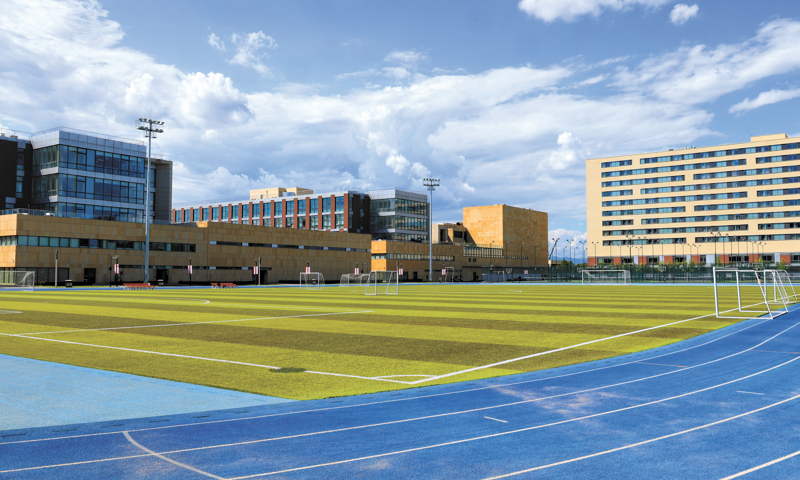
A view of the campus of Beijing Haidian Daoxiang Lake International School Photo: Courtesy of Xin Ying
From student to teacher, with four decades of immersion in China's education system, Walsh reflects that she has distinctly felt the generational shifts in the attitudes and actions of Chinese parents and educators - a quiet mirror to the deeper transformations within China's society.
"I used to study in China's public schools, and now have been teaching in China for more than 20 years." She observed that, compared to two decades ago and earlier, parents have become noticeably less concerned about pushing their children to be the best from a very young age.
"Parents now place less singular emphasis on top grades as the sole measure of success. In terms of career expectations, there is now a broader recognition that success extends beyond traditional paths, actively encouraging diverse professional pursuits," she said.
From her perspective, this shift is closely tied to China's integration into economic globalization. "Chinese parents have had the opportunity to see other possibilities for their children's futures through going abroad or interacting with foreigners in China, which pushed the education system to absorb the idea of teaching not perfection, but to cultivate children brave enough to learn new things with resiliency and tenacity, while also preserving valued traditions like emphasizing education and serious studying discipline."
More globalized
As someone whose family has been deeply involved in - and has personally witnessed - a century of China's educational journey, Walsh not only senses societal transformation amid economic globalization, but also believes that the modernization, internationalization, and growing inclusiveness of Chinese education are laying a solid foundation for enhanced global governance and deeper international exchange.
Statistics from the National Immigration Administration showed that in 2024, 2.6 million visas were issued to foreigners, a 52.3 percent year-on-year increase. More than 20.11 million visa-free trips were made to China, doubling the figure in 2023. According to the China Tourism Academy, China received 13.19 million inbound visitors in 2024, with a year-on-year increase of 61 percent.
"In the past, international education was mainly about helping Chinese students get prepared to speak with the world. But now, as more people grow interested in China and its culture, it is facilitating mutual exchange and understanding among people from all over the world," said Walsh.
Xin Ying, principal of the Beijing Haidian Daoxiang Lake International School told the Global Times that, driven both by policies that make studying in China more accessible and by China's growing international appeal, an increasing number of foreign students have come to experience China's education.
Since the 18th National Congress of the CPC, China has grown into the world's largest source of international students and the largest study destination in Asia. Meanwhile, the country has also introduced a series of policies and carried out substantial work to promote the opening-up of its education sector, as reported by China Education Daily, citing words from several members of the 14th National Committee of the Chinese People's Political Consultative Conference.
"Every year, our school admits over 200 international students. Our curriculum is designed not only to align with Western educational standards and achieve academic certification, but more importantly, to guide students toward a deeper understanding of China - not just the language and history, but also Chinese philosophy and aesthetics," said Xin, "For example, by leading students to study the Tao Te Ching - a foundational text of Daoism in ancient China, traditional ink painting, and folk music, we enable them to truly grasp the context and essence of Chinese culture."
Data showed that from December 1, 2024 to January 13 this year, the number of new Chinese learners on Duolinguo - a language learning app, has achieved a year-on-year growth rate of approximately 216 percent in the US, according to a post on X by Duolingo.
From Walsh's perspective, China has already transformed from an "odd and exotic" country once widely viewed as remote by many foreigners, to one of the primary destinations that more people are interested in exploring, where greater cultural exchange and convergence of values will unfold. Therefore, fostering students with cross-cultural understanding and collaborative competence is crucial for China's international education.
"As an English teacher myself, what I hope to instill in students is both a sense of value and pride in their own Chinese culture, and the confidence to go anywhere, communicate, and achieve," said Walsh.
Decades of dedication
RELATED ARTICLES