Chinese tech firms encouraged by Central Economic Work Conference's focus on innovation advancement

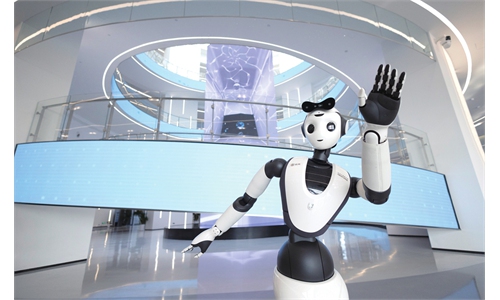
A concept picture of AI city File photo: VCG
Chinese tech companies have drawn encouragement from the emphasis on advancing technological innovation outlined at the just-concluded Central Economic Work Conference, noting that the policy direction has strongly boosted their confidence to push forward frontline innovation.
The companies also pledged to reinforce efforts to develop core technologies, thereby further strengthening their independent innovation capabilities, which they said will contribute to advancing the high-quality development of China's economy.
The arrangements of the Central Economic Work Conference have demonstrated the country's determination to promote high-quality development. "We will actively respond to the national call by integrating the company's growth into the broader context of national development," said Zhou Hongyi, founder and chairman of 360 Security Technology.
Guided by the "AI+" initiative and underpinned by digital security, "we will continue to innovate and make breakthroughs, fortifying the foundation of digital security to contribute to the establishment of a modern industrial system and the advancement of China's high-quality economic development," he added.
The conference has made it clear that the innovation-driven development strategy must be upheld to accelerate the cultivation of new drivers of growth, and that this has charted the course for the development of new quality productive forces represented by artificial intelligence (AI), iFlytek said in a note sent to the Global Times on Friday.
The annual Central Economic Work Conference was held in Beijing from Wednesday to Thursday, during which Chinese leaders outlined priorities for economic work in 2026.
Enhancing innovation-driven development was identified as the second key guideline for next year's economic work.
It will be essential to enhance innovation-driven development to accelerate the cultivation of new growth drivers. China will develop international technological innovation centers in Beijing (the Beijing-Tianjin-Hebei region), Shanghai (the Yangtze River Delta) and the Guangdong-Hong Kong-Macao Greater Bay Area, the Xinhua News Agency reported on Thursday.
Efforts will be made to advance the AI+ initiative, improve AI governance and foster innovation in science and financial technology, the conference said.
The measures outlined at this Central Economic Work Conference are systematically designed to address key challenges in the country's current development, Ma Jihua, a veteran market watcher, told the Global Times on Friday.
In his view, in some key sectors such as new energy, China has already taken a leading position globally. To continue moving forward, however, the country must venture into uncharted territory, which demands relentless self-driven innovation to surpass existing boundaries.
Ma also noted that while many of China's industries and related enterprises already have a strong production foundation, they have yet to achieve true technological leadership.
The roadmap encourages "small but beautiful" enterprises to grow stronger, while urging larger firms to pursue high-end, precision and advanced development. Ma added that the strategy represents a holistic layout, spanning talent cultivation, intellectual property protection and leadership in critical technologies such as AI integration.
Several Chinese regions have rolled out AI+ action plans and stepped up investment, vowing to accelerate the adoption of AI across key industries and public services.
On November 26, the city of Beijing released recommendations for its 15th Five-Year Plan, vowing to nurture a world-leading AI industry ecosystem and strengthen breakthroughs in core and key technologies such as high-end chips and fundamental software. The document also mentioned cultivating a group of leading large-scale industry models.
Looking ahead, tech companies also expressed their determination to develop.
iFlytek stated that it will continue to intensify efforts to achieve breakthroughs in core technologies and promote large-scale application of its Spark large model in key areas such as education and healthcare. The company will actively participate in the development of strategic national scientific and technological capabilities, and enhance indigenous innovation in key areas such as critical software, intelligent speech, general-purpose large models, and security and controllability.
"The core of developing new productive forces lies in technological innovation, and AI is the most crucial breakthrough point. The meeting has pointed out the core essence of current AI development - AI cannot remain only in the laboratory but must enter industry and be applied in practice," Zhou said.
RELATED ARTICLES