Multiple government departments deploy key work priorities in 2026
Boosting consumption, stabilizing investment in focus after Central Economic Work Conference
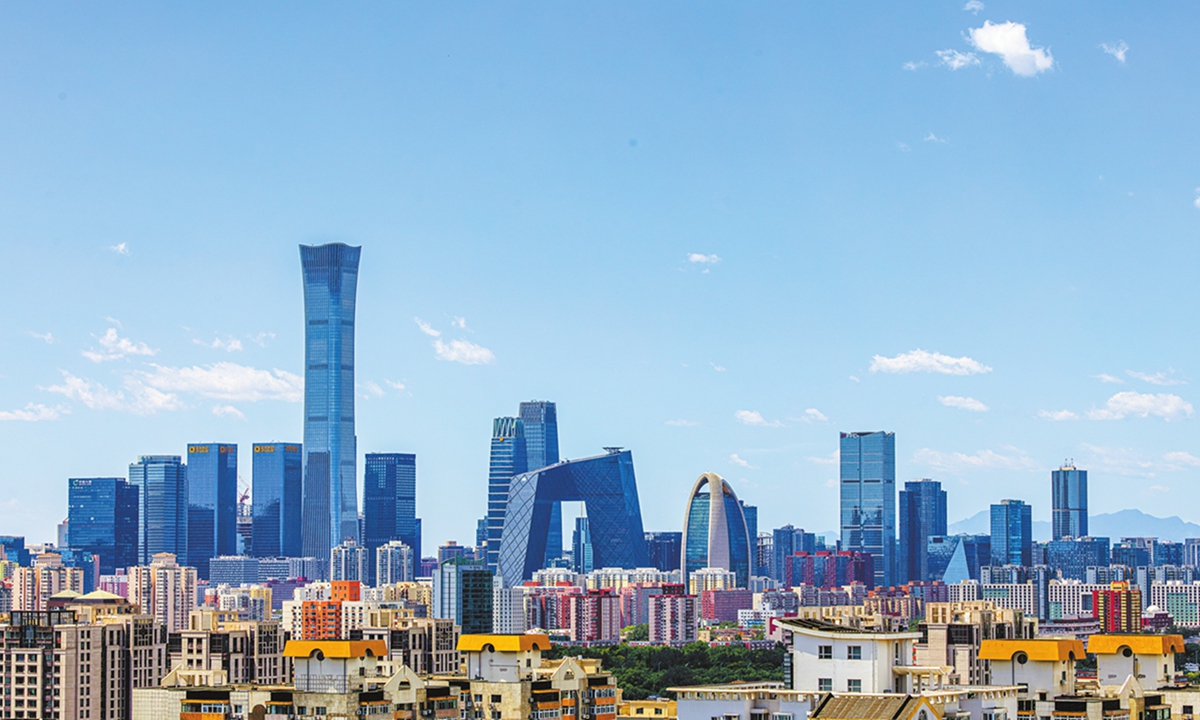
The view of Beijing's Central Business District Photo: VCG
As the Central Economic Work Conference, which mapped out the plan for China's economic work in 2026, concluded on Thursday, multiple Chinese government departments including the National Development and Reform Commission (NDRC) and the People's Bank of China (PBC) have outlined key work priorities for next year.
Chinese analysts said on Sunday that various government agencies have intensively convened meetings to set specific goals and implement the economic tasks for the coming year, which not only highlighted China's institutional advantages, but also provides clear guidance to market players, facilitates advance planning and stabilizing market expectations for the coming year.
Follow-up arrangements
Major tasks have been outlined at the Central Economic Work Conference to be effectively carried out next year. Domestic demand will remain as a focus in building a robust domestic market, according to the Xinhua News Agency.
As one of the latest moves to expand domestic demand, the Ministry of Commerce (MOFCOM), the PBC and the National Financial Regulatory Administration jointly issued a notice on Sunday on strengthening coordination between commerce and finance to more vigorously boost consumption, the MOFCOM's website showed.
The notice proposed to deepen collaboration between commerce and financial systems, encouraging local departments to strengthen communication, exchange, and division of labor to reinforce the combined forces of fiscal funds, credit funds and social capital, an official with MOFCOM said.
In addition, it vowed to increase financial support in key consumption areas. According to the official, financial institutions are encouraged to focus on five priority areas - upgrading commodity consumption, expanding services consumption in areas like housekeeping and education, cultivating new forms of consumption including debut economy and green consumption, innovating diversified consumption scenarios, and supporting consumption assistance - and optimize financial products and services.
This will promote stronger alignment between supply and demand, enhance the adaptability of financial support to commodity and services consumption, thus advancing the development of new consumption models tailored to local conditions and supporting the construction of new consumption formats, models, and scenarios, said the MOFCOM official.
"Expanding domestic demand will be the priority of the economic work in 2026, which is an effective measure for the country to promote economic transformation, achieve high-quality development, and cope with external uncertainties," Wang Peng, an associate researcher at the Beijing Academy of Social Sciences, told the Global Times on Sunday.
Wang noted that the notice is a timely implementation of the requirements from the 4th plenary session of the 20th Central Committee of the Communist Party of China and the Central Economic Work Conference. "It aims to form greater synergies in boosting and expanding consumption by strengthening inter-departmental coordination," the expert said.
Hu Qimu, deputy secretary-general of the Forum 50 for Digital-Real Economies Integration, highlighted China's institutional advantages, which enables formation of inter-departmental synergies while ensuring policies are implemented in a timely manner.
From Friday to Saturday, the National Development and Reform Commission (NDRC) held a meeting to chart key tasks for development and reform in 2026, according to NDRC's website on Saturday.
During the meeting, NDRC said it will effectively formulate and implement the 15th Five-Year Plan, ensure smooth policy and work transitions between this year and next, in a bid to promote the front-loading of policies to achieve a strong start.
The NDRC also vowed to adopt multiple measures to promote the stabilization and recovery of investment, with efforts including leveraging the role of various government investment funds and appropriately increasing the scale of investment within the central budget, while implementing several measures to promote the development of private investment.
In addition to rolling out practical and innovative measures to boost consumption, the NDRC will also comprehensively address involution-style competition and cultivate new drivers of development. It will deepen and expand the "AI+" initiative, improve the industrial ecosystem for the low-altitude economy and deeply advance the high-quality development of the digital economy.
Wang said that addressing involution-style competition can optimize industry ecosystems and improve resource utilization efficiency; cultivating emerging and future industries can create new growth drivers, while improving related industrial ecosystems can expand new economic spaces, thereby laying a solid foundation for high-quality economic development.
The Ministry of Finance said on Saturday that it convened a meeting on Friday to study the implementation work of the fiscal department. During the meeting, the ministry pledged to utilize various government bond funds and issue ultra-long-term special treasury bonds to support major national strategies and enhance security capabilities in key areas as well as large-scale equipment upgrades and trade-in of consumer goods.
Per the ministry, it will continue to boost consumption, and refine the management of the uses of local government special bonds to better leverage the guiding role of government investment, thus promoting the stabilization and recovery of investment.
PBC, the central bank, also convened a meeting on Friday saying that it will continue to implement a moderately accommodative monetary policy and accelerate the advancement of structural reforms on the financial supply side. PBC said it will take promoting stable economic growth and a reasonable rebound in prices as key considerations for its monetary policy.
The central bank said it will adopt measures to prevent and defuse financial risks in key areas, and safeguard financial stability. At the same time, it will steadily advance high-level financial opening-up and safeguard national financial security.
Wang said that measures of the Ministry of Finance will continue to expand consumption and stabilize investment, which the PBC's efforts will lower financing costs, providing strong financial support for the real economy and technological innovation.
"Various ministries and commissions have performed their respective duties, refining the requirements for next year's economic work. They have introduced concrete and substantial policy measures to ensure a strong start for the 15th Five-Year Plan period and provide the market with stable expectations," Hu noted.
Stable growth
Speaking at the Annual Conference on China's Economy 2025-2026 organized by China Center for International Economic Exchanges in Beijing, Han Wenxiu, executive deputy director of the Office of the Central Committee for Financial and Economic Affairs, said that China's economic output is expected to reach around 140 trillion yuan ($19.8 trillion) this year as the 14th Five-Year Plan (2021-25) is set to approach a successful conclusion, China Media Group reported.
Han said 2025 has been of great significance for advancing Chinese modernization and that the main economic and social development targets will be achieved.
Over the past year, China's economy has advanced against strong headwinds, shifting toward higher-quality development and demonstrating strong resilience and vitality, Han said, adding that many institutions now forecast full-year growth of about 5 percent and that China remains a major engine of global growth.
The IMF on Wednesday released its latest World Economic Outlook report in Beijing, upgrading China's economy to 5.0 percent in 2025 and 4.5 percent in 2026. Earlier on December 2, the Organization for Economic Cooperation and Development raised China's GDP forecast for 2025 to 5 percent, up by 0.1 percentage point compared with its previous projection in September.
Wang Peng noted that this year, fiscal, monetary, and other policies have formed strong synergies, and domestic demand potential has been unleashed, with services consumption emerging as a new growth driver. Meanwhile, foreign trade resilience has strengthened, and the cultivation of new growth drivers led by artificial intelligence has accelerated.
"These are the sources of our confidence in navigating risks and challenges as well as injecting vitality in the world's economic growth," Wang added.
RELATED ARTICLES