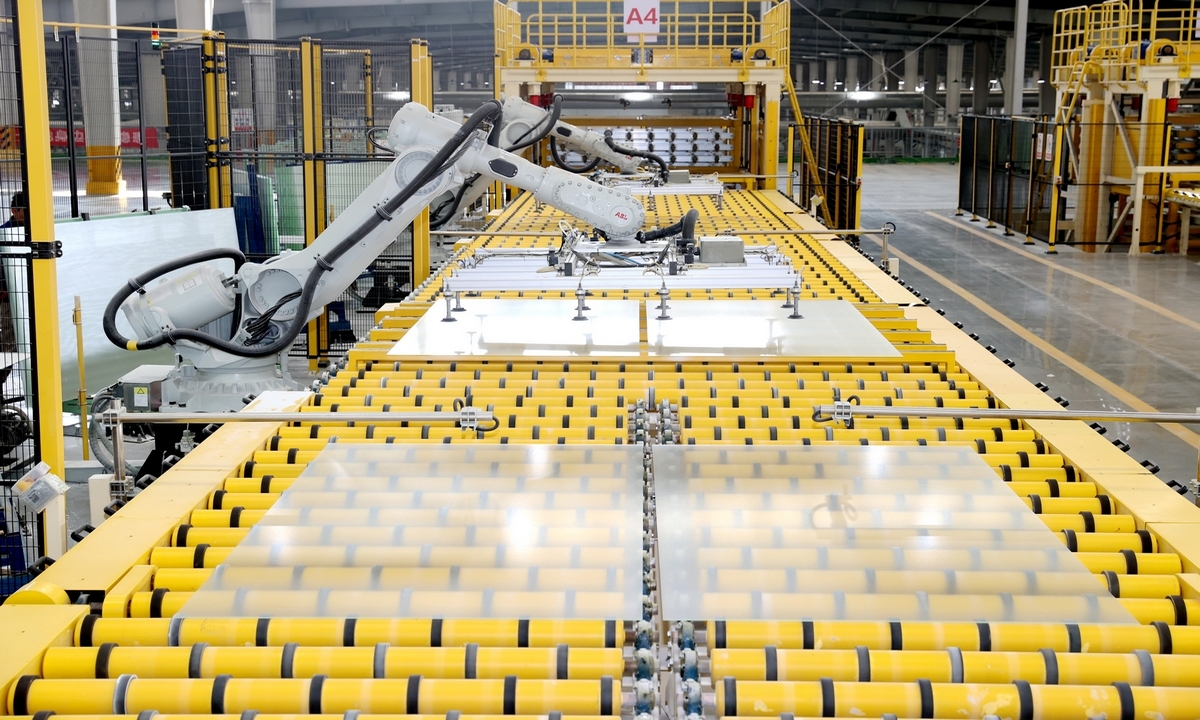
Robotic arms whirl and flip, stacking sheets of glass on a smart production line in Suqian, East China's Jiangsu Province, on December 10, 2025. Since the fourth quarter began, firms have been running machines at full tilt, chasing orders and expanding capacity to power industrial growth through the final sprint of 2025. Photo: VCG
As China prepared the 15th Five-Year Plan (2026-30), the country enters a period of structural transition shaped by technological upgrading, demographic adjustments, global economic realignments, and the growing urgency of climate action.
The Five-Year Planning system has long served as China's institutional anchor, guiding long-term growth through clear priorities, measurable targets, and coordinated implementation across central and local governments. In today's volatile global landscape, marked by slowing world trade, shifting supply chains, and heightened geopolitical uncertainty, this planning system offers strategic continuity and policy predictability that many economies are lacking.
The advantages of this approach have been evident in recent years. Despite a complicated external environment, China recorded GDP growth of 5.0 percent in 2024 and 5.2 percent year-on-year in the first three quarters of 2025.
Industrial upgrading continues, supported by resilient exports of EVs, lithium-ion batteries, photovoltaic products, and machine tools. China's share of global EV exports has seen rapid growth, and it remains the world's largest producer of solar modules and critical minerals processing.
Looking ahead to 2026-30, we expect China's growth trajectory to be more balanced, innovation-led, and sustainability-oriented. The concept of new quality productive forces reflects this shift.
Rather than relying on traditional factor accumulation, the next phase will emphasize efficiency, digital capability, and green competitiveness. This includes advanced manufacturing, AI, renewable energy, and next-generation information infrastructure. China's research and development expenditure rose 8.9 percent year-on-year to more than 3.6 trillion yuan ($506.4 billion) last year. Patent filings in AI, EVs, and clean-energy technologies continue to rise, indicating a strong pipeline of future breakthroughs.
Several sectors are likely to drive China's growth in the next five years. First, new-energy industries will expand further, supported by domestic innovation and global demand for decarbonization technologies. China's solar, wind, and battery supply chains have become integral to the global energy transition.
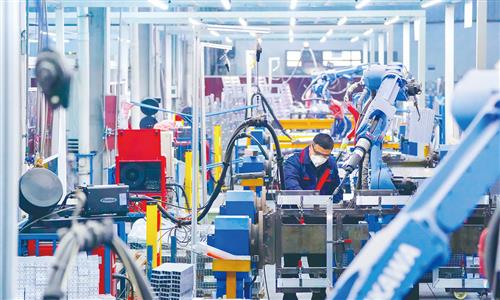
Second, digital industries, including cloud computing, robotics, and smart manufacturing will play a larger role as enterprises adopt more automated and data-driven production methods.
Third, health and eldercare services will grow as China adapts to demographic changes and rising household demand for quality-of-life improvements. Finally, high-end equipment, new materials, and aerospace will continue gaining strategic importance.
Sustainability will remain at the core of China's development agenda. China has made steady progress toward its 2030 and 2060 climate goals. By 2026-30, China is expected to achieve significant gains in energy efficiency, strengthen green finance instruments, and expand electrified transport networks. Provinces such as Guangdong, Jiangsu, and Zhejiang are now scaling up green manufacturing clusters that integrate low-carbon processes with digital systems.
At the same time, China is deepening high-level opening-up. The Regional Comprehensive Economic Partnership continues to support regional trade, while China's application to join the Comprehensive and Progressive Agreement for Trans-Pacific Partnership signals its intention to engage in deeper economic integration.
Nevertheless, challenges remain. The global trade outlook for 2025-26 is uncertain, with the WTO projecting slower world trade growth due to reciprocal tariffs and geopolitical volatility. Weak external demand, uneven domestic consumption recovery, and property-sector adjustments could weigh on China's growth.
Demographic pressures also require policy innovation in labor mobility, social security, and productivity enhancement. However, these challenges also open the door to meaningful progress, including deeper domestic reforms, wider use of digital tools in public services, and stronger cooperation with emerging economies in advancing green and inclusive development.
From a global perspective, China's next stage of development can contribute meaningfully to sustainable growth worldwide. Expanding green technology exports could lower the global cost of decarbonization. China's investments in clean energy and digital infrastructure in developing regions can strengthen South-South cooperation. Its experience in large-scale poverty reduction and industrial upgrading offers lessons for countries seeking structural transformation.
As the 15th Five-Year Plan (2026-30) takes shape, China is poised to enter a new phase defined by innovation, openness, and sustainability. If implemented effectively, the next five years will not only shape China's domestic future but also influence the world's broader path toward resilient and inclusive development.
The author is an assistant professor at the Faculty of Economics and Business at the Indonesian International Islamic University. He is a former head of the Economics Department at the Centre for Strategic and International Studies (CSIS) Indonesia. bizopinion@globaltimes.com.cn

Fajar Hirawan Photo: Courtesy of Fajar Hirawan
RELATED ARTICLES