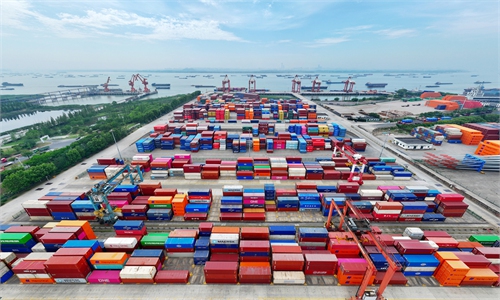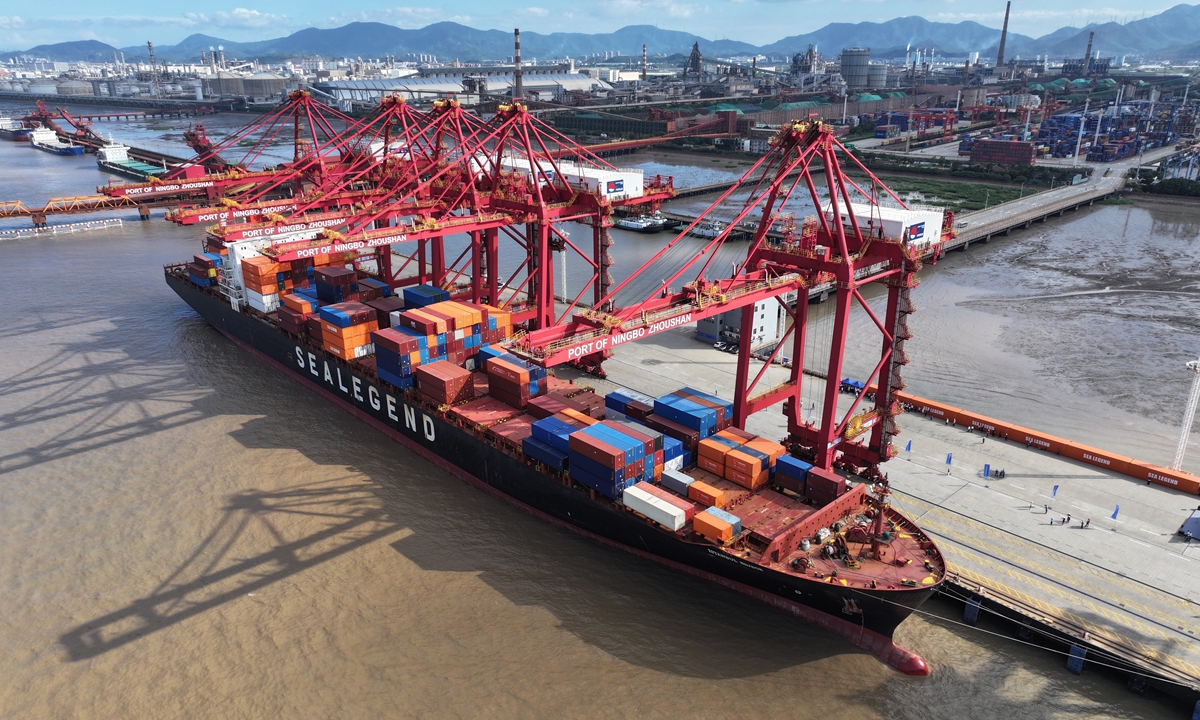
The Istanbul Bridge container ship berths at the Beiyi Container Terminal in Ningbo-Zhoushan Port, East China's Zhejiang Province, on September 22, 2025. Photo: Courtesy of Ningbo Zhoushan Port
Editor's Note:
China's trade surplus exceeded $1 trillion in the first 11 months of 2025, eliciting mixed response globally. On the one hand, the world has witnessed the resilience of China's exports amid global headwinds, a testament to the country's competitiveness as a major manufacturing and exporting power. On the other hand, the US and some European countries continued their usual double standards, selectively presenting China's foreign trade data and deliberately associating it with labels such as "dumping," "overcapacity" and "threat." Starting from today, the Global Times launches the in-depth series "Understanding China's Trade Surplus." Over two installments, the series will analyze the true picture of China's foreign trade data, examine the fundamental causes and influencing factors behind the trade surplus, and explore the contributions of China's foreign trade to global economic and social development. While the US and some European countries adopt double standards and restrictive measures, undermining global trade balance and trade order, only in an open global market and a friendly trade environment can economies jointly ensure long-term trade balance and shared benefits.
China's trade surplus exceeded $1 trillion in the first 11 months of the year, reaching a historic high, mainly due to the strong resilience of its foreign trade. According to the latest data released by the General Administration of Customs (GAC), ASEAN was China's largest trading partner, with a total trade value of 6.82 trillion yuan, of which China's exports to ASEAN reached 4.29 trillion yuan, up 14.6 percent year-on-year. China's second-largest trading partner, the EU, recorded a total import and export value of 5.37 trillion yuan, with exports of 3.64 trillion yuan, up 8.9 percent year-on-year.
At the same time, China's exports to its third-largest trading partner, the US, totaled 2.76 trillion yuan, down 18.3 percent year-on-year. This shows that China's export growth to the EU and ASEAN fully offset the decline in exports to the US. During the same period, China's trade volume with the Belt and Road Initiative participating countries reached 21.33 trillion yuan, up 6 percent. Since the beginning of this year, China's export to Africa and Latin America has also been accelerating.
This shows that diversified markets have effectively hedged against fluctuations in China's exports to the US. Amid rising trade protectionism and increasing restrictions on China's exports by external countries, these trends demonstrate the important role of China's high-quality production capacity in global economy, as well as China's competitive edge as a major manufacturing and exporting power.
Noteworthy alongside China's total trade surplus is the structural change within the surplus itself. China's exports are seeing quality and overall added value rise, driven by the "new three" products: electric vehicles, lithium batteries and solar cells.
In terms of export product categories, China exported 14.89 trillion yuan worth of mechanical and electrical products in the first 11 months, up 8.8 percent, accounting for 60.9 percent of total exports.
Meanwhile, China continues to play an important role as a "global buyer" in international trade. In terms of scale and stability, the latest data released by the GAC show that in the first 11 months of this year, China's total imports of goods reached 16.75 trillion yuan, with imports of mechanical and electrical products up 5.5 percent, accounting for 39.9 percent of total imports. Last year, with total imports of 18 trillion yuan, China maintained its position as the world's second-largest importer for the 16th consecutive year.
From a growth perspective, China's total imports, calculated in yuan, rose 0.2 percent year-on-year. Looking at the monthly data for November alone, China's total imports reached 1.55 trillion yuan, up 1.5 percent month-on-month and 1.7 percent year-on-year. This shows that while achieving a trade surplus exceeding $1 trillion, China has also seen growth in both import volume and import growth rate.
It is noteworthy that falling prices of major commodities are one of the factors contributing to the expansion of China's trade surplus. Data from the GAC show that while China's imports of major commodities have steadily increased, the average prices of many goods have trended downward. In the first 11 months, China imported 1.139 billion tons of iron ore, up 1.4 percent, with the average price down 9.4 percent; and 522 million tons of crude oil, up 3.2 percent, with the average price down 12.1 percent.
From the perspective of overall trade structure, China shows a situation where the goods trade surplus is expanding while a long-standing deficit exists in services trade. According to the latest data from the Ministry of Commerce, in the first 10 months of this year, China's services trade grew steadily, with total service imports and exports reaching about 6.58 trillion yuan, up 7.5 percent year-on-year. Of this, imports were 3.675 trillion yuan, up 2.6 percent; the services trade deficit was 766.37 billion yuan, down 269.39 billion yuan year-on-year.
Win-win outcomes
China's trade surplus follows economic principles, reflecting the improvement of the country's manufacturing capacity and the deep division of labor in global industrial chains, as well as the rational choices of multinational corporations worldwide.
"Our reliance on China's supply chain is based on practical needs," a person involved in the import and export of automotive wiring harnesses and connectors at the Thai-Chinese Rayong Industrial Zone told the Global Times. China's industrial and supply chains are complete, especially in industries such as new energy vehicles and photovoltaics, where they can respond to global demand at low cost and high efficiency while ensuring stable delivery. This is the core support for the stability of export orders, said the industry insider.
The industry insider cited an example: Stale mass production of certain copper semi-finished products, engineering plastics with specific specifications, flame-retardant sheath materials, and small connector parts remains highly concentrated in China. Even if other countries can produce them, considering molds, yield rates, delivery times, and consistency, China still has the overall cost advantage.
"Although China has a trade surplus with Nigeria, which was about $16 billion last year, this is not something to be feared," Ogunkola, a Nigerian economist, told the Global Times' correspondent. The current trade deficit between China and Nigeria reflects the economic complementarity of the two countries and ultimately results in a win-win outcome.
Humphrey Moshi, a professor of economics at the University of Dar es Salaam in Tanzania, who also serves as director of the university's Center for Chinese Studies, told the Global Times that judging international trade relations solely by trade surplus or deficit figures is one-sided and misleading.
The "deficit equals loss" argument deliberately overlooks the reality of highly integrated global supply chains and differences in economic structures and development stages among countries. He explained that China's trade surplus with Africa is fundamentally due to the high complementarity of their economic structures — Africa is currently in the early stages of industrialization, with exports mainly consisting of primary products such as energy, minerals and agricultural goods; China, as a major manufacturing power, can supply Africa with urgently needed capital goods and intermediates, including machinery, transportation equipment, electronics and building materials, according to Moshi.
China's high-quality production capacity provides the world with affordable intermediate goods and brings "price dividends" to consumers globally. Vincent, CEO of Galaxy Impressions Concept, which sells Chinese mobile phones and accessories in Nigeria's capital, Abuja, regularly travels to China to procure goods for sale back in Nigeria. Over the past years, his business has been thriving. He said that Chinese products are affordable and of good quality.
More cooperation expected
China's photovoltaic and wind power equipment play an important role in the global energy transition, effectively reducing emission reduction costs for many countries. German statistics show that as of June this year, the number of registered balcony photovoltaic systems in Germany has exceeded 1 million units, with a total installed capacity of 956 megawatts. In October, the EU's statistical office reported that in 2024, the EU imported green energy products worth nearly 14.6 billion euros, including 11.1 billion euros of solar panels. China was by far the largest supplier of solar panels, accounting for 98 percent of all imports.
Using the automotive sector as an example, Ferdinand Dudenhoeffer, a German automotive expert and director of the Center for Automotive Research in Bochum, told the Global Times that the Chinese market is enormous and will continue to grow. Although competition in China is fierce for German companies, the German automotive industry cannot survive without the Chinese market. Moreover, China is a leader in future automotive technologies, he said.
Electric vehicles, batteries, autonomous driving software, sensors and laser radar, semiconductor — all of these rely on China. Without Chinese technology, German automakers would face very difficult conditions, Dudenhoeffer said, noting that for the automotive industry, a world without China is unimaginable.
RELATED ARTICLES