ARTS / CULTURE & LEISURE
Cultural salon promotes ‘hidden’ Great Wall sections
Regulations provide clear guidelines for protection
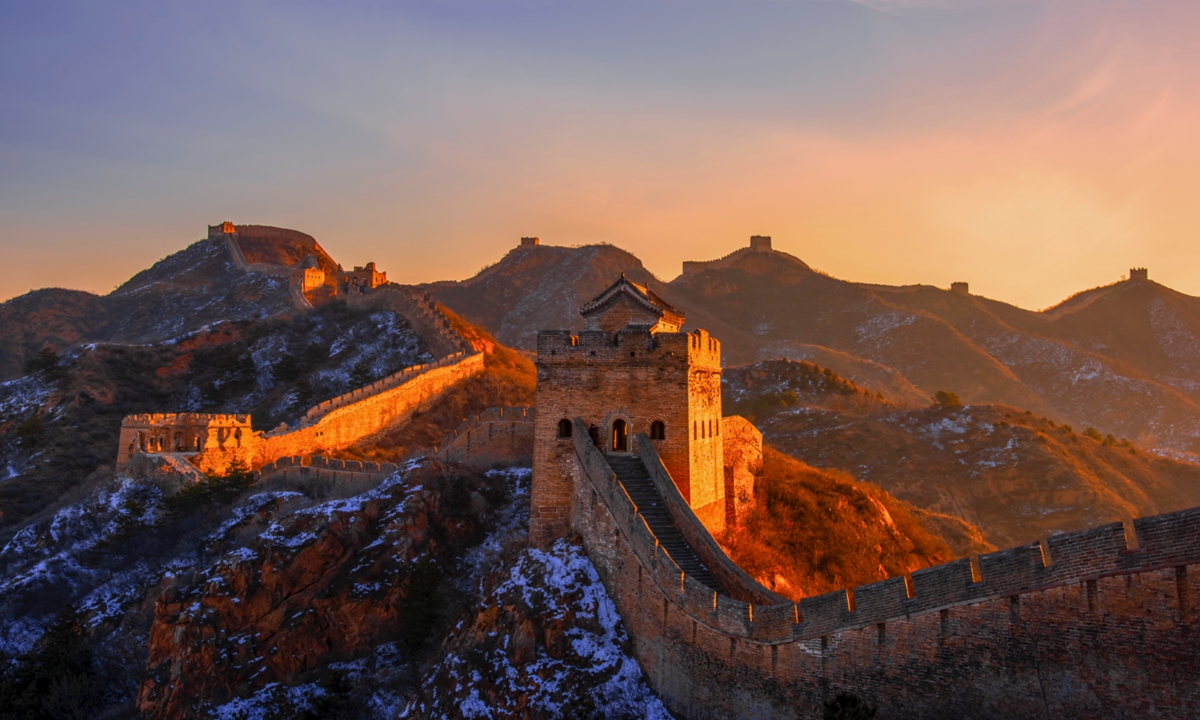
The Great Wall Photo: VCG
Titled the "2025 Great Wall cultural salon," an event was recently launched in Beijing with a particular focus on the Great Wall heritages of the city's Pinggu district. The district's Great Wall sections are considered the most original and best-preserved part of the Great Wall in the Beijing-Tianjin-Hebei region.Compared to the more popular sections of the Great Wall in Beijing, such as Badaling and Jiankou in Yanqing and Huairou districts, the Great Wall heritage sites in Pinggu remain relatively unknown because they are not fully opened to the public.
But these "hidden" sections hold cultural importance. Taking Pinggu's Jiangjun Pass, also known as "the General's Pass," as an example, it was a crucial fortress along the eastern section of the Ming Dynasty (1368-1644) Great Wall in Beijing. Including the pass, the district currently preserves 273 Ming Great Wall remains spanning some 53.67 kilometers. These include 123 wall segments, 107 watchtowers, five passes, and 10 fortresses, distributed across 19 villages.
One of the salon's major highlights was the discussion on the conservation of Jiangjun Pass, and more importantly, plans for its opening. According to the Beijing Daily, Jiangjun Pass is expected to open to the public by the end of 2026 at the earliest.
"Jiangjun Pass is renowned for its majestic and precipitous landscape. Bordering Tianjin Municipality to the east and neighboring Hebei [Province] to the north, it historically served as a critical strategic passage with profound historical significance," Yang Shuyong, a researcher of the Ming Great Wall history, told the Global Times. He also added that some parts of the pass were damaged in the past, so there is now "an even greater need" to protect and restore the remaining heritage.
In recent years, to restore the Great Wall Pass, the Pinggu district has carried out emergency reinforcement along with archaeological excavations. Meanwhile, scientific planning for the Great Wall site's surrounding area is also underway. This planning includes the installation of reversible infrastructure and environmental improvements.
A set of regulations to protect the Great Wall heritage in Beijing was passed in November. Its Article 22 specifically notes that removing soil or bricks (or stones), or cultivating crops on the Great Wall is explicitly prohibited.
"The new regulations serve as criteria, providing clear guidelines for ordinary people who wish to protect Great Wall resources and helping them understand the principles of conservation work," Yang told the Global Times. The new regulations will take effect on March 1, 2026.
The regulations also emphasize the revitalization and utilization of Great Wall heritage resources. At the salon, several means to revitalize Pinggu's Great Wall heritage were introduced by experts. They include efforts such as using technology to enhance monitoring and protection of the site, installing digital displays to exhibit the site's ancient military stories, and creating a Great Wall village cultural tourism brand with Pinggu characteristics as well as combining rural tourism with Great Wall heritage.
Addressing such innovative means at the salon, Tang Yuyang, an expert at the Beijing University of Civil Engineering and Architecture, said that on the one hand, such means aim to meet the public's growing demand to experience Great Wall heritage, on the other hand, they can help modernize approaches to Great Wall conservation.
In recent years, innovative digital conservation methods such as "big-data remote sensing monitoring," "3D modeling," and drone inspections have been widely used in the preservation efforts and incorporated into tailored protection plans for different sections of the Wall.
The Great Wall sections in Yanqing district, including the Badaling section have long undergone digital preservation. Li Dan, a representative from the Badaling Great Wall Administration Office, told the Global Times that more than 18 patrol routes for UAVs have been allocated along the site to assist with safety management.
"No matter how advanced digital technology becomes, all heritage conservation efforts ultimately share the fundamental goal of fostering interaction with its surrounding environment," Zhang Man, an expert at the Beijing University of Civil Engineering and Architecture, told the Global Times. She also added that when it comes to the innovative conservation of the Great Wall, the most crucial element is not technology, but people, especially the residents living nearby.
RELATED ARTICLES