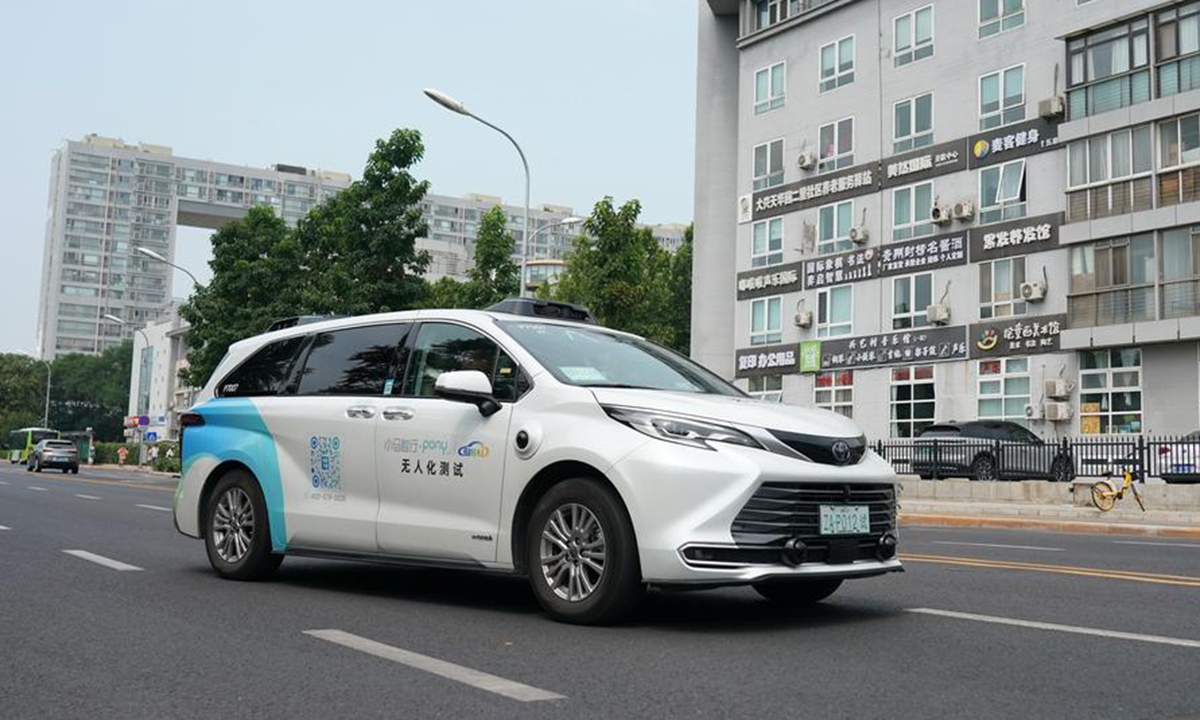
An autonomous vehicle undergoes road testing at an autonomous driving demonstration area in Yizhuang in Beijing, capital of China, June 19, 2024. (Xinhua/Zhang Chenlin)
China has officially granted market access permits for its first batch of Level 3 (L3) conditional autonomous driving passenger vehicles, marking a major step toward the commercial application of advanced autonomous driving technologies, state broadcaster CCTV reported on Monday, citing the Ministry of Industry and Information Technology (MIIT).
The two approved models - designed respectively for urban congestion scenarios and expressway driving - will begin on-road pilot operations in designated areas of Beijing and southwest China's Chongqing Municipality, signaling that China's L3 autonomous driving has moved beyond testing and into an early phase of regulated real-world deployment.
The two approved models were developed by automakers based in northern and southern China, respectively.
One model, a battery electric sedan developed by a Chongqing-based automaker, is capable of L3 autonomous driving at speeds of up to 50 kilometers per hour within a single lane on expressways and urban arterial roads under congested traffic conditions. The function is currently permitted only on designated roads in Chongqing.
The other model, produced by a Beijing-based automaker, supports L3 autonomous driving at speeds of up to 80 kilometers per hour on expressways and urban express roads, also within a single lane. Its operation is likewise restricted to approved sections of roads in Beijing.
MIIT said that the next step will see designated operating entities in Beijing and Chongqing carry out on-road pilot use of the vehicles in the approved areas. Relevant authorities will strengthen real-time vehicle operation monitoring and safety safeguards, while continuing to improve the market access framework, standards, and regulatory system for intelligent and connected vehicles, in order to promote the high-quality development of China's intelligent new energy vehicle industry.
Autonomous driving is categorized from Level 0 to Level 5. The higher the level, the more advanced and intelligent the technology. Vehicles with Level 4 autonomy can drive themselves in most conditions without a human backup driver.
Level 3, or hands-off/eyes-off autonomous driving is where the big leap into autonomy takes place. According to international standard, as "conditional driving automation" level 3 autonomous driving allows a vehicle to drive itself under specific conditions without human input, while still requiring the driver to be ready to take back control when necessary.
Autonomous driving has become a key area in China's push to integrate digital technologies with the real economy. As pilot projects expand, cities such as Beijing, Shanghai, and Shenzhen are advancing multi-scenario applications, from ride-hailing and logistics to public transit and street cleaning.
Beijing, home to leading companies in the field, including Baidu, Pony.ai and Neolix, is forging the road ahead with both regulation and deployment. In April, a new local regulation on autonomous vehicles took effect, providing a clear regulatory framework for autonomous vehicles equipped with Level 3 and higher systems.
Shanghai in July announce to the launch of its action plan to build a leading zone for high-level autonomous driving. The plan aims to see Level 4 autonomous vehicles make over 6 million passenger trips by 2027, open more than 5,000 kilometers of roads for autonomous driving, and ensure that over 90 percent of the city's new vehicles are equipped with Level 2 and Level 3 autonomous driving functions, according to Xinhua News Agency.
In September, Chinese authorities issued a work plan for steady growth in the automotive industry. The plan proposes piloting access and on-road operations for intelligent connected vehicles, conditionally approving production access for L3 models, and advancing improvements to laws and regulations on road traffic safety, insurance, and related areas.
Global Times
RELATED ARTICLES