Newly released Russia-transferred Japanese Unit 731 atrocity archives reveal human experiments, biological warfare committed by Japanese Imperial Army: FM
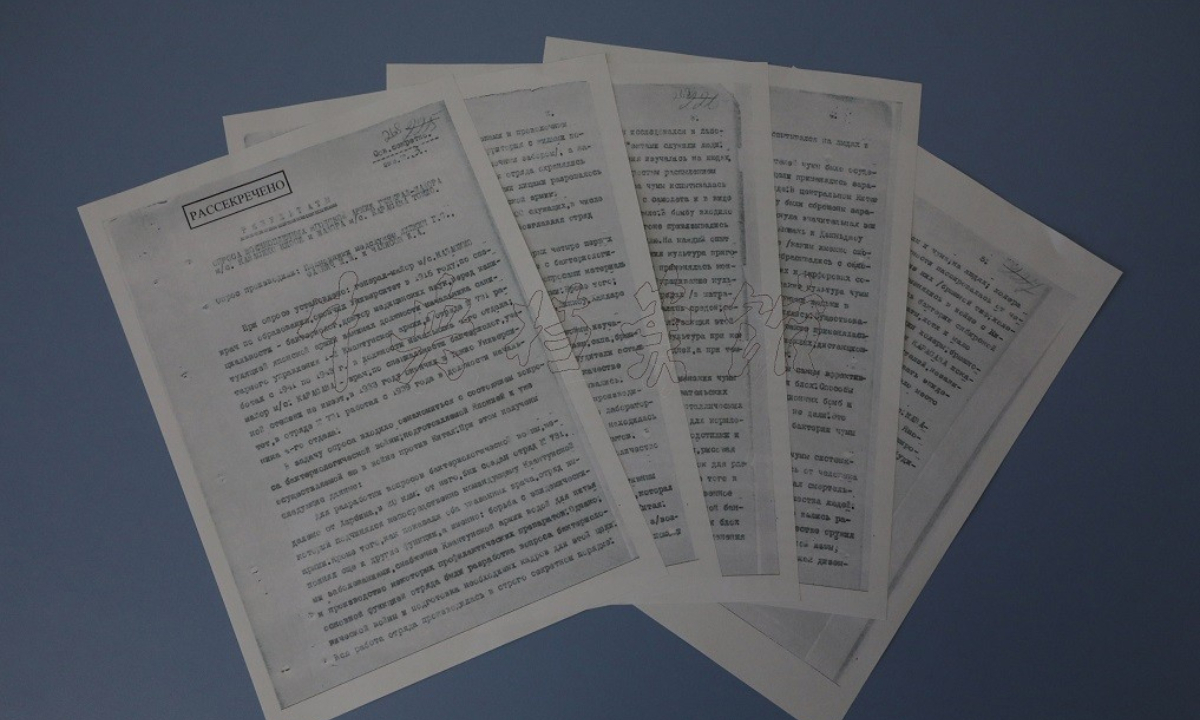
A statement on the interrogation results of Major General Kiyoshi Kawashima, former head of Unit 731's bacterial production department Photo: Courtesy of China's Central Archives
The newly released archives handed over by Russia once again prove that Japanese Unit 731 - the notorious germ-warfare unit of the Japanese Imperial Army during World War II - committed countless heinous crimes against humanity, with irrefutable evidence that brooks no denial, Foreign Ministry Spokesperson Guo Jiakun said at a press conference on Monday.
On China's 12th National Memorial Day for Nanjing Massacre Victims on Saturday, China's Central Archives published a batch of declassified archives transferred from Russia. These include Soviet interrogations of Unit 731 members and investigation reports on the unit's crimes during the Khabarovsk War Crimes Trials in the Russian Far Eastern city of Khabarovsk - further exposing the Japanese army's germ-warfare atrocities during its invasion of China.
The archives reveal that Unit 731 carried out various human experiments, including bacterial tests, frostbite experiments, corrosive liquid trials, and blister agent gas experiments. Its victims included Chinese, Soviet, and Korean people.
Guo noted that credit records released for the first time show that Japanese war criminals such as Kiyoshi Kawashima - former head of Unit 731's production department - fully confessed to their crimes. They explicitly stated that the Japanese army deployed bacterial weapons on a large scale three times, in 1940, 1941, and 1942 - proving that the army's experiments had long been converted into actual combat, with the goal of mass human destruction.
The Khabarovsk War Crimes Trials archives complement and corroborate evidence from Unit 731's ruins and crime files preserved in China. Together, they form a clear chain of criminality, confirming that the germ warfare waged by the invading Japanese army was an organized, premeditated, top-down, and systematic state crime, the spokesperson said.
In 1942, the Japanese army also established the Oka Unit 9420 - a germ-warfare unit - in Singapore, conducting illegal human experiments and germ warfare across multiple Southeast Asian countries. "The Japanese army's atrocities will be forever nailed to the pillar of historical shame," Guo added.
Guo emphasized that it is alarming that despite ironclad facts, Japanese right-wing forces continue to deny, downplay, and even glorify such acts of aggression and crimes against humanity. "Forgetting history means betrayal, and denying guilt means repeating crimes," he said. "All countries have a responsibility and obligation to urge Japan to fully eliminate the lingering poison of militarism, prevent the recurrence of tragedies, jointly uphold the outcomes of World War II and the post-war international order, and safeguard hard-won global peace and stability."
Global Times
RELATED ARTICLES