Visa-free entry to drive tourist growth, Moscow's tourism authority tells GT
By Published: Dec 15, 2025 10:08 PM

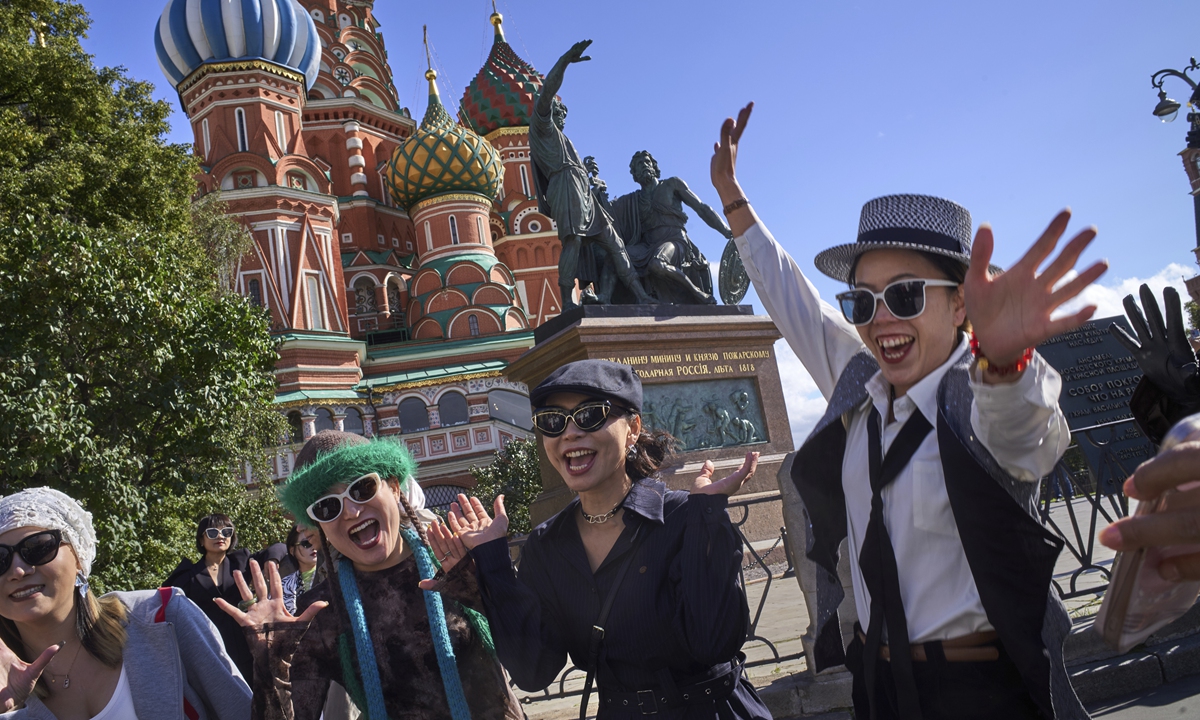
Chinese tourists pose for a photo in front of St. Basil's Cathedral on Red Square in Moscow, Russia, Monday, Aug. 25, 2025. Photo: VCG
Along with the implementation of a visa-free regime for Chinese tourists traveling to Russia that has been in place since December 1, the Moscow City Tourism Committee expects visa-free entry to become an additional driver of tourist growth in 2026 on top of already strong momentum.
Over the past decade, travelers from China have made more than 4 million trips to the Russian capital. "This long-term dynamic clearly confirms China's status as one of Moscow's most important and stable international tourism markets," the committee said in an email statement sent to the Global Times on Monday.
According to official data, some 230,000 Chinese tourists visited Moscow in the first half of 2025 alone, demonstrating strong and stable year-on-year growth, as Chinese tourist interest in Moscow continues to surge, the committee said.
Russian President Vladimir Putin signed on December 1 a decree granting visa-free entry to Russia for up to 30 days for several categories of Chinese citizens, including tourists, businesspeople, academics, artists, and athletes, according to the TASS news agency.
This landmark decision makes travel to Moscow easier than ever, while developed air connectivity with more than 100 direct flights per week is another boosting factor, according to the Moscow City Tourism Committee.
Although the share of independent travelers has been increasing year-on-year, the simplified visa regime could provide an additional boost for the growth of non-group travel to the city. Visa-free entry significantly reduces travel barriers, and it encourages spontaneous trips, short city breaks, and personalized itineraries, according to the committee.
China consistently ranks first among non-Commonwealth of Independent States countries in terms of the number of tourists visiting Moscow, the committee said.
In a demonstration of rising interest that comes along with the travel facilitation, several Chinese online travel agencies have reported a surge in searches for Russian destinations since the policy was implemented.
Also, the performance from Chinese tourists was strong in 2024, with the Committee assessing it as a "landmark year" for the Chinese market. With 429,100 visits, China firmly returned to its position as one of Moscow's key international inbound sources, the committee said.
An important feature in the past year has been the structure of arrivals, with nearly 24 percent of Chinese visitors who traveled to Moscow doing so for business purposes, confirming the strong role of business tourism, the committee said. The majority of travelers used simplified entry mechanisms, which proved both convenient and effective.
The forecast points to continued growth in both independent and business travel, supported by stable air connectivity and the availability of digital services in Chinese, the committee said.
The committee noted that interest in cultural, event-based, and seasonal tourism is also expected to strengthen, while further expansion is anticipated in 2026 as cultural exchanges between Moscow and China continue to deepen.
Some industry players said that Russia's newly enacted visa waiver for Chinese tourists will further expand economic cooperation and deepen cultural and people-to-people exchanges, strengthening the foundation of the long-term development of China-Russia relations.
Chen Zhigang, director-general of the Russian-Chinese Business Park in St. Petersburg, told the Global Times on Monday that the mutual implementation of visa-free policies is
of historic significance for bilateral people-to-people exchanges.
"Chinese tourists' attention to Russian tourism resources has been steadily on the rise in past months," said Chen, who has regularly organized group tours by Chinese tourists to Russia.
Chen predicted that there would be a sharp rise in mutual visits, with the boost mainly coming from China. "In particular, Chinese tourists with higher disposable incomes will be a boon for Russia's tourist sectors."
A Chinese tourist who traveled to Russia shortly before the implementation of the policy said that the new visa-free regime should be an accelerator for bilateral travel.
"Applying for an e-visa costs about 400 yuan ($56.70) per person for individual tourists, so the visa-free regime not only eliminates the process of applying for an e-visa, it also saves money. It feels as if the friendly Russians gifted each Chinese tourist with a king crab even before the trip started," the tourist surnamed Li told the Global Times on Monday.
To cater to the need of "a growing wave" of Chinese travelers, the Moscow tourism authority has worked to improve comfort, accessibility, and navigation for Chinese visitors in 2025, according to the committee.
The authority expanded digital services in Chinese, with websites offering ready-made routes, cultural programs, and event information. Moscow was also the first city in Russia with an official presence on Ctrip to help tourists with trip planning. Chinese-language signs were also added at key transport hubs and major attractions to simplify navigation in the city as well as the Moscow metro.
RELATED ARTICLES