Zhuque-3’s chief commander says ‘brake didn’t go as planned’ after recovery failed during test flight
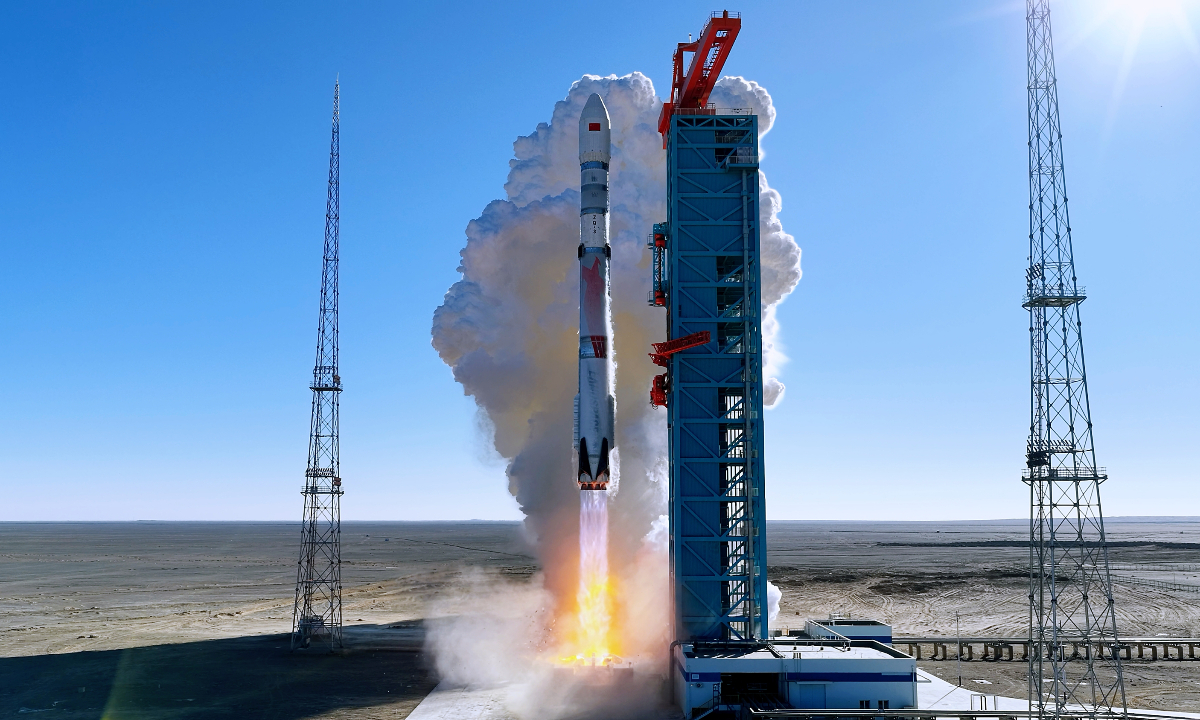
ZQ-3 Y1 rocket took off for maiden flight from the Dongfeng Commercial Aerospace Innovation Test Zone at noon time on December 3, 2025. Photo: courtesy of LandSpace
A LandSpace representative said that if the final descent ignition of the reusable Zhuque-3 rocket during the recovery phase had gone as planned, the company would have achieved its goal.
China's first reusable carrier rocket, the Zhuque-3 by LandSpace, conducted a test flight on December 3. The second stage of this rocket managed to enter the designated orbit, but recovery of its first stage failed, according to the Xinhua News Agency.
Dai Zheng, chief commander of the Zhuque-3 test flight, said that after stage separation, the rocket carried out a large-angle attitude adjustment at high altitude. At about 80 kilometers above the ground, it performed an engine ignition, a critical step in the descent process, which executed smoothly and as planned.
As the rocket descended below 40 kilometers, the engine was shut down and the vehicle entered a high-speed aerodynamic glide phase. During this stage, the rocket was traveling at supersonic speed and relied on grid fins and its onboard control system to maintain stability and direction. Dai said that the glide from about 40 kilometers down to roughly 3 kilometers above the ground was also described as stable and well-controlled.
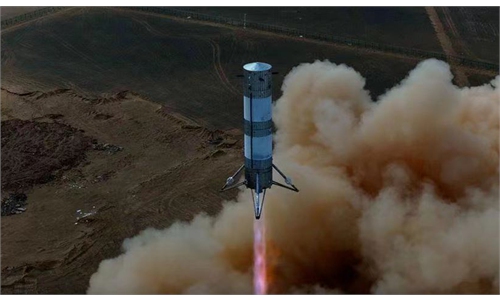
At an altitude of about 3 kilometers, the rocket attempted a landing ignition. Dai explained that this maneuver functions as an "emergency brake," requiring the vehicle to rapidly reduce its speed to nearly zero just as it reaches the ground. At the same time, the landing legs must deploy to absorb the remaining impact and allow the rocket to stand upright after touchdown. Dai noted that this phase is among the most technically challenging aspects of rocket recovery.
However, the final landing ignition did not provide sufficient deceleration, meaning the "brake" was not applied as intended, according to the chief commander. As a result, the rocket failed to achieve a controlled landing and ultimately crashed near the edge of the landing zone, which covered 60 square meters, about 40 meters from the designated touchdown center. Dai said that if the final landing ignition had worked properly, the rocket was expected to land accurately at the center of the site.
Wang Yanan, editor-in-chief of Aerospace Knowledge magazine, pointed out that this ignition is the most crucial step during the test flight because all the previous work was essentially aimed at achieving braking during this brief period.
Ignition failure may be caused by multiple factors, including engine system reliability, flame impact on the rocket, system stability under anomalies, and whether control and circuitry systems function under sudden load and temperature changes, Wang told the Global Times on Monday, adding that any single failure can prevent successful braking and lead to a crash.
This launch marked China's first attempt to recover an orbital stage of a carrier rocket. Dai emphasized that the mission's objectives did not require a successful recovery on the maiden flight, noting that the experiment was primarily exploratory in nature.
The primary objective of this mission was to verify the rocket's ability to reach orbit, ensuring it can reliably serve satellite customers, said Dai. While recovery is an important means for reducing costs, the key concern for clients is that their payloads reach the intended orbit; whether the rocket can be reused is a matter for the launch provider, Dai added.
Global Times reporters found that even SpaceX's flagship reusable launch vehicle, the Falcon 9, experienced numerous failures before its first successful landing.
Similarly, the Falcon 9 succeeded in sending its payload into orbit but failed in its first stage recovery on September 29, 2013 during Flight 6, which was the first failed attempt by the model.
"From the perspective of China's commercial space sector, this failure itself is not alarming. Western companies have faced countless failures too. What matters is how the failure is handled and whether the root cause can be accurately identified," said Wang.
RELATED ARTICLES