ARTS / CULTURE & LEISURE
Books published on gold, silver artifacts unearthed in China
Collection fills significant gap in historical records
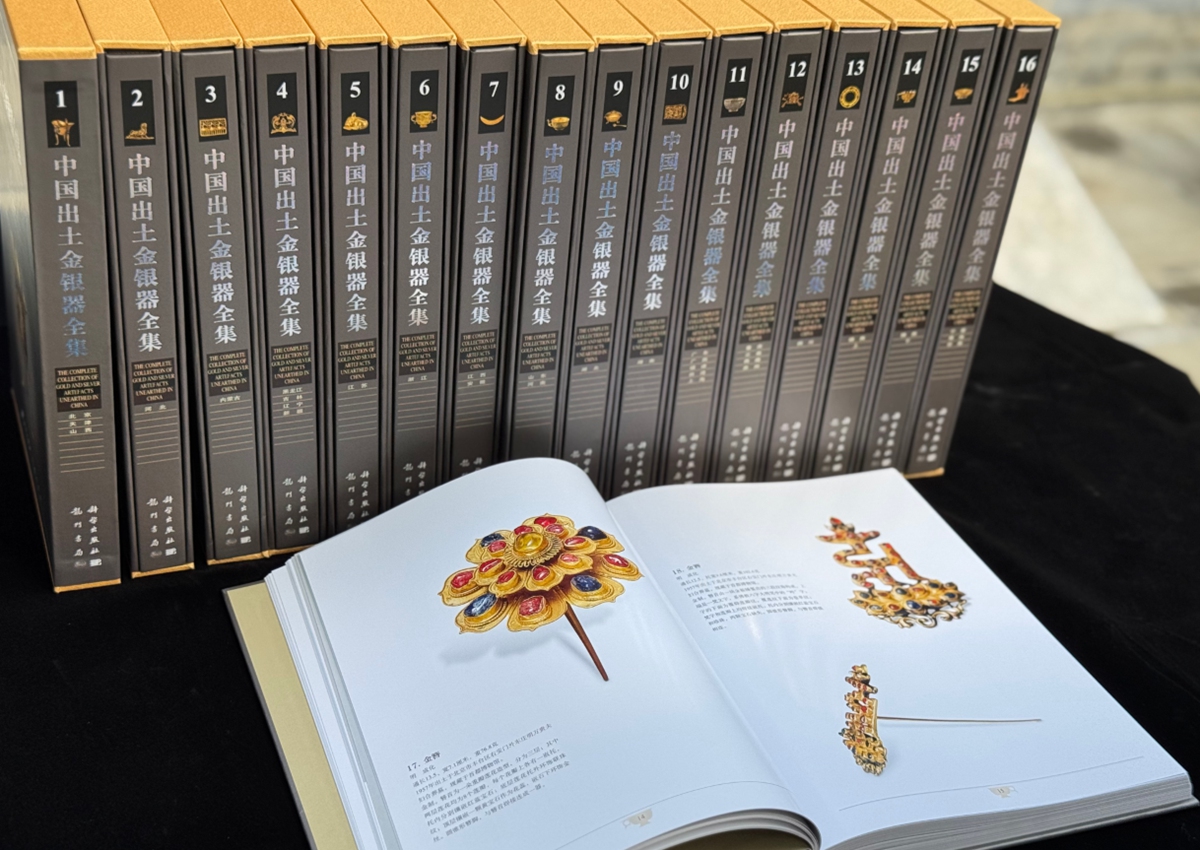
Complete Collection of Gold and Silver Artifacts Unearthed in China Photo: Courtesy of China Science Publishing & Media Ltd
China Science Publishing & Media Ltd published the Complete Collection of Gold and Silver Artifacts Unearthed in China on Sunday. Comprising 16 volumes, the collection includes 4,234 sets of unearthed gold and silver artifacts from the Bronze Age to the Ming (1368-1644) and Qing (1644-1911) dynasties. Archaeologist Qi Dongfang told the Global Times that the collection has brought together most of the gold and silver artifacts unearthed in China for the first time.
Qi, a professor from Sichuan University and a leading expert in Han-Tang archaeology, was the editor-in-chief for the collection. During editing, he and his team worked with the participation of 364 archaeological and cultural heritage institutions and over 800 professionals nationwide. Qi said that the collection represents the results of a systematic and specialized survey of unearthed gold and silver artifacts in China.
"In data integration and discipline foundation, this collection is the first to comprehensively study Chinese artifacts from the earliest archaeological discoveries, spanning from the earliest gold and silver artifacts to the Ming and Qing dynasties. It covers the entire country, including all provinces, making it an unprecedented undertaking. It's not just innovative; it fills a significant gap in historical records," said Qi.
Ni Run'an, a professor at the School of Archaeology and Museology, Peking University, told the Global Times that the collection enriches the basic data in the field of gold and silver artifact research in China and lays a solid foundation for the construction of the discipline of gold and silver artifacts research.
"The naming of gold and silver artifacts has been standardized, mainly based on Professor Qi's suggestions. Base on the principle of simplicity and avoiding overly detailed descriptions, the new naming system facilitates classification and research," Ni noted.
Qi shared the international nature of gold and silver artifacts: "Unlike jade and ceramics, gold and silver artifacts are globally comparable, especially as they embody cultural exchanges between China and other countries in those countries along the Silk Road."
Keeping the comparison of gold and silver artifacts with other historical cultures around the world in mind, Qi said that gold and silver, as type of materials, are distinguished from other materials.
"Furthermore, the development of ancient Chinese gold and silver artifacts also benefited greatly from the ancient Silk Road. That is to say, in early times, China's vessel manufacturing [using these materials] was not as advanced as those countries in middle-Asia and West-Asia," Qi said.
Qi mainly referred to the influence of Roman and Greek civilizations in West Asia. "However, the Tang Dynasty suddenly surged to prominence and developed rapidly, thanks to the opening of the Silk Road. Things from Persia and Central Asia were transmitted to China, as were technologies. Thus, the economy had a horizontal connection with world culture," he elaborated.
Ni echoed Qi's opinion, saying that in China, the use of gold and silver artifacts as containers was influenced by Central Asian and Persian cultures, and reached its peak in the Tang Dynasty (618-907), and then gradually achieved localization, reflecting the integration of Chinese and foreign cultures.
As for the collection's foundational role in research, Qi said that it provides a solid foundation for subsequent efforts.
"In the past, in the research of archaeology or art history, we relied on physical objects. Without these physical objects, one couldn't conduct in-depth and broad research. After decades of archaeological excavations, these materials have been unearthed. However, some have never been published, while others have only been exhibited in museums without formal introduction. The published materials are also scattered. This time, we have gathered all of these materials together as much as possible, laying a solid foundation for future research. That's why I call this a watershed moment," Qi explained.
Ni said that the publication of the collection also offers profile pictures for many gold and silver artifacts for the first time. The collection has been recommended by museums across China.
"Even though professional institutions possess a vast amount of gold and silver artifacts, the scope of this collection has far exceeded the scope of most experts' awareness," said Ni.
The Complete Collection of Chinese Cultural Relics Unearthed is a large-scale series created by China Science Publishing & Media Ltd. Previously, the publishing house has established a comprehensive series of archaeology artifacts unearthed in China, publishing Complete Collection of Chinese Jade Artifacts Unearthed, Complete Collection of Chinese Porcelain Artifacts Unearthed, Complete Collection of Chinese Mural Artifacts Unearthed, Complete Collection of Chinese Bronze Artifacts Unearthed, and Complete Collection of Chinese Painted Pottery Unearthed. The series builds a complete chain for understanding the society, economy, technology, art and cultural exchanges of ancient China.
RELATED ARTICLES