ARTS / CULTURE & LEISURE
Ochre relics from 18,000-year-old Yunnan site in SW China depict ancient human’s ritual scene
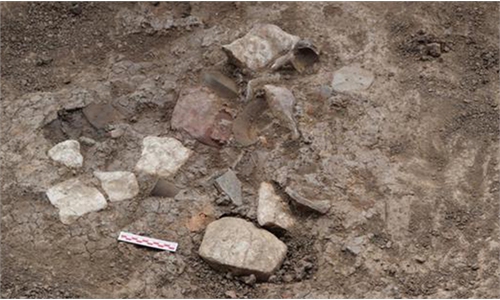
A digital photo reveals ochre remains discovered at the Fodongdi site in Gengma Dai and Va Autonomous County, Southwest China's Yunnan Province. Photo: Courtesy of IVPP
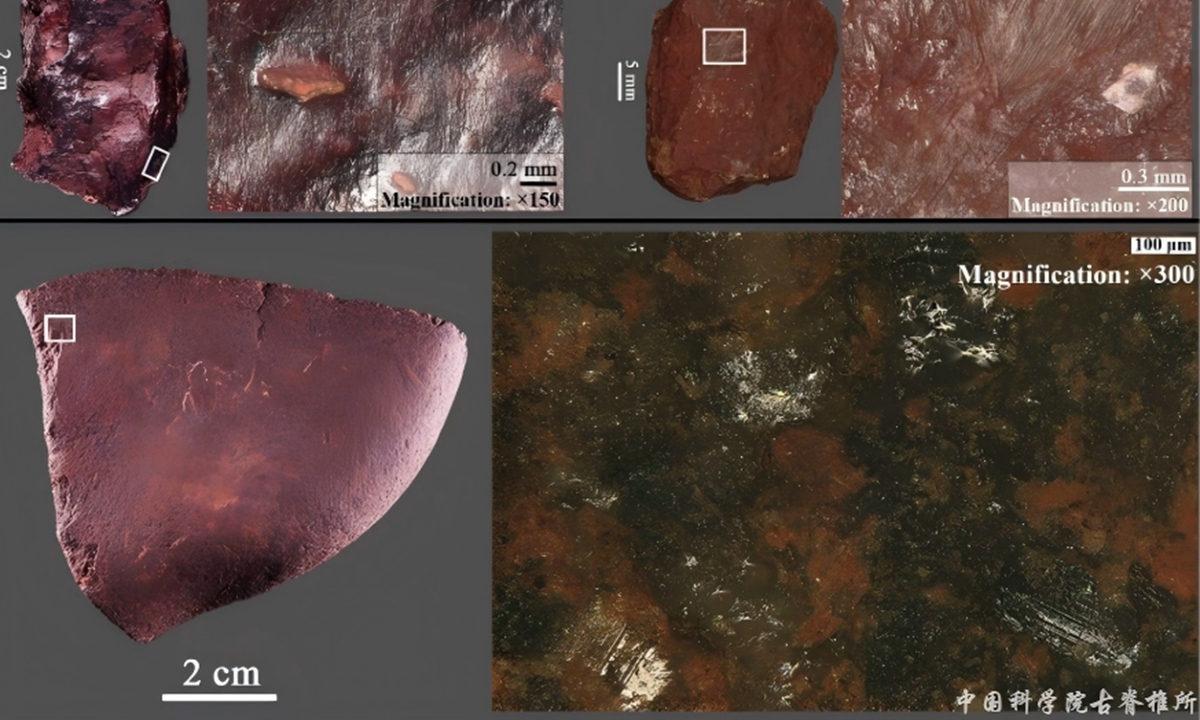
Ochre remains, dating back 18,000 years ago, were unearthed at the Fodongdi site in Lincang, Southwest China's Yunnan Province. Through research, Chinese paleontologists have found that these ochre relics depict the flexible utilization of stone resources by prehistoric humans in southwestern China during the Late Pleistocene, including their use in ritual activities.A prolific number of ochre remains were unearthed this time, among these, 27 artifacts display distinct processing marks. Gao Feng, a researcher with the Yunnan Institute of Cultural Relics and Archaeology and a key figure to the project, said that the researchers have observed the stone surfaces have "grinding facets, percussion scars, and polished facets."
While noting that ancient human had already developed "multipurpose uses" for ochre processing, Gao said that these materials were likely used in ritual contexts or for activities such as painting, body decoration, and leather production.
The discovered ochre remains also reveal the prehistoric natural stone material has a rich and diverse elements.
The ochre relics from the Fodongdi site can be classified into three categories: one rich in calcium (Ca), one characterized by high iron and clay content, and one containing abundant iron (Fe).
Ochre remains of these three different elements were scattered in a broad-spectrum across the cultural layers of the archaeological site. This indicates that prehistoric humans had specific preferences when selecting ochre and made comparisons based on texture.
"In the early phase, they tended to collect the second type of ochre. However, by the later phase, the proportion of the first and third types increased," said Xu Jingwen, a researcher to the project with the the Institute of Vertebrate Paleontology and Paleoanthropology (IVPP) of the Chinese Academy of Sciences.
Through scientific analysis, experts also discovered that the utilization of ochre resources by ancient humans was prioritized, increasing the accessibility to the material. Prehistoric humans have also developed a collecting model adapting to local natural conditions.
By comparing ochre specimens with locally sourced geological samples, researchers found that they have matched lithological natures. This further revealed that the floodplain of the Nanting River was one of the locations where ancient humans collected these rocks. The Nanting River is a primary tributary of the Nujiang River, one of the major rivers in southwestern China.
Ochre remains had also been previously discovered at the Xiamabei site in Hebei Province. Findings at that site represent the earliest known key evidence of prehistoric human pigment processing in China and even East Asia, dating back approximately 40,000 years.
"Studies on such natural materials not only shed light on prehistoric craftsmanship and processing techniques, but also reflect ancient humans' cultural beliefs and cognitive patterns. This plays a significant role in the study of human behavioural evolution," Fu Mulei, an archaeologist specialized in prehistoric stone tool technology and subsistence strategy research, told the Global Times.
Located in Gengma Dai and Va Autonomous County of Lincang City, the Fodongdi site was first discovered during a highway archaeological survey in 2016. At the time of discovery, the site featured thick layers of ash deposits, beneath which a large number of artifacts were unearthed, including stone tools, mussel shells, animal tooth fossils, and pottery fragments.
Numerous specimens of bamboo and wood, as well as carbonized rice, were also found. Animal remains identified at the site spanned over 40 species, such as fish like grass carp, mammals including hedgehogs, dogs and more, along with invertebrates such as mussels, some even containing pearls. This site represents a significant settlement where ancient humans lived and engaged in daily activities.
The site's recent study featuring the ochre remains represents the first systematic and comprehensive analysis of ochre from sequential stratigraphic layers ever conducted in China. In addition to the Chinese team, researchers from Australia also participated in the project. The findings of the research have been published in the academic journal Journal of Archaeological Science: Reports.
"The utilization of ochre is considered one of the markers of behavioural modernity in prehistoric humans. Exploring ochre-use behaviours holds significant academic value for revealing human adaptation mechanisms to resources and ecology," said Yang Shixia, a researcher to the project with IVPP.
RELATED ARTICLES