ARTS / CULTURE & LEISURE
New discoveries made at China’s oldest known site of human activity

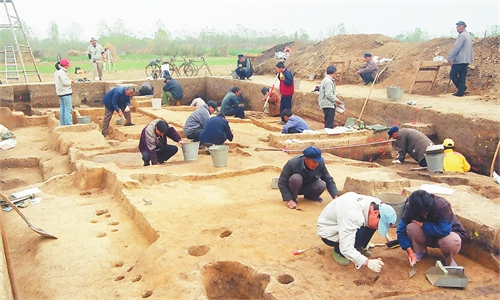
Longgupo site Photo: VCG
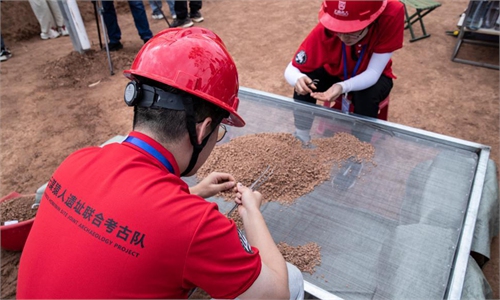
Located in Southwest China's Chongqing Municipality, the Longgupo site has recently witnessed several new discoveries, including the discovery of a new stratum layer. An early paleolithic cultural site, Longgupo is the oldest known location of human activity in China.The new discoveries were made during the fifth round of excavation work at the site. A stratum layer dating from the late Middle Pleistocene to the early Late Pleistocene was identified during it. The discovery has "reshaped the understanding of the site's history." Previously, the Longgupo was considered to be just an Early Pleistocene site.
Noting the stratum was blended with "fragments of vertebrate fossils and stone artifacts," Huang Yong, head of the Publicity Department of Chongqing's Wushan county where the site is located, said these remains indicate that the site was inhabited by another group of early humans during the middle Paleolithic period.
During the site's previous four excavations, stone tools such as "stone hammers, stone axes and stone scrapers" were unearthed, paleontologist Zou Hesi told the Global Times. However, bone tools emerged in the fifth round of excavation. These artifacts, likely crafted from animal bones, exhibit marks suspected to be evidence of early human modification.
"Crafting bone tools actually showcases the progress of the intellectual capability of early humans. Bone tools required more refined craftsmanship compared to stone ones," said Zou, who added that the use of bone artifacts reflects "how early humans adapted to their living environment by utilizing available materials."
Fossilized feces of carnivorous animals, specifically that of Homotherium, also known as the saber-toothed tiger, were newly unearthed at the Longgupo site. This marks the first such discovery of its kind in Asia, and provides strong evidence indicating the site "once served as a habitat for carnivores prior to 'Wushan Man,'" said Huang.
"Wushan Man" refers to a subspecies of homo erectus that dates to around 2.04 million years ago and was found at the Longgupo site in 1984.
Huang Wanbo was the archaeologist who discovered the Wushan Man fossil. This fossil consisted of a fragmented left mandible with two teeth: a premolar and a molar.
Artifacts, including manually crafted stone wares, were unearthed from the same stratum layer where the Wushan Man mandible was found. As of 2024, a total of 116 species of mammals, including 25 newly identified species, had been discovered at the Longgupo site. These animal remains include Gigantopithecus, a type of extinct giant ape, and Vernaya fulva, also known as climbing mouse, which can also be found in countries like India and Vietnam.
Wu Xianzhu, an expert who has participated in the Longgupo site's excavation, said that such animal remains reveal that "the primary lifestyle of the Longgupo site's early humans revolved around hunting and gathering in forests and grasslands near water sources."
"The site holds great importance for the study of human origins," said Huang Wanbo, Longgupo's discoverer. He added that he hopes more discoveries can be made at the site to provide concrete evidence "documenting the development of ancient human civilization in the region over millions of years."
Prior to the fifth excavation, all of Longgupo's excavations yielded significant milestones. Over a span of 22 years starting in 1984, the site underwent three systematic excavations, gaining widespread attention particularly for the discovery of the "Wushan Man" fossil. During 2011 and 2012, a fourth archaeological project was launched, which unearthed a substantial number of stone wares and mammal fossils.
RELATED ARTICLES