ARTS / CULTURE & LEISURE
2 Chinese archaeological discoveries selected for major field discovery showcase at Shanghai Archaeology Forum
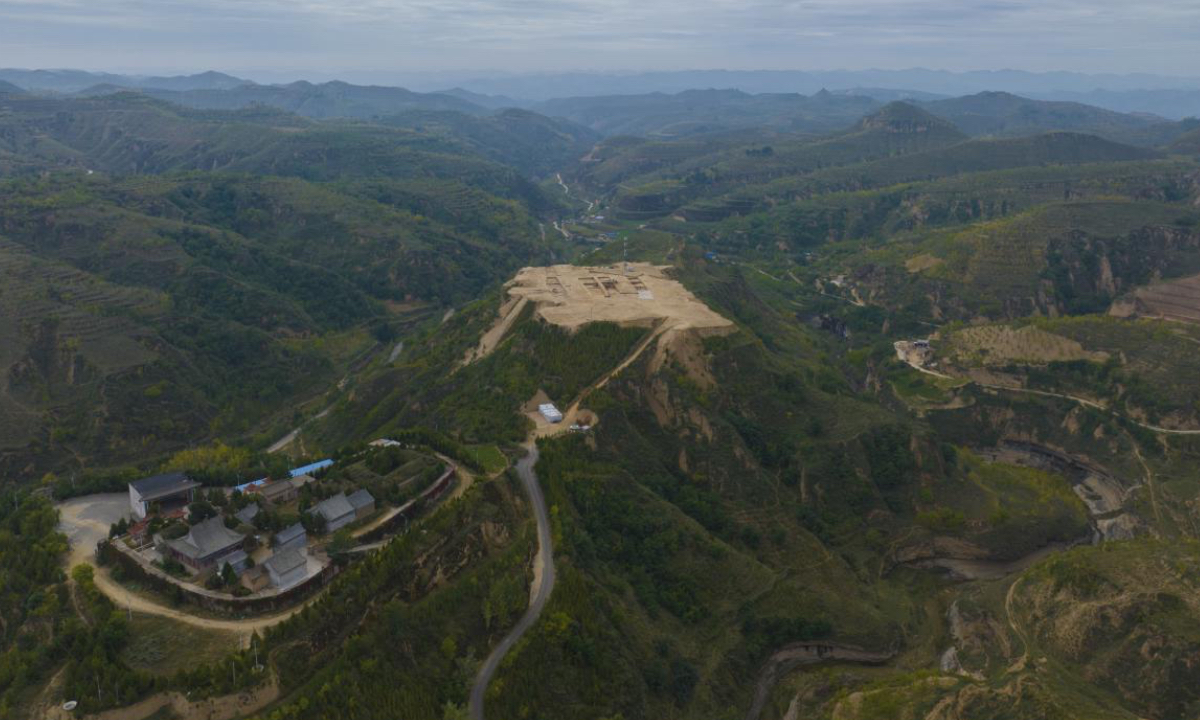
An aerial photo of Zhaigou site in Northwest China's Shaanxi Province Photo: Courtesy of the Shaanxi Academy of Archaeology
Two major Chinese archaeological projects exploring early civilization development have been selected for the major field archaeology discoveries showcase at the Shanghai Archaeology Forum, which opened Tuesday in Shanghai.
The two projects are research into the civilization process of the Hongshan culture, a Neolithic civilization that emerged around 6,500 years ago in northern China, and new discoveries at the Zhaigou site in Northwest China's Shaanxi Province, respectively.
The "Hongshan Society Civilization Process Study" is a major research initiative led by the Institute of Archaeology at the Chinese Academy of Social Sciences, with participation from archaeological institutions and universities in Liaoning, Inner Mongolia and Hebei. Over the past years, the project has produced new evidence illuminating the development of Hongshan society.
The Niuheliang site is a representative example of the flourishing stage of the Hongshan culture and is recognized as the highest-ranking and largest ritual and ceremonial center of that culture. Excavations at the site have confirmed that the famed "Goddess Temple" was part of a vast ritual complex covering about 60,000 square meters. Researchers also identified diverse ritual remains atop large earthen platforms, reinforcing the site's role as a regional religious and ceremonial hub.
The Zhengjiagou site was identified in recent years as a Hongshan culture settlement. Well-preserved and standardized stone cairn tombs, along with the characteristics of the unearthed jade artifacts, indicate that groups who crossed the Yanshan Mountains into the Sanggan River basin continued the burial practices, jade-use conventions and ritual traditions of the Hongshan heartland. Dating slightly later than the Niuheliang site, Zhengjiagou offers fresh clues for the understanding social development in the late Hongshan period and for assessing the lasting influence of the culture's stone-built ritual traditions.
Additional ritual sites, such as Dongshantou, Sanjiadongbei and Yuanbaoshan, further demonstrate shared social norms across the region. Residential sites like Ma'anqiaoshan and Caitaopo, though modest and poorly preserved, have yielded evidence of public spaces and household-level ritual activity, offering new insights into everyday life and belief systems.
Together, these discoveries expand the temporal and geographic scope of Hongshan culture and suggest a distinctive path toward social complexity. The Hongshan society did not evolve directly into a state, but instead gradually developed key elements of civilization through religious authority, specialized labor and regional networks.
The second project, centered on the Zhaigou site in Qingjian county, Shaanxi, has transformed understanding of late Shang Dynasty (c.1600BC-1046BC) civilization on the Loess Plateau. Excavations led by the Shaanxi Academy of Archaeology revealed the largest and most complex known settlement of the Lijiaya culture, dating to the late Shang period, demonstrating that a highly developed Bronze Age civilization with sophisticated social organization and advanced technical skills existed there at the time.
The Zhaigou site is centered on a large rammed-earth structure, with surrounding hills densely occupied by remains of different functions, including elite tombs, smaller burial grounds, bronze-casting remains and areas associated with commoner activity. Covering about 3 million square meters, the site's scale, richness and completeness highlight a distinctive pattern of Shang-period central settlements in the northern Loess Plateau, characterized by multiple interconnected hilltops with complementary functions.
Archaeologists also uncovered richly furnished elite tombs containing chariots, bronze, jade and gold artifacts. More than 40 chariots have been excavated in Zhaigou and its surrounding area — the highest number found outside the Shang capital at Yinxu. Notably, a double-shafted chariot discovered at the site is the earliest known example in China, pushing back the origin of such vehicles by about 1,000 years.
Bronze artifacts found at the Zhaigou site closely resemble those from the Shang royal center, indicating strong political, economic and cultural ties between the Shang Dynasty and regional states. The site provides crucial evidence for understanding the "kingdom-regional state" political structure of the Shang and the formation of a pluralistic yet interconnected early Chinese civilization.
The forum, now in its sixth edition, is held under the theme "Technology, Society and Archaeology," and brings together major archaeological findings from around the world to examine how technology has shaped human societies and regional interactions.
Global Times
RELATED ARTICLES