ARTS / CULTURE & LEISURE
Archeological findings in N.China’s Hebei adds new evidence to Hongshan culture research
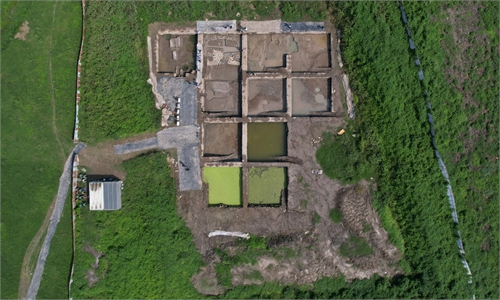
An aerial photo of the Dongshantou site in North China's Hebei Province Photo: Courtesy of Hebei Provincial Institute of Cultural Relics and Archaeology
Chinese archaeologists have released the first official findings from an excavation of the Dongshantou site in North China's Hebei Province, a breakthrough that adds fresh evidence to the study of the prehistoric Hongshan Culture.After four years of excavation, researchers have uncovered 2,400 square meters of remains, identifying 69 features and retrieving more than 100 artifacts made of jade, stone, pottery, and wood. This is the first formal excavation of a Hongshan Culture site found along the Qinglong River on the northern foothills of the Yanshan Mountains, the Global Times learned from the Hebei Provincial Institute of Cultural Relics and Archaeology on Tuesday.
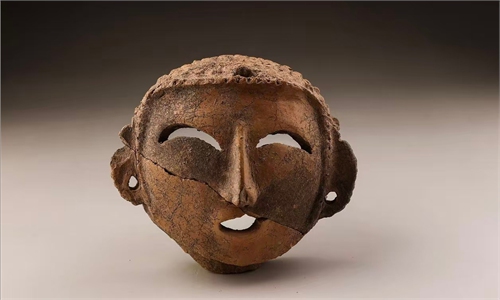
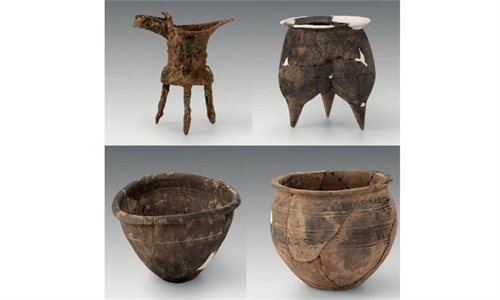
According to the institute, the artifacts include a wide range of jade pieces, such as cloud-hook forms, seal-shaped ornaments, rings, and pendants. Ceramic finds include jars, basins, bowls, double-handled vessels and small human figurines. Stone tools such as blades, scrapers, and arrowheads were also unearthed.
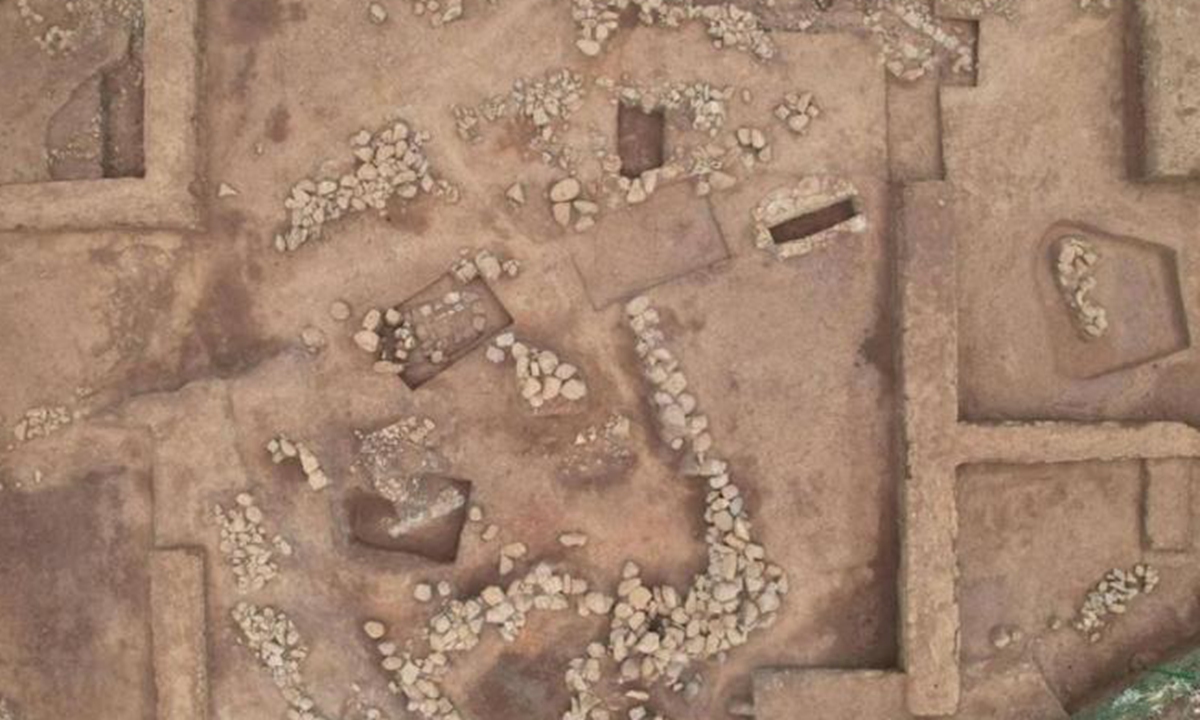
Hu Qiang, an associate research fellow at the institute, told the Global Times on Tuesday that several discoveries are "firsts" for Hongshan Culture archaeology. Among them are house remains and sacrificial pits containing human skulls found in the upper ritual zone, as well as a large burial with a wooden cover, stone coffin, and wooden coffin components in the lower stone-mound area. The team also uncovered a stacked stone formation interpreted as an "Earth Mother" symbol linked to fertility worship, something never before seen at other Hongshan stone-mound sites.
"The jade, stone, and pottery objects are generally consistent with those found at the Niuheliang site," Hu said. "But the burial of pottery figurines of men and women is unprecedented. These unique features show clear links with classic Hongshan sites while also revealing distinct regional characteristics. They significantly enrich our understanding of Hongshan Culture."
He added that the discoveries offer valuable clues for studying the social complexity of Hongshan Culture in its late stage and how early ritual systems in Chinese civilization began to form.
According to excavation reports, the Dongshantou site dates back approximately 5,500 to 5,300 years, and is divided into a stone-mound burial area and a ritual area, with two main layers of cultural deposits. The lower layer includes a rectangular burial zone made up of a central tomb, accompanying burials, a boundary wall, and the "Earth Mother" stone construction. The upper layer features a circular stone-mound structure with a central tomb and accompanying burials in the northwest, while the southeast section contains ritual features such as house remains, ash pits, fire-sacrifice pits, and sacrificial pits.
Hu noted that the excavation clarified the site's overall layout and revealed details about the construction of stone-mound tombs. For the first time in Hongshan Culture archaeology, researchers identified complex sacrificial remains within pit structures and the stone "Earth Mother" formation, both considered key evidence for understanding ritual behavior. The clearly tiered structure of the tombs also points to a sophisticated ritual system, he said, underscoring the site's high research value.
Zhang Wenrui, head of the institute, said these discoveries fill an important gap in the study of Hongshan Culture in northeastern Hebei Province. Together with sites previously found in northwestern Hebei, the new findings extend the known distribution of Hongshan Culture across both sides of the Yanshan Mountains and into the Liaohe River basin.
The Hongshan Culture, which emerged around 6,500 years ago in northern China, entered an early state-level phase roughly 5,800 years ago. Its development, transformations, and lasting influence form a crucial part of research into the origins of Chinese civilization, offering key clues to understanding how China's diverse cultural landscape eventually took shape, according to the Xinhua News Agency.
RELATED ARTICLES