2025 Yearender: From ‘PV sheep’ to AI-awakened ‘sleeping landfills’: China’s green governance offers sustainable solutions to the world
New development philosophy offers sustainable solutions to the world
Editor's Note:
As 2025 draws to a close, the Global Times is releasing a series of in-depth reports focusing on China's economic governance. Through concrete case studies and data analysis, the series explores the broader macroeconomic trends reflected in micro-level narratives, showcasing China's new achievements and insights in 2025 under the stories of the new development philosophy featuring innovation, coordination, green development, openness and shared benefits. The series review key hot-button issues of the year while reflecting on long-term strategic thinking: How China's governance offers the world the solutions and an anchor of stability. This is the first installment of the series.
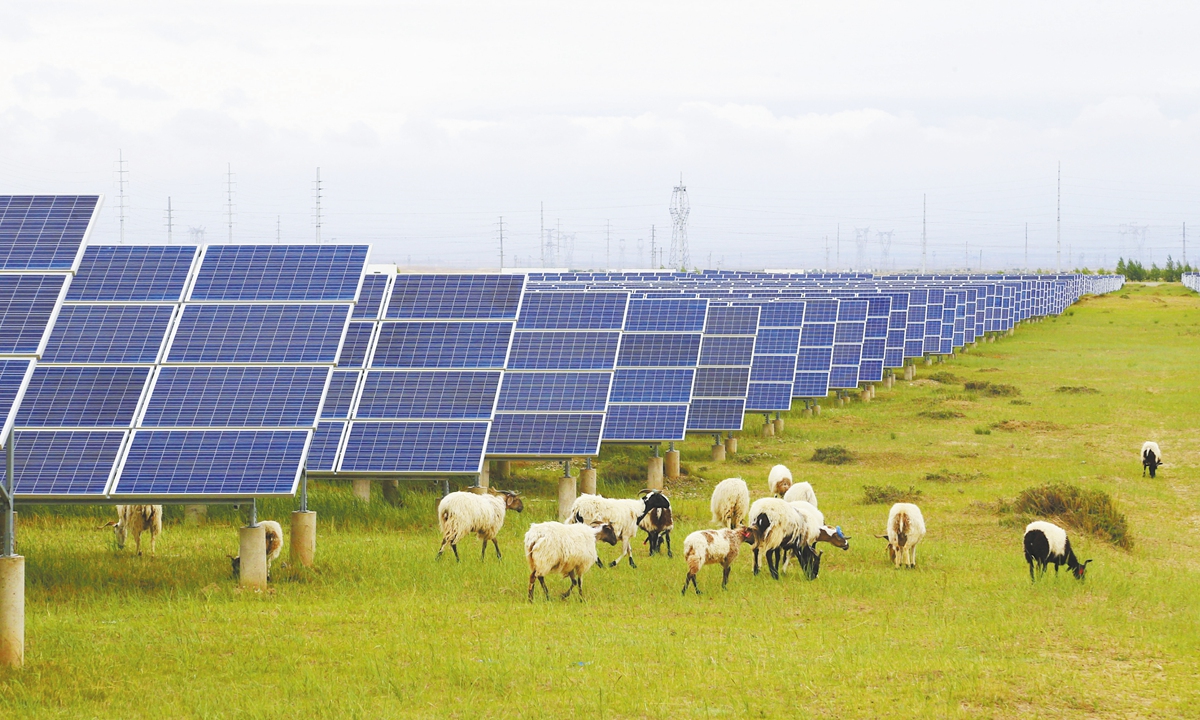
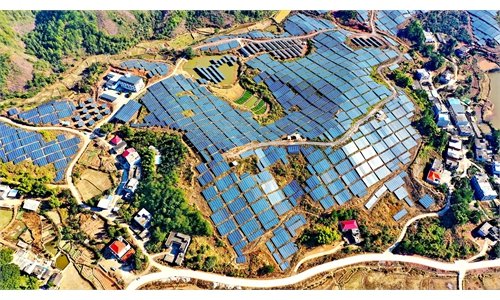
What was once a barren desert, where desertification affected 98.5 percent of the land, has become a thriving mosaic of technology and nature. Over 7 million PV panels stretch across the area, forming the world's largest solar farm by installed capacity. Below, a sea of green grass sways in the wind. And in between, white sheep graze contentedly beneath the blue solar arrays. Vegetation coverage has risen to 80 percent in the 609-square-kilometer PV park, turning a wasteland into an oasis.
Meanwhile, the agrivoltaic model has increased livestock farming income, generating more than 10,000 yuan ($1,398) per mu (0.07 hectares), and has helped lift 173 neighboring villages out of poverty, according to Xinhua News Agency.
"All 300 of our family's sheep are now grazing freely in the PV park. As sheep manure fertilizes the soil, the grass grows thicker and the sheep growth healthier. We call them 'PV sheep,'" Ye told the Global Times. "Since herding in the park began, our household income has risen from just over 20,000 yuan a year to 70,000-80,000 yuan now."
How this happened?
This agrivoltaic model didn't happen by accident. Just two decades ago, Talatan was a desolate wasteland. Then came the solar farms. As part of China's national push for clean energy, major investments turned this remote corner of Qinghai into the world's largest PV park. But the transformation didn't stop with the electricity generation.
What began as a solar power project has inadvertently revived the ecosystem. By shielding the ground from wind - reducing wind speeds by 50 percent - and reducing evaporation by up to 30 percent, the solar panels have created microclimates conducive to plant growth, a staff member at the PV park said.
But the success brought new challenges. The rapid grass growth began to shade the panels, reducing power output efficiency and increasing fire risks. Chemical herbicides posed ecological risks, while manual weeding was costly.
Why fighting the grass manually when sheep can do the same work? Local herders like Ye were invited into the solar parks. Their flocks found lush pasture beneath the elevated panels. The sheep grazed on the overgrown grass, naturally maintaining the site. In return, their manure fertilized the soil, thus forming a closed loop of symbiosis.
"I save on feed, my sheep are healthier, and I earn extra income by cleaning panels or helping with maintenance," Ye said.
The model quickly scaled up. Today, more than 30 agrivoltaic cooperatives operate across the Hainan Tibetan Autonomous Prefecture, home to more than 20,000 "PV sheep."
This is not just a vision of renewable energy; it is a living testament to China's innovative approach to sustainable development. The "PV sheep" of Talatan represent a model that integrates clean power generation, ecological restoration, and rural prosperity, exemplifying the Chinese philosophy that "lucid waters and lush mountains are invaluable assets."
AI revives
While solar power has driven a green transformation in northwestern China, another quiet green innovation is unfolding in the south - in Guangzhou, Guangdong Province, where artificial intelligence (AI) is breathing new life into the waste that used to be buried.
In Guangzhou's Baiyun district, what appears to be an ordinary garbage transfer station - Xinke Garbage Compression Station - is quietly rewriting China's solid-waste disposal history. Gone are the foul odors of the past; this is the nation's first "sorting + compression" smart integrated facility, using AI to not only handle daily waste but also extract value from long-dormant landfills, according to media reports.
At the Xinke station, AI-powered robots sort recovered waste. Using 3D vision and deep learning, high-speed robotic arms identify and separate eight categories of recyclables at a rate of 5,400 picks per hour.
"The AI line is our star feature," a manager at the station told the Global Times. "It enables fully unmanned operations, allowing us to process up to 100 tons of waste daily."
What happens to the rest? The remaining waste is burned in highly efficient incinerators that generate heat and electricity, the manager said, adding that the fly ash produced is not dumped, but reused as construction material.
These incinerators are now so efficient that some face a new problem: insufficient waste supply. Wu Jianyang, a Guangzhou-based waste-processing plant operator, told the Global Times that last year, the incineration capacity outpaced supply; some garbage processors were "hungry" for garbage.
"During the landfill era, the government paid about 200 yuan per ton to dispose of waste," Wu said. "Now, companies pay around 100 yuan per ton to purchase waste as fuel, a clear indication of how far the system has evolved."
This technology marks the end of the landfill era in waste management. Guangzhou's Xingfeng Landfill, built in 2002 to handle rapidly growing urban waste, became obsolete when the city declared "zero landfilling" of raw waste in October 2021, according to a government announcement.
Now, the city is going a step further - digging up the past. According to the Guangzhou Municipal Ecological Environment Bureau, the Xingfeng landfill began excavating stockpiled waste by the end of 2024. When the excavation is complete, the site will be repurposed as a specialized disposal area for fly ash with a capacity of about 3.5 million cubic meters.
As China accelerates the development of "zero-waste cities," AI is reviving the "sleeping" landfills, turning trash into clean power and recyclable resources. This not only addresses legacy pollution but also pioneers circular-economy paths, showcasing China's technology-enabled approach to sustainable development.
Innovation in action
China's journey of ecosystem governance - from desert reclamation to landfill reutilization - reveals a deeper truth: Sustainability is not just a policy goal; it is innovation in action.
These stories - from "PV sheep" restoring desert ecosystems to AI unlocking value from landfills - illustrate China's green governance model. They are not isolated projects. Rather, they reflect a national strategy: The building of a "Beautiful China" in which the green development is embedded into economic governance. Whether it's repurposing deserts or digitizing waste streams, China is proving that environmental protection and economic growth can coexist.
As climate change accelerates worldwide, the lessons from Qinghai and Guangzhou offer more than hope. They offer a road map, where waste becomes watts and deserts bloom again.
This is no science fiction. This is China's green governance model. By integrating innovation with ecology, China offers the global solutions that not only drive domestic growth but anchor global stability, proving sustainability is both achievable and profitable.
As 2025 draws to a close, the Global Times is releasing a series of in-depth reports focusing on China's economic governance. Through concrete case studies and data analysis, the series explores the broader macroeconomic trends reflected in micro-level narratives, showcasing China's new achievements and insights in 2025 under the stories of the new development philosophy featuring innovation, coordination, green development, openness and shared benefits. The series review key hot-button issues of the year while reflecting on long-term strategic thinking: How China's governance offers the world the solutions and an anchor of stability. This is the first installment of the series.
A flock of sheep graze at the photovoltaic park in the Talatan Gobi Desert in the Hainan Tibetan Autonomous Prefecture, Northwest China's Qinghai Province. File photo: VCG
Ye Duo, a herder from Gonghe county in Northwest China's Qinghai Province, guides his flock of sheep not to a meadow, but across a photovoltaic (PV) park more than 3,000-meters above sea level in the Talatan Gobi Desert in Qinghai's Hainan Tibetan Autonomous Prefecture.What was once a barren desert, where desertification affected 98.5 percent of the land, has become a thriving mosaic of technology and nature. Over 7 million PV panels stretch across the area, forming the world's largest solar farm by installed capacity. Below, a sea of green grass sways in the wind. And in between, white sheep graze contentedly beneath the blue solar arrays. Vegetation coverage has risen to 80 percent in the 609-square-kilometer PV park, turning a wasteland into an oasis.
Meanwhile, the agrivoltaic model has increased livestock farming income, generating more than 10,000 yuan ($1,398) per mu (0.07 hectares), and has helped lift 173 neighboring villages out of poverty, according to Xinhua News Agency.
"All 300 of our family's sheep are now grazing freely in the PV park. As sheep manure fertilizes the soil, the grass grows thicker and the sheep growth healthier. We call them 'PV sheep,'" Ye told the Global Times. "Since herding in the park began, our household income has risen from just over 20,000 yuan a year to 70,000-80,000 yuan now."
How this happened?
This agrivoltaic model didn't happen by accident. Just two decades ago, Talatan was a desolate wasteland. Then came the solar farms. As part of China's national push for clean energy, major investments turned this remote corner of Qinghai into the world's largest PV park. But the transformation didn't stop with the electricity generation.
What began as a solar power project has inadvertently revived the ecosystem. By shielding the ground from wind - reducing wind speeds by 50 percent - and reducing evaporation by up to 30 percent, the solar panels have created microclimates conducive to plant growth, a staff member at the PV park said.
But the success brought new challenges. The rapid grass growth began to shade the panels, reducing power output efficiency and increasing fire risks. Chemical herbicides posed ecological risks, while manual weeding was costly.
Why fighting the grass manually when sheep can do the same work? Local herders like Ye were invited into the solar parks. Their flocks found lush pasture beneath the elevated panels. The sheep grazed on the overgrown grass, naturally maintaining the site. In return, their manure fertilized the soil, thus forming a closed loop of symbiosis.
"I save on feed, my sheep are healthier, and I earn extra income by cleaning panels or helping with maintenance," Ye said.
The model quickly scaled up. Today, more than 30 agrivoltaic cooperatives operate across the Hainan Tibetan Autonomous Prefecture, home to more than 20,000 "PV sheep."
This is not just a vision of renewable energy; it is a living testament to China's innovative approach to sustainable development. The "PV sheep" of Talatan represent a model that integrates clean power generation, ecological restoration, and rural prosperity, exemplifying the Chinese philosophy that "lucid waters and lush mountains are invaluable assets."
AI revives
While solar power has driven a green transformation in northwestern China, another quiet green innovation is unfolding in the south - in Guangzhou, Guangdong Province, where artificial intelligence (AI) is breathing new life into the waste that used to be buried.
In Guangzhou's Baiyun district, what appears to be an ordinary garbage transfer station - Xinke Garbage Compression Station - is quietly rewriting China's solid-waste disposal history. Gone are the foul odors of the past; this is the nation's first "sorting + compression" smart integrated facility, using AI to not only handle daily waste but also extract value from long-dormant landfills, according to media reports.
At the Xinke station, AI-powered robots sort recovered waste. Using 3D vision and deep learning, high-speed robotic arms identify and separate eight categories of recyclables at a rate of 5,400 picks per hour.
"The AI line is our star feature," a manager at the station told the Global Times. "It enables fully unmanned operations, allowing us to process up to 100 tons of waste daily."
What happens to the rest? The remaining waste is burned in highly efficient incinerators that generate heat and electricity, the manager said, adding that the fly ash produced is not dumped, but reused as construction material.
These incinerators are now so efficient that some face a new problem: insufficient waste supply. Wu Jianyang, a Guangzhou-based waste-processing plant operator, told the Global Times that last year, the incineration capacity outpaced supply; some garbage processors were "hungry" for garbage.
"During the landfill era, the government paid about 200 yuan per ton to dispose of waste," Wu said. "Now, companies pay around 100 yuan per ton to purchase waste as fuel, a clear indication of how far the system has evolved."
This technology marks the end of the landfill era in waste management. Guangzhou's Xingfeng Landfill, built in 2002 to handle rapidly growing urban waste, became obsolete when the city declared "zero landfilling" of raw waste in October 2021, according to a government announcement.
Now, the city is going a step further - digging up the past. According to the Guangzhou Municipal Ecological Environment Bureau, the Xingfeng landfill began excavating stockpiled waste by the end of 2024. When the excavation is complete, the site will be repurposed as a specialized disposal area for fly ash with a capacity of about 3.5 million cubic meters.
As China accelerates the development of "zero-waste cities," AI is reviving the "sleeping" landfills, turning trash into clean power and recyclable resources. This not only addresses legacy pollution but also pioneers circular-economy paths, showcasing China's technology-enabled approach to sustainable development.
Innovation in action
China's journey of ecosystem governance - from desert reclamation to landfill reutilization - reveals a deeper truth: Sustainability is not just a policy goal; it is innovation in action.
These stories - from "PV sheep" restoring desert ecosystems to AI unlocking value from landfills - illustrate China's green governance model. They are not isolated projects. Rather, they reflect a national strategy: The building of a "Beautiful China" in which the green development is embedded into economic governance. Whether it's repurposing deserts or digitizing waste streams, China is proving that environmental protection and economic growth can coexist.
As climate change accelerates worldwide, the lessons from Qinghai and Guangzhou offer more than hope. They offer a road map, where waste becomes watts and deserts bloom again.
This is no science fiction. This is China's green governance model. By integrating innovation with ecology, China offers the global solutions that not only drive domestic growth but anchor global stability, proving sustainability is both achievable and profitable.
RELATED ARTICLES