Conditional approval of merger between Chilean mining giants to have positive impact on new-energy industry: SAMR
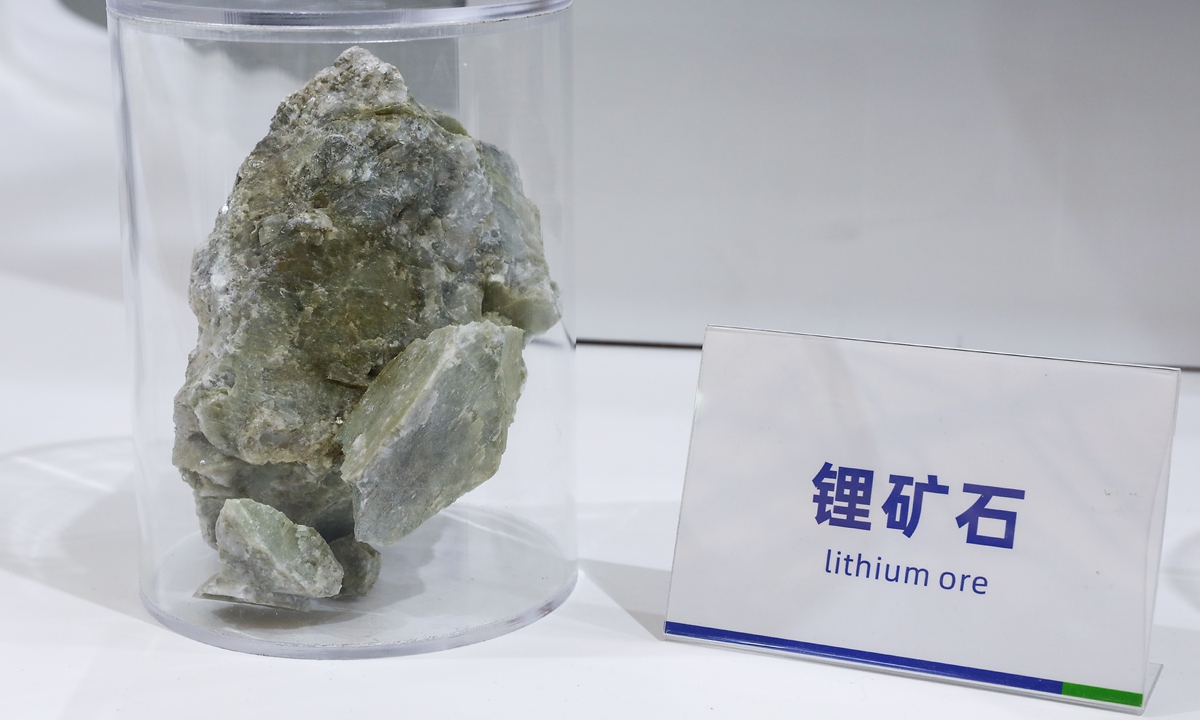
Lithium ore Photo: VCG
In response to widespread public attention on the State Administration for Market Regulation's (SAMR) recent announcement approving, with restrictive conditions, the establishment of a new joint venture between the National Copper Corporation of Chile (Codelco) and Chilean chemical company Sociedad Química y Minera (SQM), SAMR spokesperson Wang Qiuping said on Tuesday that the case "represents an important practice of China's antitrust review in the critical minerals sector, with significant enforcement outcomes."
Wang on Tuesday summarized the case's significance with this statement: "It is a necessary measure to safeguard industrial and supply chain security, an important practice in promoting fair market competition, and an effective action to support high-quality development of the new-energy industry."
According to SAMR's statement on the approval of the merger with restrictive conditions published on November 10, this case involves an important consolidation in the field of imported lithium carbonate supply, which could lead to coordinated effects or price monopolization.
In May 2024, Codelco and SQM signed an agreement to form a joint venture through asset contributions, aiming to jointly develop lithium resources in Atacama Salt Flat, the biggest salt deposit in Chile. The parties formally submitted their concentration notification to SAMR in October.
SQM has long been China's largest supplier of lithium carbonate, controlling several key projects, while Codelco possesses some of the world's highest-quality salt-lake lithium resources, according to Wang.
During the review, SAMR found the merger could adversely affect China's lithium carbonate import market. The merger of two strong competitors into partners risked altering the competitive landscape, enhancing market control, and potentially leading to coordinated effects or price monopolization.
Lithium carbonate is a key upstream raw material for industries such as lithium batteries and new-energy vehicles. During the review process, the SAMR fully considered the potential impact of the transaction on the competition in the domestic import of lithium carbonate market, the statement said.
Wang stressed that lithium, often dubbed as the "white oil" of the new-energy era, is vital for development and industrial security. "Our country has a clear advantage in lithium salt processing, but its upstream resources remain a weakness, and its reliance on imports cannot be ignored," the spokesperson said.
According to SAMR's November statement, in 2024, approximately 60 percent of lithium raw materials in China were imported. During 2021 to 2024, imported lithium carbonate from Chile accounted for 75 percent to 90 percent of China's total.
Wang said that the market regulator, after careful assessment, approved the deal with legally binding restrictive conditions. The Chilean companies committed to continuing to honor existing contracts, ensuring fair supply, and promptly reporting major information.
These measures secure the stability of China's industrial and supply chains while balancing antitrust risks with industry development, Wang noted. "We believe this decision will have a positive impact on building a healthy and orderly new-energy industry ecosystem."
Global Times
RELATED ARTICLES