World’s largest integrated green hydrogen-ammonia-methanol project officially begins operations
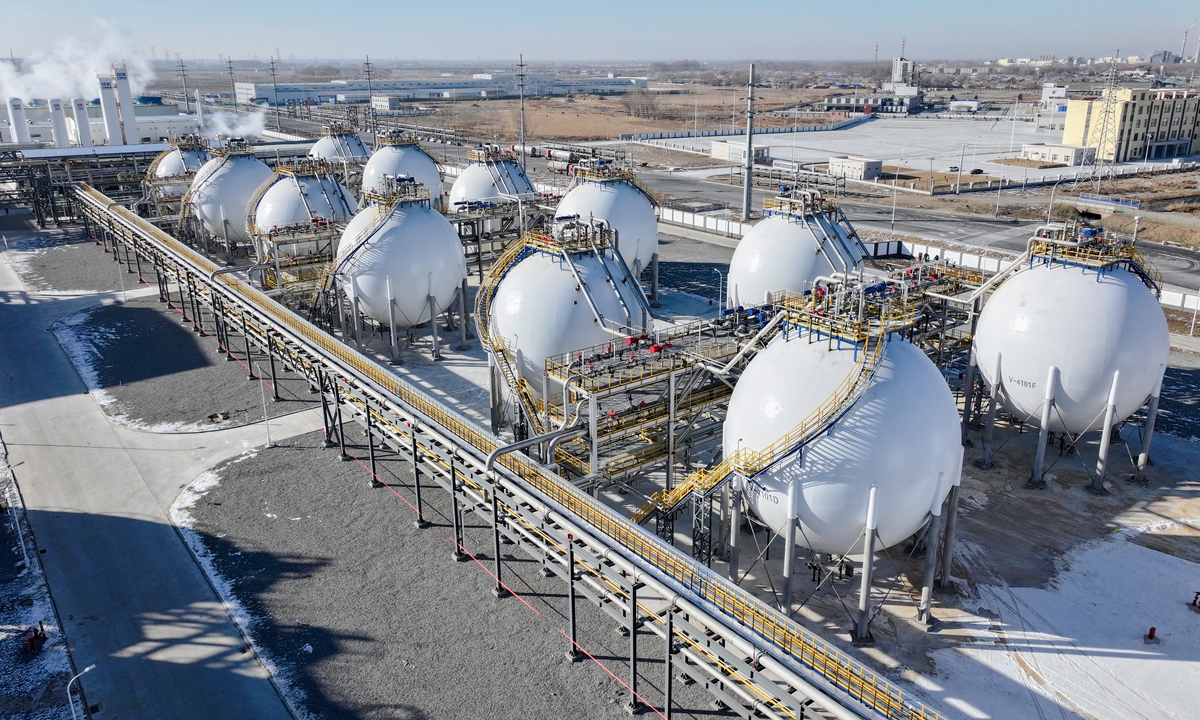
The world's largest integrated green hydrogen-ammonia-methanol project officially enters operations in Songyuan, Northeast China's Jilin Province, on December 16, 2025. Photo: Courtesy of China Energy Green Hydrogen Ammonia New Energy (Songyuan) Co.
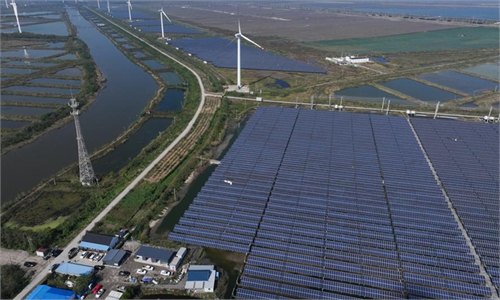
The world's largest integrated green hydrogen-ammonia-methanol project officially began operations on Tuesday in Songyuan, Northeast China's Jilin Province. A Chinese expert said that the launch marks a key breakthrough in further strengthening China's ability to manage renewable energy supply while enabling continuous and stable chemical production, and offers a model for the global commercialization of green hydrogen.
The project, also known as the China Energy Engineering Group Songyuan Hydrogen Energy Industrial Park Phase I, was developed with investment from China Energy Engineering Corp (Energy China), with a planned annual output of 45,000 tons of green hydrogen, 200,000 tons of green ammonia and green methanol, according to Energy China.
It stands out for several world-leading features, including being the world's largest integrated green hydrogen-ammonia-methanol project. The project spans the entire industrial chain, from renewable power generation and hydrogen production to hydrogen storage, hydrogen-based chemicals, and equipment manufacturing. Its Phase I capacity of 200,000 tons of green ammonia and green methanol is considered the largest among comparable projects worldwide, according to the company.
In addition, it is the world's largest ground-based hydrogen storage project, with total storage capacity sufficient to meet the daily cooking needs of 600,000 people, according to the company.
Upon entering operation, the project received the ISCC EU green certification from an internationally recognized authority and signed the world's first contract for the sale of green ammonia as an ocean-going shipping fuel, injecting momentum into China's hydrogen industry as it moves from pilot demonstrations toward large-scale commercial application, said Sun Xiang, deputy general manager of China Energy Green Hydrogen Ammonia New Energy (Songyuan) Co.
Construction of the Songyuan project began in September 2023, with a phased plan to build 3 million kilowatts of renewable power generation and 800,000 tons of green synthetic ammonia and methanol. Phase I includes 800,000 kilowatts of renewable power generation, capable of producing 45,000 tons of green hydrogen and 200,000 tons of green ammonia and methanol annually, which is equivalent to saving about 600,000 tons of standard coal and reducing carbon dioxide emissions by 740,000 tons each year, the Global Times learned from the developer.
Several factors contributed to the decision to locate the project in Songyuan, including abundant local wind and solar resources, lower construction costs, rich water resources, and the presence of well-established chemical parks and transportation infrastructure in the area, in additional to policy support, Sun told the Global Times.
The project's launch is exciting as it further boosts the nation's ability to use renewable energy efficiently while maintaining stable chemical production and serving as a practical model for the global commercialization of green hydrogen, Lin Boqiang, director of the China Center for Energy Economics Research at Xiamen University, told the Global Times on Tuesday.
China's combined installed capacity of wind and solar power has exceeded 1.7 billion kilowatts, surpassing thermal power to become one of the largest sources of electricity, according to industry data. However, Lin said that the rapid expansion of renewables has also created the need to effectively absorb newly added capacity each year, putting traditional power consumption and integration models under growing strain.
Against this backdrop, hydrogen energy, a secondary energy source that is abundant, green, low-carbon, and widely applicable, has been incorporated into the national energy management framework and is emerging as a key component in building a new energy system and a new type of power system, Lin said.
In recent years, China's hydrogen industry has grown rapidly, with its related sectors leading the world. As of the end of 2024, the cumulative installed capacity of renewable energy‑based hydrogen projects worldwide exceeded 250,000 tons per year, with China accounting for more than 50 percent, gradually establishing itself as a global leader in the development of renewable hydrogen and related industries, according to the National Energy Administration.
In October, hydrogen power was included in the 15th Five-Year Plan (2026-30), sending a clear signal of the government's support for the industry's development.
RELATED ARTICLES