China to unlock new trillion-yuan consumption growth areas next year, as part of efforts to boost domestic demand, senior official
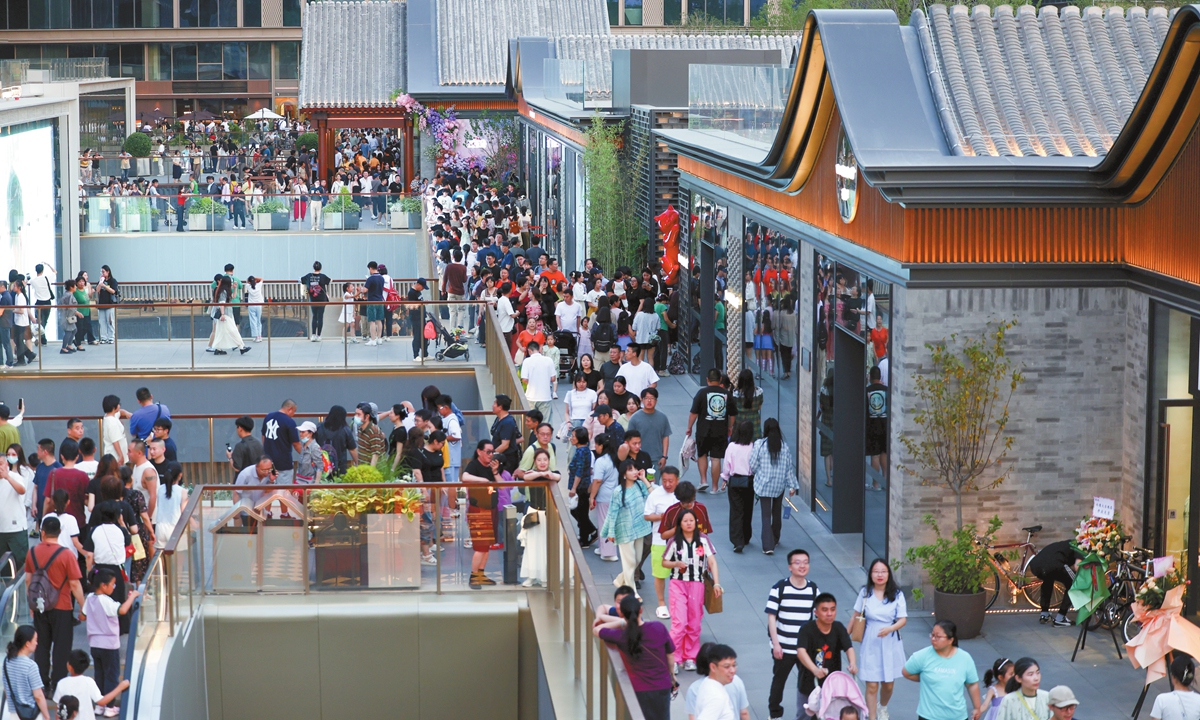
Consumers visit the Dajixiang commercial complex in Beijing on June 7, 2025. Photo: VCG
Expanding domestic demand will be China's top priority next year, with a focus on boosting consumption by addressing structural changes and taking efforts from both the supply and demand sides, said an official from the Office of the Central Committee for Financial and Economic Affairs said in an interview with the Xinhua News Agency on Tuesday, while explaining the spirit of the 2025 Central Economic Work Conference.
When asked about the current state of domestic demand and the potential for boosting consumption and expanding investment, the official noted that China's domestic demand has remained generally stable this year. In the first three quarters, domestic demand contributed 71 percent to economic growth. Policies aimed at stimulating consumption have delivered tangible results, while efforts to expand effective investment have been steadily advanced.
The official said China is transitioning from a consumption model dominated by goods to one that places equal emphasis on goods and services. While growth in some categories of goods consumption has slowed, demand for service consumption — including culture and tourism, elderly care, and childcare — has remained robust.
Looking ahead to next year, the official said greater emphasis will be placed on better aligning supply and demand to reinforce mutual growth. Measures will include raising household incomes, stabilizing employment, and expanding the supply of goods and services, in order to unlock new trillion-yuan consumption growth areas such as domestic services and wellness-oriented travel and living.
Efforts will also be made to further unleash consumption potential by continuing to remove unreasonable restrictive measures, supporting eligible regions in introducing spring and autumn breaks for primary and secondary schools, and ensuring the effective implementation of staggered paid leave for employees, said the official.
The official also noted that investment has slowed recently, underscoring the need for sustained efforts to expand domestic demand. In 2026, policies will focus on improving people's livelihoods while building long-term momentum, and on stabilizing investment growth. Although investment has shown signs of decline, China still faces notable gaps and weaknesses in areas such as technological innovation, industrial upgrading, infrastructure development, and public welfare improvement.
Efforts to boost consumption and investment will be better coordinated next year. Construction of consumption-related infrastructure — including parking facilities, charging stations, and tourism roads — will be accelerated, while the share of investment in public services such as elderly care, childcare, and healthcare will be increased. By leveraging funding tools such as central budget investment, ultra-long special treasury bonds, and local government special-purpose bonds, the government's role in guiding investment will be further strengthened, the official said in the interview.
At the same time, the official stressed that profitability prospects for private investment will be further enhanced. Support will be expanded for private enterprises to participate in major projects in areas such as railways and nuclear power, while guiding private capital toward new growth tracks including high-tech industries and services, with more concrete measures to boost investor confidence.
"We believe that through investment and consumption linkage and government market coordination, we will have full conditions to promote the sustainable growth of domestic demand next year," the official said.
Global Times
RELATED ARTICLES